All species › Cranes, rails and allies › Cranes › Grey Crowned Crane
Grey Crowned Crane | Balearica regulorum
Grijze kroonkraanvogel | Grulla Coronada Cuelligrís
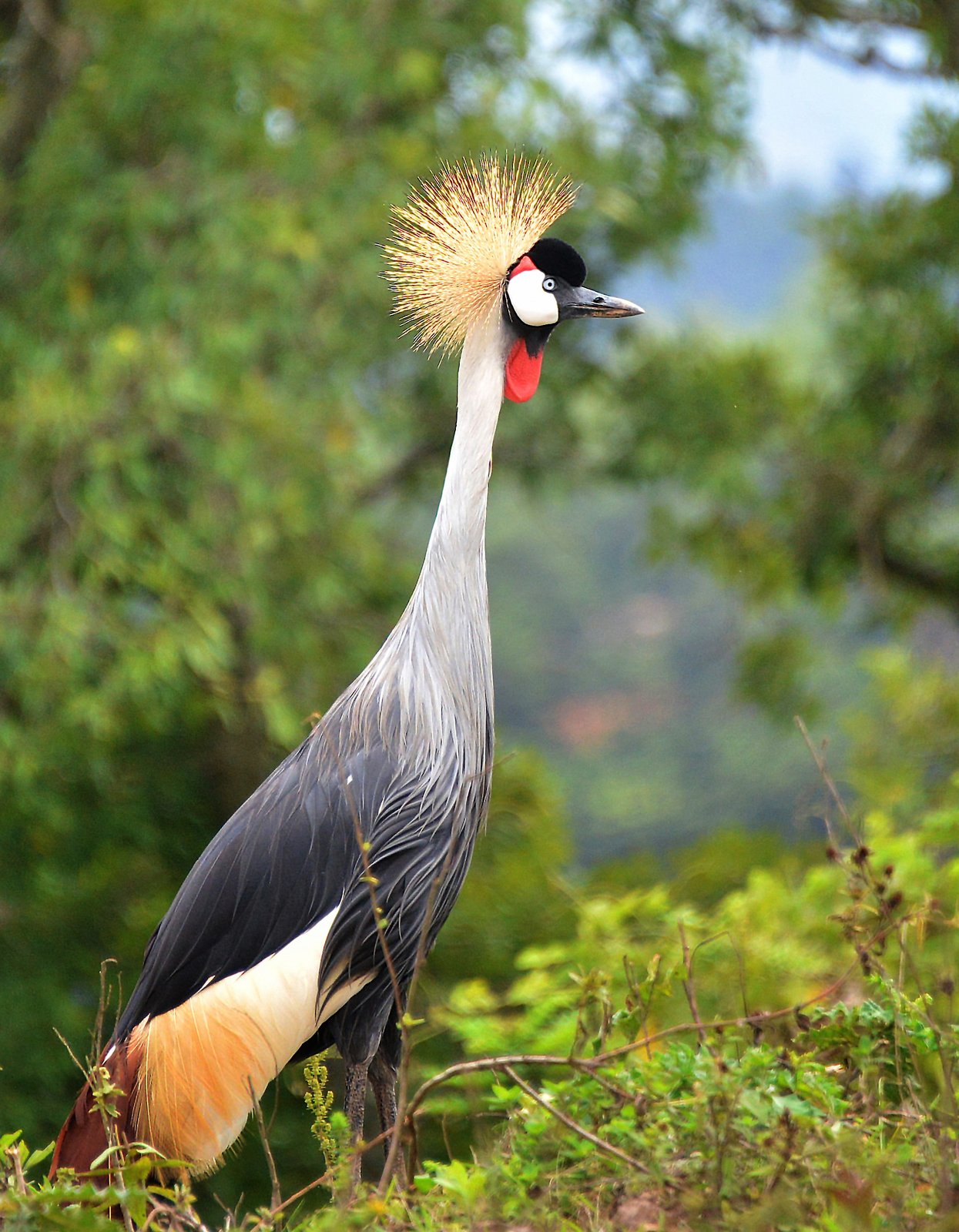
The Grey Crowned Crane is a bird of the African marsh: grey of body, with a fan of stiff, straw-coloured feathers on the crown, white cheeks and a red throat wattle. Unlike the typical cranes it roosts in trees. It is the national bird of Uganda and at the same time a species declining rapidly throughout its range.
Voice
A deep, trumpeting, disyllabic oo-wahng or mahem, audible at long range and often given in duet. In display also a dull, resonant booming with inflated throat sac, oomp-oomp, which is hard to locate even at close range. Pairs dance with spread wings, leaps and bows.
Recording: isaac kilusu — CC BY-NC-SA 4.0 · converted to mono · xeno-canto
Identification
100–110 cm tall, wingspan 180–200 cm. The body is pale grey, the neck slightly paler, with long lanceolate grey feathers hanging over the breast. The head has a velvety black forehead, behind which rises a crown of golden, bristly feathers. The bare cheek patch is white with a narrow red upper edge, and a small red wattle hangs below the chin. The wings are white with golden-brown coverts and black primaries, giving a large white wing panel in flight. The bill is short and black, the legs black. The sexes are alike. Juveniles are grey-brown with a small brownish crown and a feathered rufous cheek.
Confusion species
No real confusion within the region: no other bird wears such a golden crown. Blue Crane Grus paradisea is uniform blue-grey without a crown and has trailing plumes to the ground. Wattled Crane Grus carunculata is much larger, with a white neck and two white feathered wattles. In flight the white wing panel can suggest a stork, but the neck is outstretched and the crown visible.
Habitat
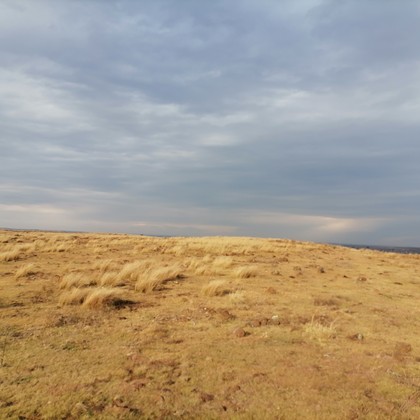
Flat marshes, vleis and flooded grassland, usually with open water nearby, and in the uplands also pasture, maize stubble and ploughed fields. It breeds in tall sedges and rushes standing in shallow water. Unlike other cranes it roosts in tall trees near water. Food consists of seeds, tubers, insects, frogs and small vertebrates, gathered while walking and stamping its feet.
Where the bird is most at home, classified by the vegetation units of southern Africa.

Range and movements
In the region mainly in the east: in South Africa on the Mpumalanga highveld, in the KwaZulu-Natal midlands and the north-east of the Eastern Cape, and further in Eswatini, the Eastern Highlands and central plateau of Zimbabwe, central Mozambique, Malawi and Zambia (Kafue Flats, Bangweulu, Luangwa). In Botswana and the Zambezi Region of Namibia it is scarce in the Okavango Delta and along the Chobe, and in Angola found mainly in the east. Beyond the region it ranges through East Africa to Uganda and Kenya and into eastern DR Congo.
- Resident
- Summer visitor (c. Oct–Mar)
- Winter visitor (c. Apr–Sep)
- Passage (Mar–Apr, Oct–Nov)
- dark = core range, pale = thinly spread
How and when to look
In South Africa best seen in the vleis around Wakkerstroom, Dullstroom and the KwaZulu-Natal midlands; in Zambia on the Kafue Flats and in the Bangweulu Swamps, sometimes in flocks of hundreds outside the breeding season. Watch in the late afternoon for pairs flying to their roost trees, and in the early morning listen for the trumpeting duet over the marsh.
Conservation status
Endangered on the Red List: the world population has more than halved in a few decades. Causes are the drainage and cultivation of wetlands, overgrazing, the removal of chicks and eggs for trade and as pets, poisoning and collisions with power lines. In South Africa the population is fairly stable thanks to conservation projects; stewardship agreements with farmers over breeding vleis and the marking of power lines are the main measures.
Scientific name
Balearica regulorum | (Bennett, 1834)
Bennett described the species in 1834 as Anthropoïdes Regulorum; because it was later moved to another genus, the author and year stand in brackets. The genus Balearica was introduced in 1760 by Brisson. Balearica is Latin for 'of the Balearic Islands'; why the crowned crane was named after these Mediterranean islands, where it does not occur, is unclear. regulorum is Latin for 'of the princes' — for the golden crest that sits like a crown on the head. The specimen the first description was based on came from South Africa (not further specified).