All species › Pigeons and doves › Pigeons and doves › Rock Dove
Rock Dove | Columba livia
Rotsduif | Paloma Bravía
In southern Africa the Rock Dove occurs only as the feral pigeon, derived from domestic birds brought by European settlers. It is tied to cities, towns, harbours and grain silos and has virtually no wild populations away from buildings.
Voice
A soft, rolling coo, oo-roo-coo, and in display a puffed-up, repeated roo-coo-coo as the male turns in circles with neck inflated. The wings clap audibly on take-off.
Recording: Stanislas Wroza — CC BY-NC-SA 4.0 · converted to mono · xeno-canto
Identification
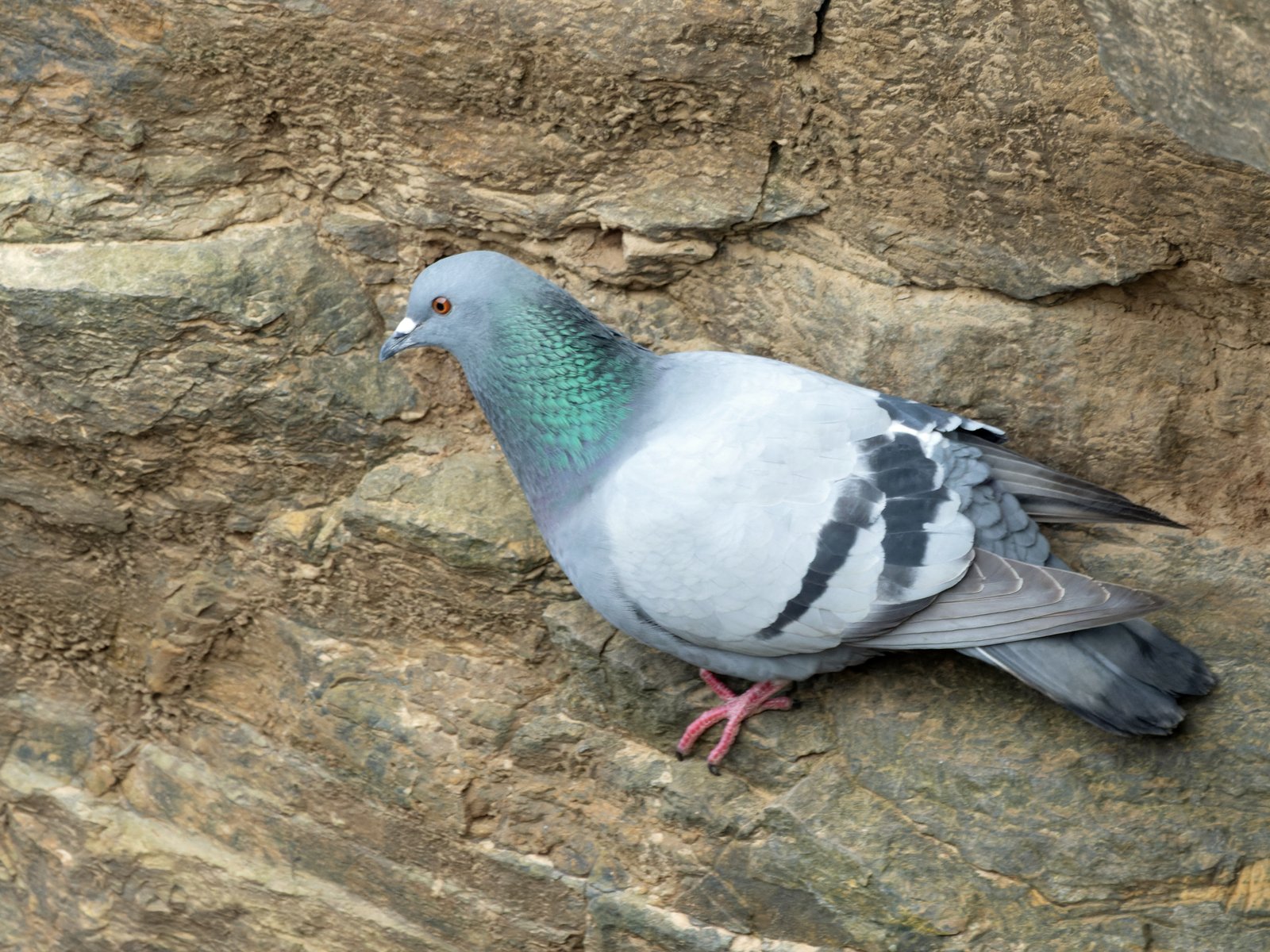
About 33 cm, compact, with a small head and pointed wings. The original wild-type plumage is blue-grey with a green and purple glossed neck, two black wing bars, a white lower back and a dark terminal tail band. Feral birds vary greatly, from almost white, rufous or pied to wholly blackish, often with a chequered wing pattern. The eye is orange, the bill dark with a white cere, the legs red. The sexes are nearly alike.
Confusion species
Speckled Pigeon (Columba guinea) has white triangular spots on a rufous wing and a broad bare red eye patch, and also breeds on buildings; hybrids are not known. African Olive Pigeon (Columba arquatrix) is dark wine red with a yellow bill and lives in forest. Doves such as Ring-Necked Dove (Streptopelia capicola) are slimmer, brownish grey and have a black neck collar.
Habitat
City centres, stations, harbours, grain silos, factories and farmyards, where buildings offer ledges and cavities. It feeds on streets, squares, rubbish dumps and fields on seeds, grain and food scraps.
Where the bird is most at home, classified by the vegetation units of southern Africa.

Range and movements
In every country of the region in cities and larger towns, most numerous in South Africa, Zimbabwe and the towns of Namibia, Botswana and Mozambique; virtually absent away from buildings. The wild form originally inhabits rocky coasts and mountains of Europe, North Africa and south-western Asia; feral birds now live in cities throughout the world.
- Resident
- Summer visitor (c. Oct–Mar)
- Winter visitor (c. Apr–Sep)
- Passage (Mar–Apr, Oct–Nov)
- dark = core range, pale = thinly spread
How and when to look
In any town, around stations, markets and grain silos. In large flocks look for individuals in the original wild-type plumage, and at silos and bridges for the difference from Speckled Pigeon, which often mixes with them. All year.
Conservation status
Not threatened; very numerous worldwide. In the region it is an introduced species regarded as a pest in towns and grain stores. It may compete with Speckled Pigeon for nest sites on buildings and is prey for Peregrine Falcons breeding in cities.
Scientific name
Columba livia | Gmelin, 1789
Gmelin described the species in 1789 and placed it straight away in the genus where it still stands. The genus Columba was introduced in 1758 by Linnaeus. Columba is the Latin word for 'dove, pigeon'. livia is a Medieval Latin variant of livida 'livid, bluish grey', Theodorus Gaza's rendering of Greek peleia 'dove', itself from pellos 'dark-coloured'. The specimen the first description was based on came from southern Europe.