All species › Birds of prey › Hawks, eagles and kites › African Cuckoo-Hawk
African Cuckoo-Hawk | Aviceda cuculoides
Afrikaanse koekoekswouw | Baza Africano
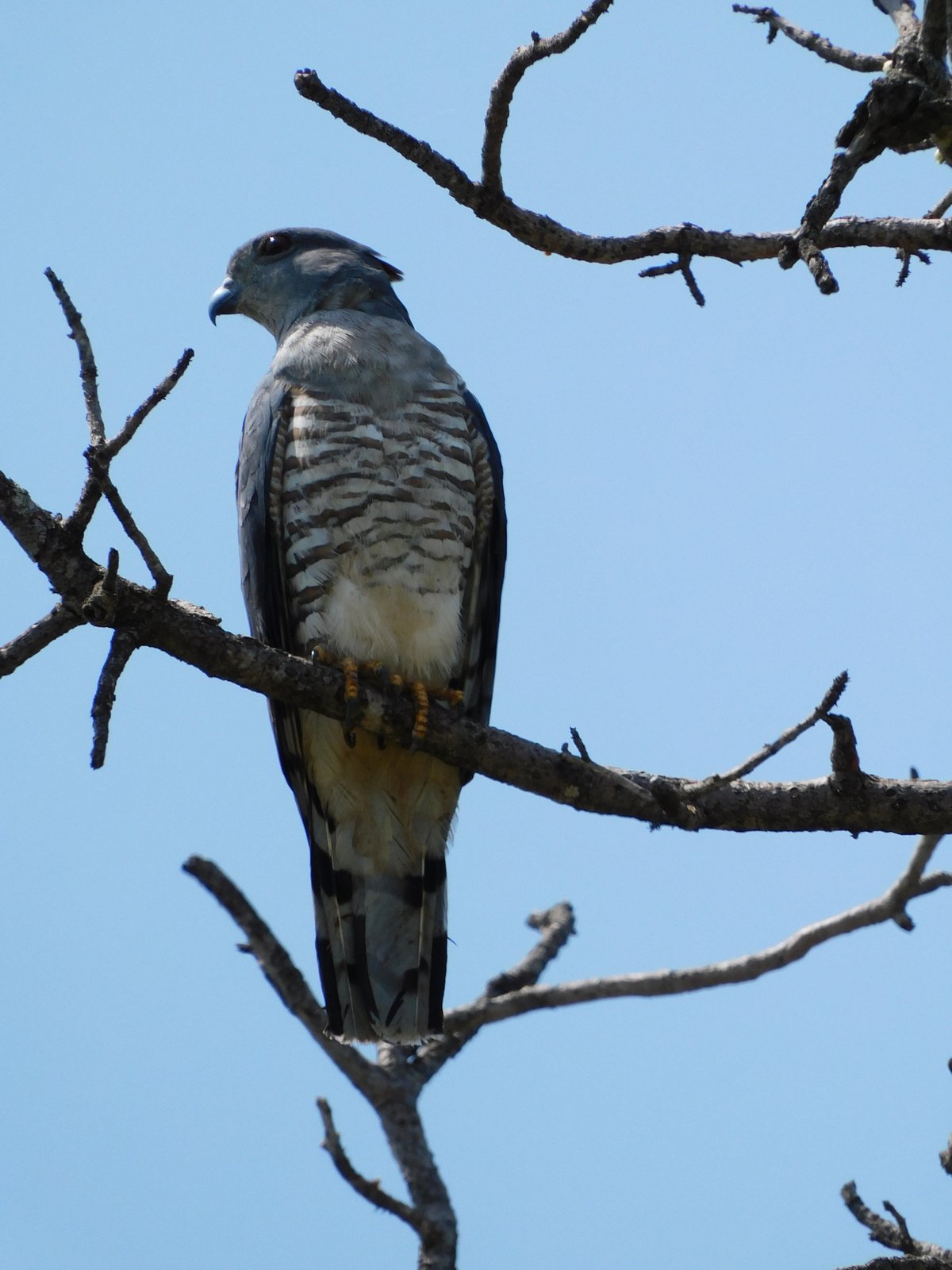
The African Cuckoo-Hawk is a medium-sized, rather quiet forest raptor with a small crest and underparts strongly reminiscent of a cuckoo or a goshawk. It hunts from a concealed perch in the canopy for large insects, chameleons and lizards, which it plucks from branches and leaves.
Voice
Most often heard is a loud whistled teeeeuw or pee-ooo, falling strongly at the end, often repeated from the canopy or in display flight. Also a soft, plaintive kiuu. During display in early summer the call is heard far more often than at other times of year.
Recording: Alain Verneau — CC BY-NC-SA 4.0 · converted to mono · xeno-canto
Identification
About 40 cm. The adult has a grey head, throat and breast, dark greyish-brown upperparts and a small, often barely visible black crest on the hindcrown. The belly is white with broad chestnut bars. The eye is yellow to orange-yellow, the legs short and yellow. The wings are long and reach close to the tail tip when perched. The female has a browner breast and a yellower eye. Juveniles are brown above with a pale supercilium and white below with large brown teardrop spots, and have a dark eye. In flight the long, broad wings with rufous underwing coverts and three dark tail bands stand out; the flight is light and buzzard-like.
Confusion species
African Goshawk (Aerospiza tachiro) has shorter wings and longer legs, a more finely barred breast and lacks the grey bib and crest. Lizard Buzzard (Kaupifalco monogrammicus) has a white throat with a black central stripe, a finely barred belly and a single white tail band. African Cuckoo (Cuculus gularis) is slimmer with a pointed bill, heavily barred underparts up to the throat and a long graduated tail. The long wingtips and the broad rufous bars on the belly point to the cuckoo-hawk.
Habitat
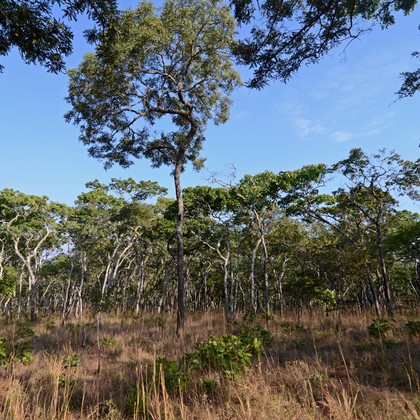
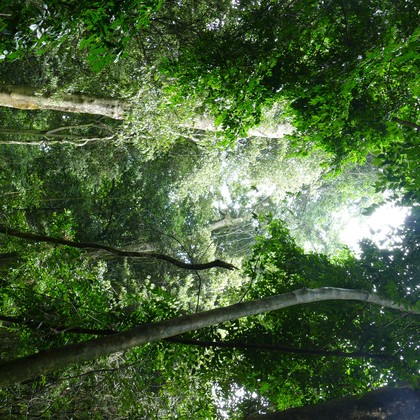
Riverine forest, forest edges, open miombo, coastal forest and rich woodland, and nowadays also large parks, gardens and plantations of eucalyptus and pine. It sits still in the canopy for long periods and drops onto prey in foliage or on the ground: mainly grasshoppers, caterpillars, chameleons and lizards, sometimes frogs and nestlings. The nest is a small, flimsy platform of twigs, often lined with green leaves, high in a tree fork.
Where the bird is most at home, classified by the vegetation units of southern Africa.

Range and movements
The north and east of the region: Angola, Zambia, Malawi, Mozambique and Zimbabwe, northern Botswana (Okavango and Chobe) and the Zambezi Region of Namibia, and eastern South Africa from Limpopo and Mpumalanga through Eswatini and KwaZulu-Natal to the Eastern Cape. It is spreading onto the highveld, including around Gauteng. Beyond the region it occurs in wooded parts of sub-Saharan Africa, from Senegal to Ethiopia and Kenya.
- Resident
- Summer visitor (c. Oct–Mar)
- Winter visitor (c. Apr–Sep)
- Passage (Mar–Apr, Oct–Nov)
- dark = core range, pale = thinly spread
How and when to look
Easiest to find in early summer (September–November), when birds give their whistled call and display above the forest. Walk along riverine forest or a forest edge and watch for a raptor gliding silently from one crown to the next; perched, it is often surprisingly tame. The grey breast with the small crest and the long wingtips are the best features on a perched bird.
Conservation status
Not threatened. An unobtrusive species that is easily overlooked and probably commoner than records suggest. In South Africa its range is expanding westwards and inland, helped by planted trees in gardens and towns; there are local declines where riverine forest is cleared.
Scientific name
Aviceda cuculoides | Swainson, 1837
Swainson described the species in 1837 and placed it straight away in the genus where it still stands. The genus Aviceda was introduced in 1836 by Swainson. Aviceda comes from Latin avis, 'bird', and caedere, 'to kill': 'bird-killer', although bazas mainly eat insects and lizards. cuculoides means 'cuckoo-like', from Latin cuculus, 'cuckoo' — for the barred underparts, as in a cuckoo. The specimen the first description was based on came from Senegal.