All species › Cuckoos › Cuckoos › African Cuckoo
African Cuckoo | Cuculus gularis
Afrikaanse koekoek | Cuco Barbiblanco
The African Cuckoo is the African counterpart of the Common Cuckoo: almost as large and just as grey, but a breeding bird that moves south from Central Africa with the rains. In spring the male gives himself away with a hoopoe-like hoop-hoop from a high branch.
Voice
The male's call is a soft, hollow hoop-hoop, both notes at about the same pitch or the second slightly higher, very like the call of a hoopoe. It is repeated endlessly, even in the middle of the day. The female has a rapid, bubbling kwik-kwik-kwik.
Recording: Dries Van de Loock — CC BY-NC-SA 4.0 · converted to mono · xeno-canto
Identification
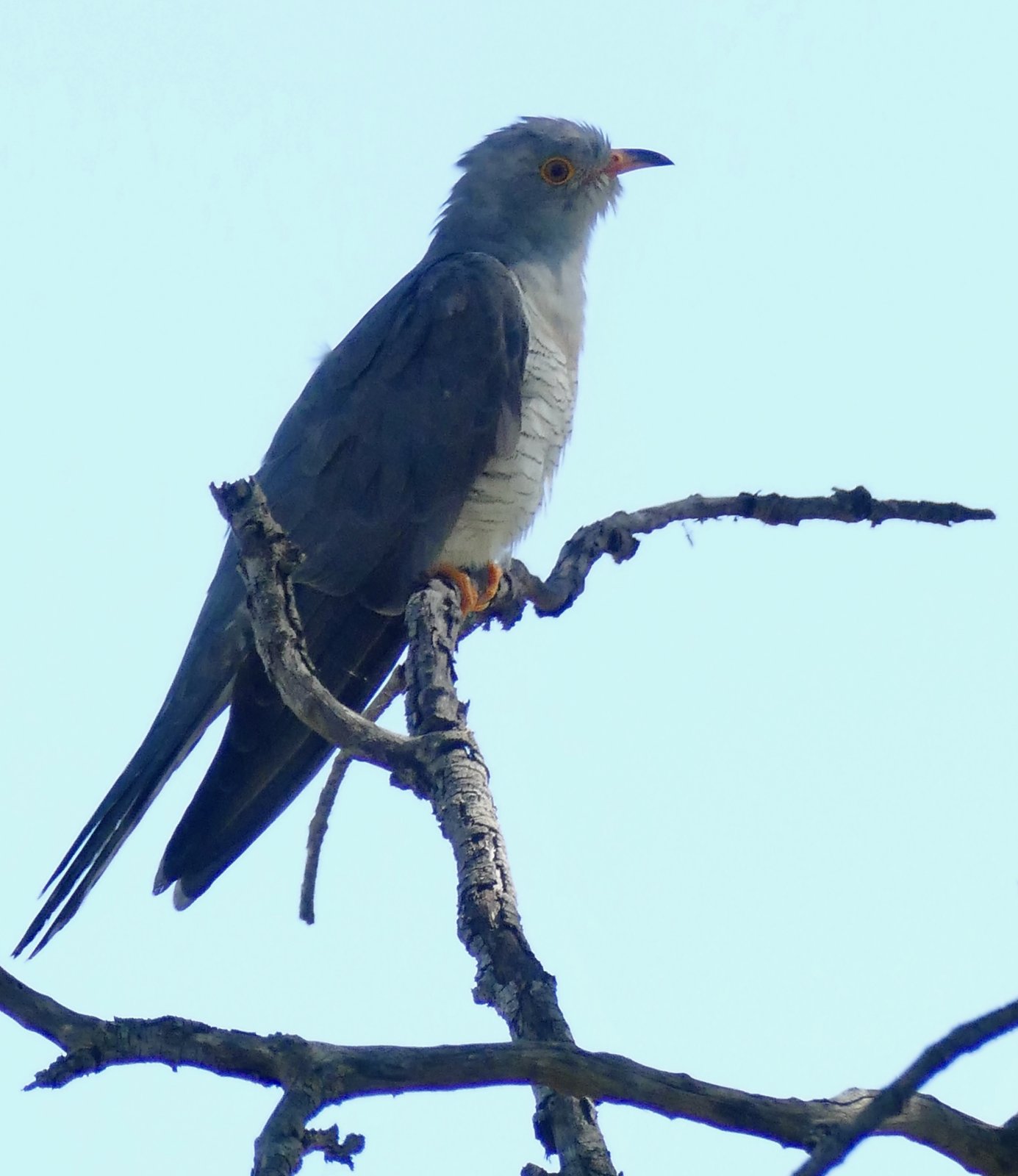
About 31 to 33 cm long and around 100 grams in weight; slim and long-tailed, with pointed wings that recall a small falcon or sparrowhawk in flight. Upperparts, head and breast slate-grey, the belly white with fine dark barring. The bill is conspicuously yellow with a dark tip, the yellow covering well over half its length. The underside of the tail shows complete white bars across the full width of the outer feathers. Eye-ring and legs yellow. The female closely resembles the male but has a faint buff wash on the breast; juveniles are grey-brown and densely scaled and barred white.
Confusion species
Common Cuckoo (Cuculus canorus) is almost identical in the field; it has a darker bill with only a yellow base, and the outer tail feathers carry white spots rather than complete bars. It is also a silent non-breeding visitor, whereas the African Cuckoo calls. Madagascar Cuckoo (Cuculus rochii) is smaller and occurs here only in the austral winter. Shikra (Tachyspiza badia) and Gabar Goshawk (Micronisus gabar) look cuckoo-like in flight but have a short hooked bill and broader, rounder wings.
Habitat
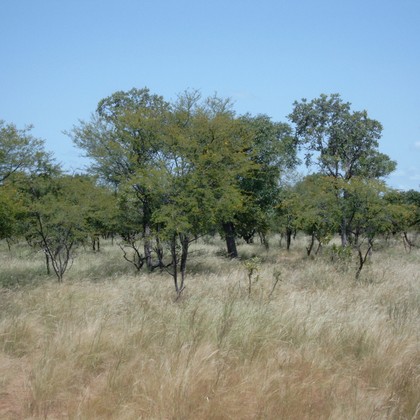
Open and semi-open woodland: miombo, mopane and mixed broadleaf woodland and dry acacia savanna, usually with tall trees. It feeds mainly on hairy caterpillars. It is a brood parasite, almost exclusively of Fork-Tailed Drongo (Dicrurus adsimilis), laying its eggs in the drongo's nest.
Where the bird is most at home, classified by the vegetation units of southern Africa.


Range and movements
As a breeding bird widespread across the north and east of the region: Angola, Zambia, Malawi, Mozambique, Zimbabwe, northern Botswana and Namibia, north-eastern South Africa (Limpopo, Mpumalanga, northern KwaZulu-Natal) and Eswatini. It is absent from the arid west and the Cape. Outside the breeding season it moves north to the equatorial belt; separate populations also breed in the Sahel and the savannas of West and East Africa.
- Summer visitor (c. Oct–Mar)
- Winter visitor (c. Apr–Sep)
- Passage (Mar–Apr, Oct–Nov)
- dark = core range, pale = thinly spread
How and when to look
Look for it in October and November, just after arrival, when the males call most and often sit in the open on a dead branch. Learn the difference from the hoopoe: the hoopoe usually gives three notes, the cuckoo two. Keep an eye on Fork-Tailed Drongos, which chase cuckoos fiercely; a drongo in pursuit of a grey bird often points out the cuckoo.
Conservation status
Not threatened. The species is widespread and common in suitable woodland. Large-scale clearance of miombo and other woodlands removes habitat, but does not yet pose a serious threat to the overall population. Because it depends on a single host, its numbers closely track those of the Fork-Tailed Drongo, which is itself abundant.
Scientific name
Cuculus gularis | Stephens, 1815
Stephens described the species in 1815 and placed it straight away in the genus where it still stands. The genus Cuculus was introduced in 1758 by Linnaeus. Cuculus is the Latin word for the cuckoo. gularis is Modern Latin for 'of the throat, -throated', from the Latin gula, 'throat'. The specimen the first description was based on came from Camdeboo, Eastern Cape, South Africa.