All species › Cuckoos › Cuckoos › Lesser Cuckoo
Lesser Cuckoo | Cuculus poliocephalus
Kleine koekoek | Cuco Chico
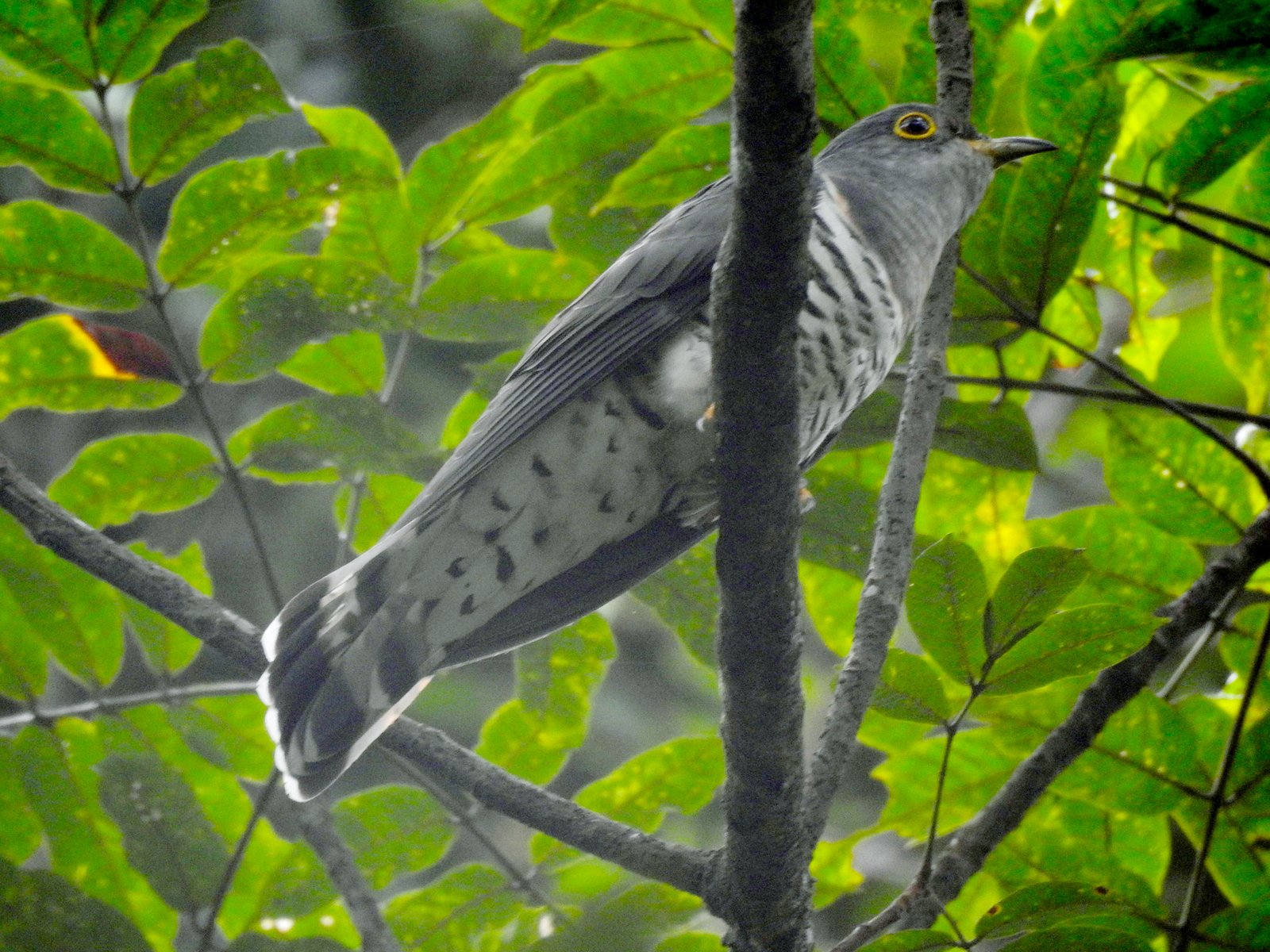
The Lesser Cuckoo is an Asian breeder, from the Himalaya to Japan, that spends part of the northern winter in East Africa. The southern edge of its wintering range lies in the north-east of the region, where it is scarce and almost always silent; every record deserves careful documentation.
Voice
Almost silent in winter quarters. On the breeding grounds a fast, stuttering phrase of five or six notes, stressed on the first, rendered chok-chok-cherre-chok, which is occasionally heard in Africa in spring.
Recording: Yang Li — CC BY-NC-SA 4.0 · converted to mono · xeno-canto
Identification
25–27 cm, a scaled-down Common Cuckoo with relatively shorter wings and a long tail. The male has a grey head, throat and breast and dark slate-grey upperparts, with a grey rump showing little contrast. The belly is white to pale cream with broad, widely spaced black bars; the undertail coverts are warm buff and barely barred. The tail is blackish grey with white spots. The bill is dark with a yellow base, and the eye-ring and legs are yellow. The female occurs in a grey and a rufous (hepatic) morph; the rufous morph is bright rufous-brown and almost unbarred on crown and rump. Juveniles are darker grey with white feather edges.
Confusion species
Madagascar Cuckoo (Cuculus rochii) is virtually identical and hardly separable without voice or in the hand; however, it is present on the mainland mainly from April to October, outside the Lesser Cuckoo's period. Common Cuckoo (Cuculus canorus) is larger, with finer, denser barring on a whiter belly and barred undertail coverts. African Cuckoo (Cuculus gularis) is larger, with a largely yellow bill and a barred tail. Rufous-morph females resemble those of Common Cuckoo but have a less barred rump.
Habitat
In winter quarters forest edges, riverine forest, dense woodland and miombo, also secondary forest and well-wooded gardens. It forages in the canopy and middle storey, mainly on caterpillars.
Where the bird is most at home, classified by the vegetation units of southern Africa.



Range and movements
Within the region scarce in Malawi, Zambia, northern and central Mozambique and eastern Zimbabwe; a vagrant to north-eastern South Africa. The main African wintering population lies in Kenya and Tanzania. It breeds from Afghanistan and the Himalaya through China to Korea, the Russian Far East and Japan; another part of the population winters in India and Sri Lanka.
- Summer visitor (c. Oct–Mar)
- dark = core range, pale = thinly spread
How and when to look
Treat every small, grey Cuculus cuckoo between November and April in the north-east of the region as a candidate, and note the date, size relative to nearby birds, the barring of belly and undertail coverts and the colour of the rump. Photographs of upper- and underside are essential. A bird in April or May could just as well be a Madagascar Cuckoo.
Conservation status
Not threatened and widespread on its Asian breeding grounds. Poorly studied in Africa; the number of wintering birds in the region is small and irregular.
Scientific name
Cuculus poliocephalus | Latham, 1790
Latham described the species in 1790 and placed it straight away in the genus where it still stands. The genus Cuculus was introduced in 1758 by Linnaeus. Cuculus is the Latin word for the cuckoo. poliocephalus comes from the Greek polios, 'grey', and kephalē, 'head' — for the grey head. The specimen the first description was based on came from India.