All species › Cuckoos › Cuckoos › Red-Chested Cuckoo
Red-Chested Cuckoo | Cuculus solitarius
Heremietkoekoek | Cuco Solitario
The Red-Chested Cuckoo is the voice of the southern African summer: its three-note call, rendered in Afrikaans as Piet-my-vrou, rings from every forest and garden with tall trees from late September. The bird itself usually stays hidden in the canopy and is seen far less often than heard.
Voice
A loud, clear three-note whistle, wheet-wheet-wheeoo, the last note lower, repeated endlessly and also heard at night; the Afrikaans name Piet-my-vrou and the English rendering it will rain derive from it. The female gives a fast, bubbling pik-pik-pik.
Recording: David Tattersley — CC BY-NC-SA 4.0 · converted to mono · xeno-canto
Identification
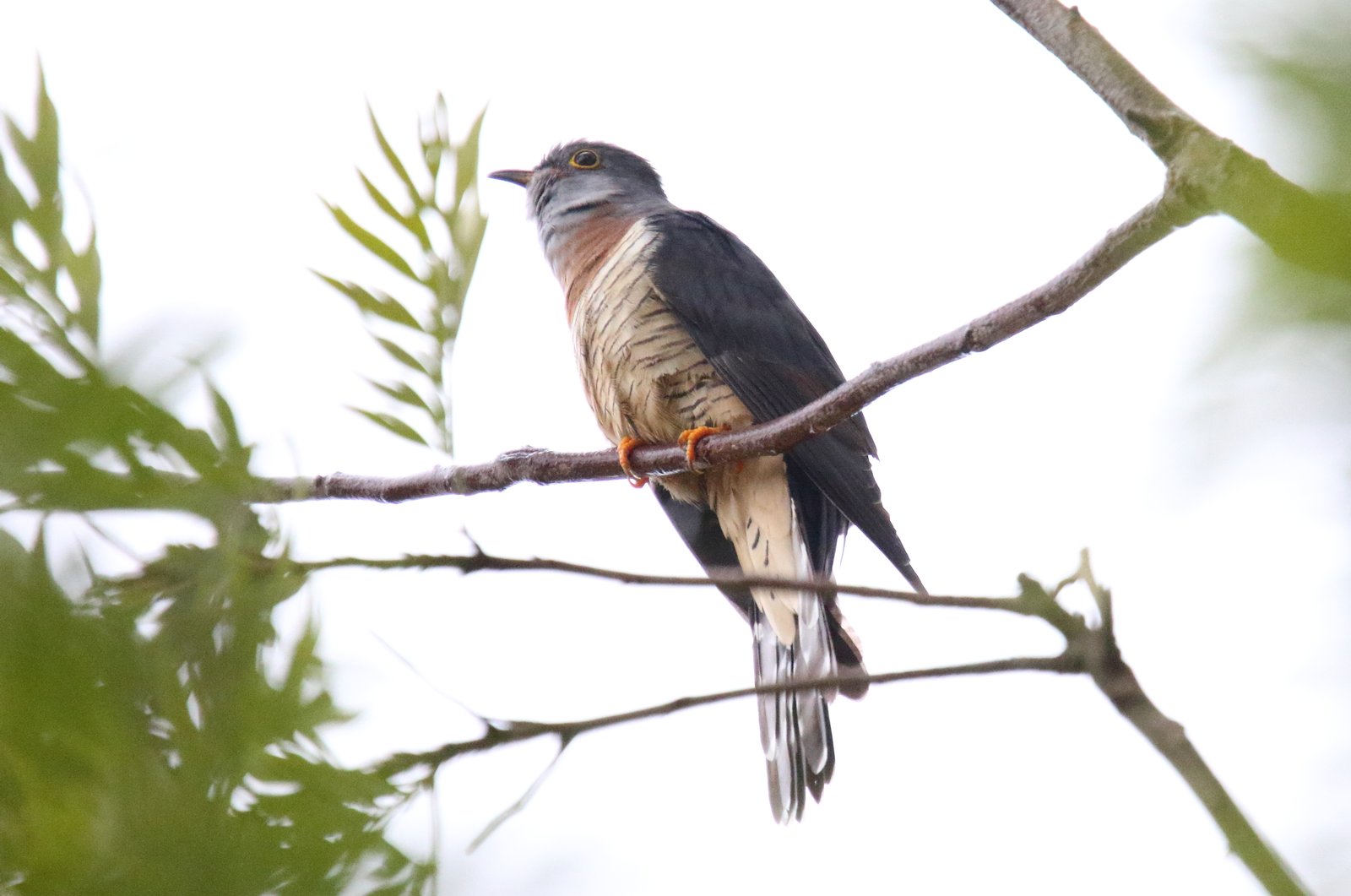
28–31 cm. Dark slate-grey above, with grey head and throat. The breast is warm rufous, sometimes pale, and the belly and flanks are white to buff with broad black bars; the undertail is buff. The tail is long, blackish grey with white spots and tips. The bill is dark with a yellow base, and the eye-ring and legs are yellow. The female has a paler, less distinct rufous breast. Juveniles look quite different: almost wholly blackish on head, back and throat, with white feather edges and heavily barred underparts.
Confusion species
Common Cuckoo (Cuculus canorus) and African Cuckoo (Cuculus gularis) lack the rufous breast and have a pale grey throat and breast; African Cuckoo also has a largely yellow bill. Lesser Cuckoo (Cuculus poliocephalus) and Madagascar Cuckoo (Cuculus rochii) are smaller and grey-breasted. Juvenile Red-Chested Cuckoos can be mistaken for Black Cuckoo (Cuculus clamosus), but that lacks white feather edges and a barred belly.
Habitat
Montane forest, forest edges, riverine forest, moist woodland, plantations, and gardens and parks with tall trees, into urban areas. It forages in the canopy on caterpillars and other insects. As a brood parasite it mainly uses robin-chats and other thrush-like birds, in the region especially Cape Robin-Chat, White-Browed Robin-Chat, Olive Thrush and Cape Wagtail.
Where the bird is most at home, classified by the vegetation units of southern Africa.



Range and movements
Across most of the region: from the Western Cape along the south coast and the Eastern Cape, through KwaZulu-Natal, Lesotho, Eswatini and the east and north of South Africa to Zimbabwe, Mozambique, Malawi, Zambia, northern Botswana, northern Namibia and Angola. Absent from the driest parts of the Karoo, the Kalahari and the Namib. Beyond the region it occurs across most of Africa south of the Sahara; southern breeders winter in Central Africa.
- Resident
- Summer visitor (c. Oct–Mar)
- Passage (Mar–Apr, Oct–Nov)
- dark = core range, pale = thinly spread
How and when to look
From late September, when the first birds call and herald the rains. A calling bird usually sits high in a dense crown: look at the branches near the trunk rather than the outside of the canopy. In flight it is fast and falcon-like; watch for the rufous breast as it passes overhead.
Conservation status
Not threatened and common across most of the region. It benefits from gardens, parks and plantations with tall trees, which have allowed it to spread into urban areas; there is no evidence of declines.
Scientific name
Cuculus solitarius | Stephens, 1815
Stephens described the species in 1815 and placed it straight away in the genus where it still stands. The genus Cuculus was introduced in 1758 by Linnaeus. Cuculus is the Latin word for the cuckoo. solitarius is Latin for 'solitary'. The specimen the first description was based on came from Eastern Cape, South Africa.