All species › Cuckoos › Cuckoos › Black Cuckoo
Black Cuckoo | Cuculus clamosus
Zwarte koekoek | Cuco Negro
The Black Cuckoo is an all-black cuckoo best known in summer by its voice: a plaintive, three-part whistle heard in woodland day and night. It parasitises almost exclusively boubous and shrikes of the genus Laniarius, such as Southern Boubou and Crimson-Breasted Shrike.
Voice
A drawn-out, plaintive three-note whistle, hoo-hoo-wheeeh, the last note rising; often rendered as I'm so sick. Also an excited, accelerating series yow-yow-yow-yow, which can develop into a duet between male and female. It calls from a hidden perch in the canopy, also at night.
Recording: Ehren Eksteen — CC BY-NC-SA 4.0 · converted to mono · xeno-canto
Identification
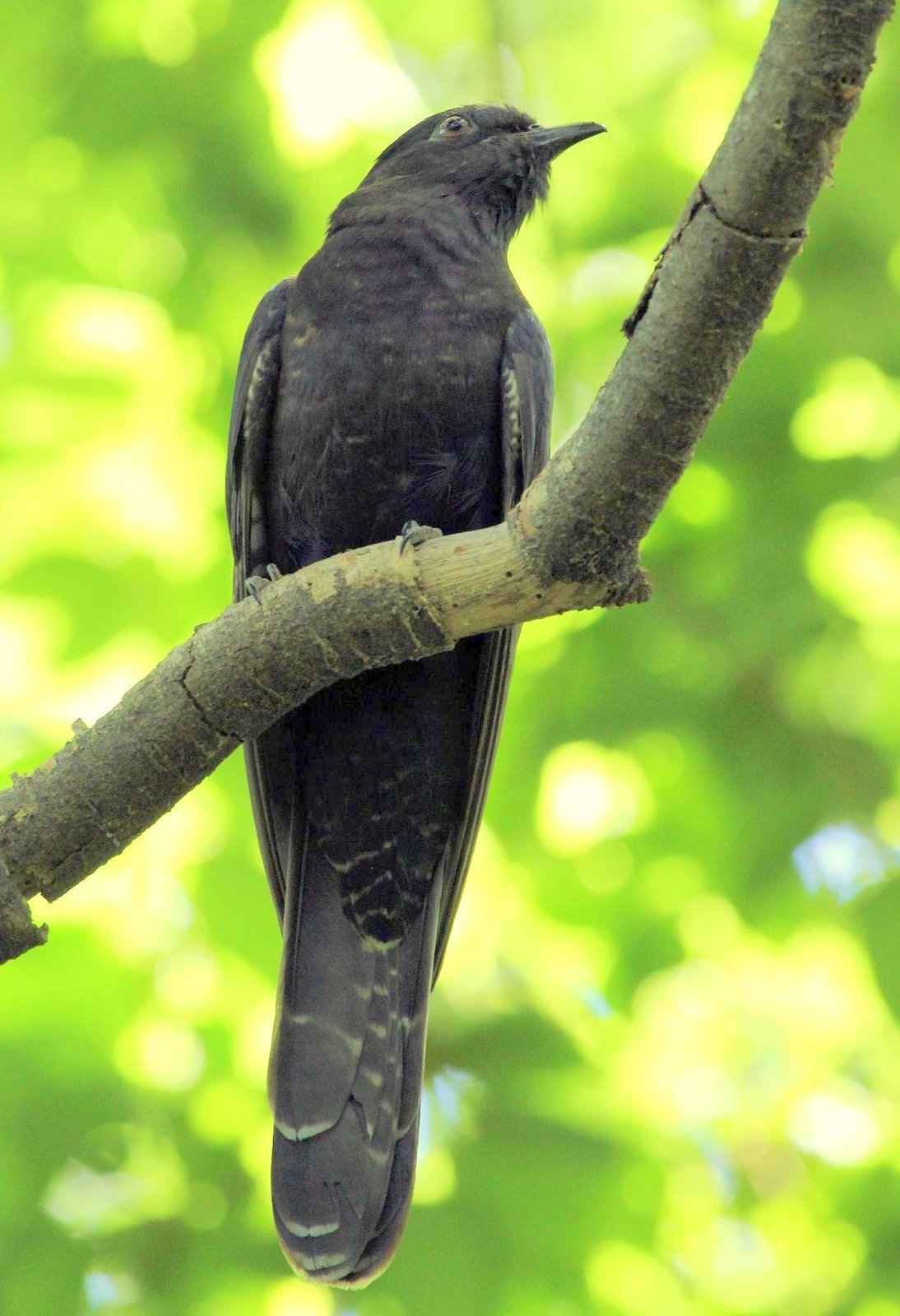
29–31 cm. Adults are dull black with a faint blue or green gloss above; some birds show faint, fine paler barring on the belly and undertail. The tail is long, rounded and black, with narrow white tips visible in flight. The bill is black, the eye dark brown and the legs blackish to grey. The sexes are alike. Juveniles are duller brownish black without gloss. In flight it looks like a falcon or sparrowhawk, with pointed wings and fast, shallow wingbeats.
Confusion species
Fork-Tailed Drongo (Dicrurus adsimilis) is smaller, with a deeply forked tail, a red eye and an upright, drongo-like posture. The male Black Cuckooshrike (Campephaga flava) is smaller, with an orange-yellow gape and often a yellow shoulder patch. The dark morph of Jacobin Cuckoo (Clamator jacobinus) has a crest and a white patch in the primaries. Juvenile Red-Chested Cuckoos (Cuculus solitarius) are blackish but have white feather edges and a barred belly.
Habitat
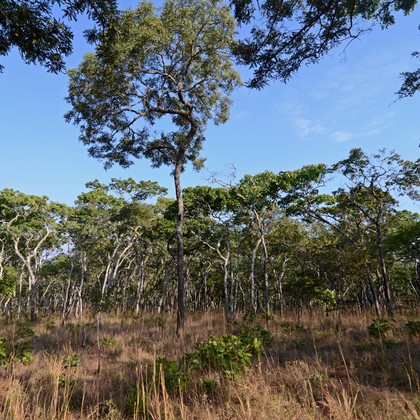
Dense woodland, miombo, riverine forest, forest edges and thicket with tall trees, also gardens and parks in the east. It feeds mainly on hairy caterpillars gathered in the canopy. It lays almost exclusively in the nests of Laniarius species, in the region mainly Southern Boubou, Tropical Boubou and Crimson-Breasted Shrike.
Where the bird is most at home, classified by the vegetation units of southern Africa.


Range and movements
Widespread in the east and north of the region: from the Eastern Cape through KwaZulu-Natal, Eswatini, Mpumalanga, Limpopo and Gauteng to Zimbabwe, Mozambique, Malawi, Zambia, Botswana, northern and central Namibia and Angola. Absent from the Western Cape, the Karoo and the Namib. Beyond the region it occurs across most of Africa south of the Sahara; southern breeders move to Central Africa in winter.
- Summer visitor (c. Oct–Mar)
- Passage (Mar–Apr, Oct–Nov)
- dark = core range, pale = thinly spread
How and when to look
November to January, especially in the heat of the afternoon and on warm nights, when the plaintive whistle is repeated endlessly. The bird hides in the canopy; wait until it flies from tree to tree or is chased by a boubou, when the long tail and falcon-like flight stand out.
Conservation status
Not threatened and fairly common across most of the region. Numbers seem stable; the species benefits from thicket and gardens where boubous breed.
Scientific name
Cuculus clamosus | Latham, 1801
Latham described the species in 1801 and placed it straight away in the genus where it still stands. The genus Cuculus was introduced in 1758 by Linnaeus. Cuculus is the Latin word for the cuckoo. clamosus is Latin for 'noisy, clamorous' — for the persistent, mournful call. The specimen the first description was based on came from Cradock, Eastern Cape, South Africa.