All species › Hoopoes and hornbills › Hornbills › African Grey Hornbill
African Grey Hornbill | Lophoceros nasutus
Grijze tok | Toco Piquinegro
The African Grey Hornbill is a slim, grey-brown hornbill of dry woodland, with a dark bill and a broad white eyebrow. It lives more in the canopy than the red- and yellow-billed hornbills and wanders in loose flocks outside the breeding season.

Click a thumbnail to switch the photo above.
Voice
A series of plaintive whistled notes, pee-pee-pee-peeoo-peeoo, swelling and then fading. While calling the bird points the bill upwards and half-opens its wings with each note; pairs call in duet in the same way.
Recording: Magnus Wadstein — CC BY-NC-SA 4.0 · converted to mono · xeno-canto
Identification
About 46 cm. Head and upperparts are grey-brown, the wing coverts narrowly edged pale, and a narrow white stripe runs down the back. A broad whitish supercilium runs from the eye to the nape; the breast is grey-brown and the belly dirty white. The tail is dark with white tips to the outer feathers. The male has a black bill with a cream stripe along the base of the upper mandible and a distinct casque; in the female the upper mandible is largely cream with a maroon tip and the casque is small. Flight undulating, alternating flapping and gliding.
Confusion species
Bradfield's Hornbill (Lophoceros bradfieldi) is plainer brown, lacks the white supercilium and has an orange bill. Pale-Billed Hornbill (Lophoceros pallidirostris) of miombo has an entirely pale, ivory bill. Crowned Hornbill (Lophoceros alboterminatus) is darker brown with a red bill. Southern Yellow-Billed Hornbill (Tockus leucomelas) and Southern Red-Billed Hornbill (Tockus rufirostris) have yellow or red bills and clearly spotted wings.
Habitat
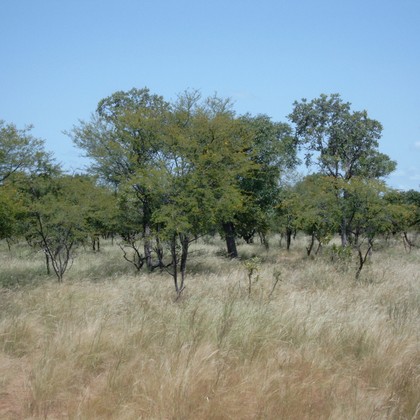
Dry mixed woodland, miombo, acacia savanna and open mopane, also well-wooded edges of farmland. It feeds more in trees than on the ground: grasshoppers, caterpillars, other insects, tree frogs and lizards, supplemented by fruit and seeds. It nests in a natural tree cavity, which the female seals with mud and droppings to a narrow slit.
Where the bird is most at home, classified by the vegetation units of southern Africa.


Range and movements
Widespread in the north of the region: Angola, Zambia, Malawi, Mozambique, Zimbabwe, Botswana and northern and central Namibia. In South Africa mainly in Limpopo, Mpumalanga, northern North West and northern KwaZulu-Natal; also in the Eswatini lowveld. Absent from southern and western South Africa and from Lesotho. Beyond the region across almost all of sub-Saharan Africa, east to south-western Arabia.
- Resident
- Summer visitor (c. Oct–Mar)
- Winter visitor (c. Apr–Sep)
- Passage (Mar–Apr, Oct–Nov)
- dark = core range, pale = thinly spread
How and when to look
Present all year in woodland, but most often seen in the dry season, when parties of ten to fifty birds roam about and settle in fruiting trees. Watch for the undulating flight from tree to tree and listen for the whistled call, quite unlike the clucking of the red- and yellow-billed hornbills.
Conservation status
Not threatened and common in suitable woodland. Like other small hornbills it depends on old trees with cavities; cutting for firewood and charcoal locally reduces the number of nest sites.
Scientific name
Lophoceros nasutus | (Linnaeus, 1766)
Linnaeus described the species in 1766 as Buceros nasutus; because it was later moved to another genus, the author and year stand in brackets. The genus Lophoceros was introduced in 1833 by Hemprich & Ehrenberg. Lophoceros comes from the Greek lophos, 'crest', and keras, 'horn' — for the ridge-like casque on the bill. nasutus is Latin for 'large-nosed' — for the large, curved bill. The specimen the first description was based on came from Senegal.