All species › Hoopoes and hornbills › Hornbills › Pale-Billed Hornbill
Pale-Billed Hornbill | Lophoceros pallidirostris
Diksnaveltok | Toco Piquiclaro
The Pale-Billed Hornbill is the grey-brown hornbill of miombo woodland, identified by its pale, ivory-coloured bill. It is less conspicuous than the African Grey Hornbill and more often heard than seen, high in the canopy of brachystegia trees.

Voice
A series of plaintive whistled notes, pee-pee-peew-peew-peew, first rising and then falling, somewhat fuller and slower than in African Grey Hornbill. While calling the bird raises its bill and opens its wings with each note.
Recording: Dries Van de Loock — CC BY-NC-SA 4.0 · converted to mono · xeno-canto
Identification
About 50 cm. Head, neck and upperparts are dark grey-brown with pale edges to the wing coverts, and a pale supercilium runs from the eye to the nape. The underparts are pale grey-brown to dirty white. The bill is entirely cream to horn-coloured, with a small, low casque in the male; in the female the casque is smaller still and the bill tip often darker. The tail is dark with white tips to the outer feathers. The sexes are otherwise alike; juveniles have a shorter bill without a casque.
Confusion species
African Grey Hornbill (Lophoceros nasutus) is smaller and has a dark bill (male) or a cream upper mandible with a maroon tip (female), never an entirely pale bill. Bradfield's Hornbill (Lophoceros bradfieldi) has an orange bill and lacks the supercilium. Crowned Hornbill (Lophoceros alboterminatus) is darker with a red bill.
Habitat
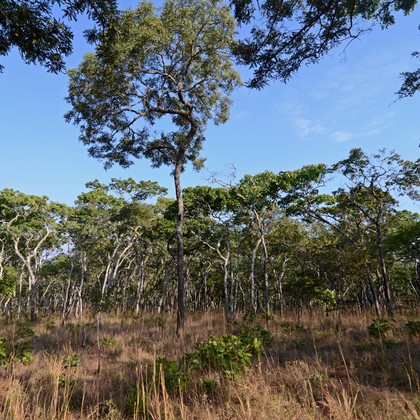
Chiefly miombo woodland with brachystegia and julbernardia, also other dry broadleaved woodland and rocky wooded hills. It forages in the canopy and on large branches for insects, fruit and seeds, and comes to the ground less often than other small hornbills. It nests in a tree cavity sealed by the female.
Where the bird is most at home, classified by the vegetation units of southern Africa.

Range and movements
In the region confined to the miombo belt in the north: central and northern Angola, most of Zambia, Malawi and northern and western Mozambique north of the Zambezi. Absent from Zimbabwe, Botswana, Namibia and South Africa. Beyond the region in southern DR Congo and western and southern Tanzania.
- Resident
- Summer visitor (c. Oct–Mar)
- Winter visitor (c. Apr–Sep)
- Passage (Mar–Apr, Oct–Nov)
- dark = core range, pale = thinly spread
How and when to look
Search extensive miombo, for example Kasanka and Kafue in Zambia or the Nyika and Vipya plateaus in Malawi, and listen in the morning for the whistled series. The pale bill shows well even against the light and separates the species from African Grey Hornbill, which occurs in the same woodland in places.
Conservation status
Not threatened and fairly common in good miombo. Large-scale clearing of miombo for farming and charcoal is the main long-term threat, since the species relies on old trees with cavities.
Scientific name
Lophoceros pallidirostris | (Hartlaub & Finsch, 1870)
Hartlaub & Finsch described the species in 1870 as Buceros pallidirostris; because it was later moved to another genus, the author and year stand in brackets. The genus Lophoceros was introduced in 1833 by Hemprich & Ehrenberg. Lophoceros comes from the Greek lophos, 'crest', and keras, 'horn' — for the ridge-like casque on the bill. pallidirostris is Latin for 'pale-billed', from pallidus, 'pale', and rostrum, 'bill' — for the ivory-coloured bill. The specimen the first description was based on came from Caconda, Angola.