All species › Hoopoes and hornbills › Hornbills › Southern Yellow-Billed Hornbill
Southern Yellow-Billed Hornbill | Tockus leucomelas
Geelsnaveltok | Toco Piquigualdo Sureño
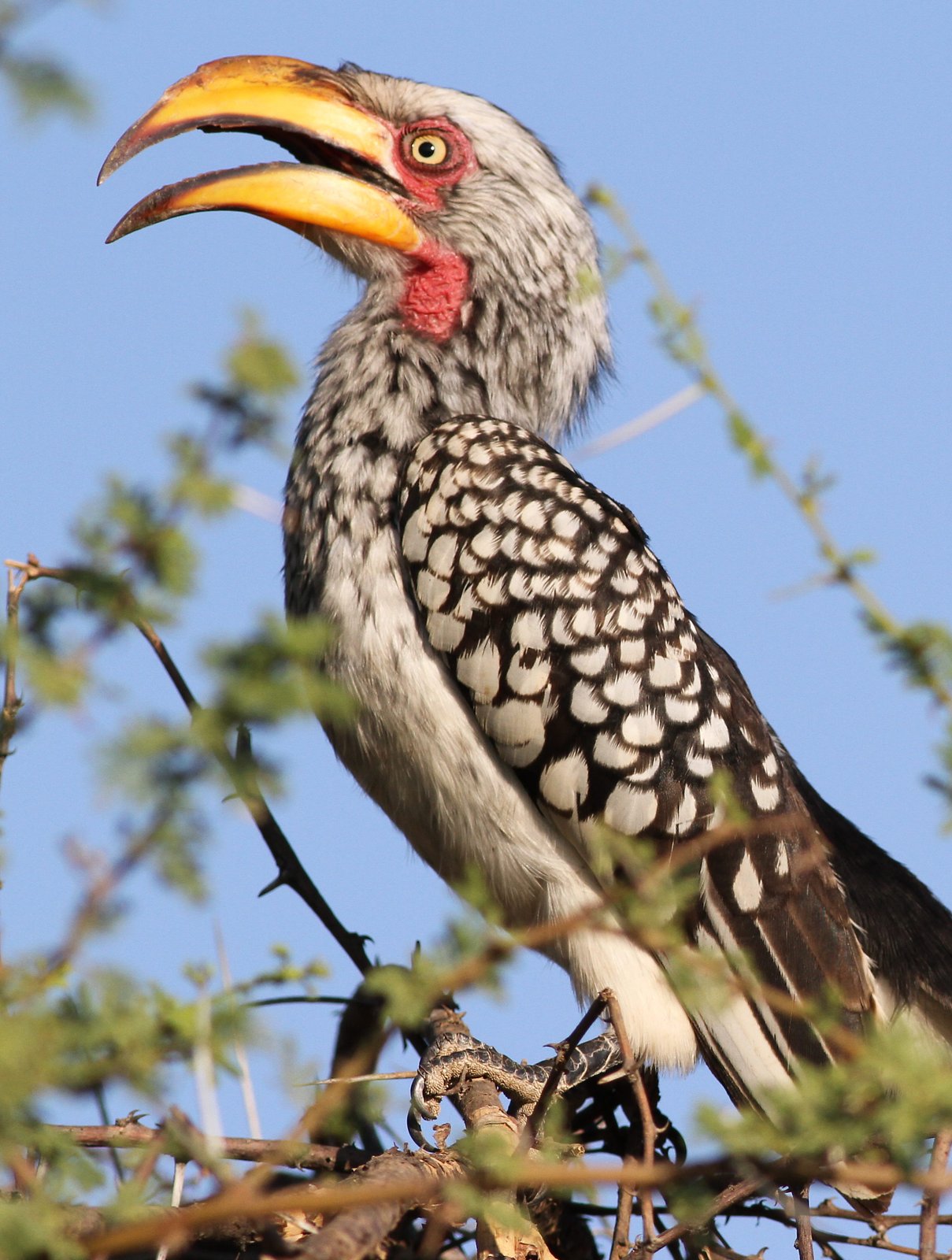
The Southern Yellow-Billed Hornbill is the common hornbill of dry thornveld in southern Africa, with a long down-curved yellow bill and black-and-white spotted plumage. It hops along the ground with the tail raised and is a fixture around rest camps and picnic sites.
Voice
A long series of clucking notes, tok tok tok-tok-tok-toktoktok, accelerating in tempo and swelling in volume. While calling the bird bows its head and raises its wings; pairs often duet, the partners filling in each other's phrases.
Recording: Richard White — CC BY-NC-SA 4.0 · converted to mono · xeno-canto
Identification
About 50 cm, with a conspicuously long, curved, bright yellow bill. The upperparts are blackish-brown with rows of white spots, a white stripe runs down the back and the underparts are white. Bare skin around the eye and on the throat is pink, the iris pale yellow. The male has a larger bill with a more pronounced ridge on the upper mandible; the female's bill is shorter and slimmer. Flight alternates flapping and gliding in deep undulations between trees.
Confusion species
Southern Red-Billed Hornbill (Tockus rufirostris) is smaller with a red bill. African Grey Hornbill (Lophoceros nasutus) is grey-brown with a dark bill marked by a cream stripe, the female's tipped maroon. Monteiro's Hornbill (Tockus monteiri) of the Namibian escarpment has a red bill and much coarser white wing spots, and Damara Red-Billed Hornbill (Tockus damarensis) a white head with a dark crown. Eastern Yellow-Billed Hornbill occurs only north-east of the region.
Habitat
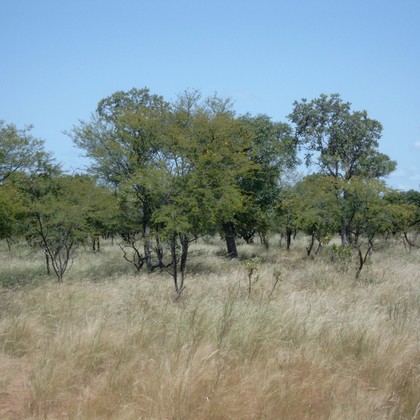
Dry thornveld, acacia and mopane woodland, Kalahari sandveld and broadleaved savanna. It forages largely on the ground on termites, grasshoppers, beetles, scorpions, seeds and small vertebrates, and locally follows dwarf mongooses to catch the insects they flush.
Where the bird is most at home, classified by the vegetation units of southern Africa.

Range and movements
Close to endemic in the region: Namibia, Botswana, Zimbabwe, northern and north-eastern South Africa, southern Angola, south-western Zambia and southern Mozambique. Absent from the Cape, the Karoo and the wet east coast. North of the Zambezi it is replaced by related hornbills.
- Resident
- Winter visitor (c. Apr–Sep)
- Passage (Mar–Apr, Oct–Nov)
- dark = core range, pale = thinly spread
How and when to look
Present all year in thornveld, and notably tame around the rest camps of Kruger, Etosha and the Kalahari. Listen in the early morning for the accelerating clucking series. In the breeding season, September to March, look for a tree cavity with a narrow vertical slit: the female seals herself in with mud and droppings and is fed by the male while she moults inside.
Conservation status
Not threatened and common across the dry interior. The species depends on large trees with natural cavities, so woodcutting and the removal of dead trees limit nest sites. In the Kalahari sustained high temperatures have been shown to reduce breeding success sharply.
Scientific name
Tockus leucomelas | (Lichtenstein, 1842)
Lichtenstein described the species in 1842 as Buceros leucomelas; because it was later moved to another genus, the author and year stand in brackets. The genus Tockus was introduced in 1830 by Lesson. Tockus is onomatopoeic, imitating the tocking, ticking sound of these hornbills' call. leucomelas comes from the Greek leukos, 'white', and melas, 'black' — for the black-and-white plumage. The specimen the first description was based on came from the Eastern Cape.