All species › Hoopoes and hornbills › Hornbills › Monteiro's Hornbill
Monteiro's Hornbill | Tockus monteiri
Monteiro's tok | Toco Angoleño
Monteiro's Hornbill is the largest small hornbill of the region, a near-endemic of the dry escarpment and rocky hills of Namibia and south-western Angola. With its heavy red bill and much white in wing and tail it is unmistakable in flight.

Voice
A series of deep, hoarse clucking notes, kok-kok-kok-kokkokkok, accelerating and swelling. While calling the bird bows its head towards the ground and raises its wings; pairs duet.
Recording: Bram Vogels — CC BY-NC-SA 4.0 · converted to mono · xeno-canto
Identification
About 56 cm. The bill is heavy, curved and red. Head and neck are grey-brown with fine pale streaks, the back and wings dark grey-brown with large round white spots on the coverts. The secondaries are largely white and form a conspicuous white panel in flight; the outer tail feathers are entirely white. The underparts are white. The bare skin around the eye is dark grey in the male and turquoise in the female; the female is smaller with a shorter bill.
Confusion species
Damara Red-Billed Hornbill (Tockus damarensis) is smaller, with a white head and dark crown, smaller white wing spots and no white outer tail feathers. Southern Red-Billed Hornbill (Tockus rufirostris) is smaller, has a yellow iris and occurs only in northern and eastern Namibia. Southern Yellow-Billed Hornbill (Tockus leucomelas) has a yellow bill.
Habitat
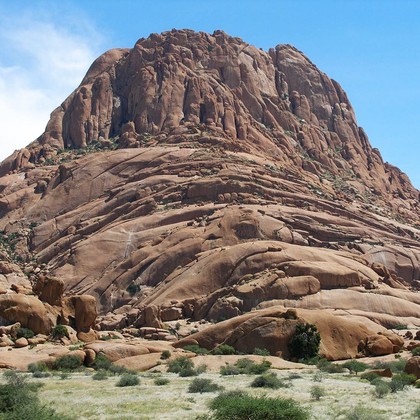
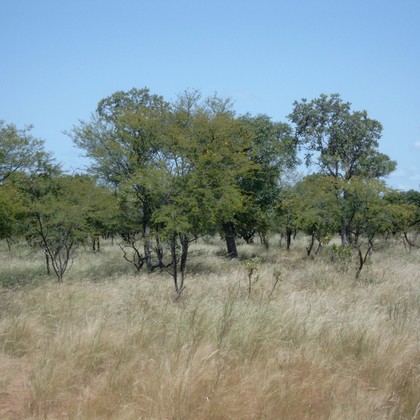
The driest habitat of any hornbill: rocky hills, gorges and the edge of the inland escarpment with scattered trees, dry riverbeds with acacias and open thornveld, into areas with less than 100 mm of rain a year. It forages mainly on the ground, digging with the bill for larvae, bulbs and seeds and catching insects and small reptiles. It nests in tree cavities but also in rock crevices.
Where the bird is most at home, classified by the vegetation units of southern Africa.

Range and movements
Near-endemic to the region: north-western and central Namibia, from the Kaokoveld and Damaraland through Erongo and the Khomas Hochland to around Rehoboth, and south-western Angola (Namibe, the Huíla escarpment and southern Benguela). Found nowhere else.
- Resident
- Winter visitor (c. Apr–Sep)
- dark = core range, pale = thinly spread
How and when to look
Easily seen all year in the Erongo Mountains, at Spitzkoppe, around the Waterberg and in the hills around Windhoek, and in the dry riverbeds of Damaraland. Birds often visit waterholes and feeding spots at lodges. In flight look for the white wing panel and white tail edges.
Conservation status
Not threatened; locally common within its small range. Because it also nests in rock crevices it depends less on large trees than related hornbills. Prolonged drought can reduce breeding success sharply.
Scientific name
Tockus monteiri | Hartlaub, 1865
Hartlaub described the species in 1865 and placed it straight away in the genus where it still stands. The genus Tockus was introduced in 1830 by Lesson. Tockus is onomatopoeic, imitating the tocking, ticking sound of these hornbills' call. monteiri honours the Portuguese mining engineer and naturalist Joachim John Monteiro (1833–1878), who collected in Angola. The specimen the first description was based on came from Benguela, Angola.