All species › Hoopoes and hornbills › Hornbills › Southern Red-Billed Hornbill
Southern Red-Billed Hornbill | Tockus rufirostris
Zuidelijke roodsnaveltok | Toco Piquirrojo Sureño
The Southern Red-Billed Hornbill is the small red-billed hornbill of mopane and thornveld, often the most numerous hornbill in the north-east of the region. It forages largely on the ground and is a familiar sight in the lowveld parks.

Voice
A long series of clucking notes, wa-wa-wa-wa-kok-kok-kok-kokok, accelerating and swelling. While calling the bird bows its head, but unlike related red-billed hornbills it does not raise its wings. Pairs duet.
Recording: Ehren Eksteen — CC BY-NC-SA 4.0 · converted to mono · xeno-canto
Identification
About 42 cm, with a slender, curved red bill; in the male the lower mandible is black at the base to a variable extent, in the female the bill is shorter and all red. The iris is yellow and the bare skin around the eye pink to grey. Crown and hindneck are dark grey, the face white with clear black streaking from the ear coverts to the side of the neck. The upperparts are blackish-brown with rows of white spots on the coverts and a white back stripe, the throat and underparts white.
Confusion species
Damara Red-Billed Hornbill (Tockus damarensis) of north-western Namibia has a dark iris and a white face with little or no streaking. Southern Yellow-Billed Hornbill (Tockus leucomelas) is larger with a yellow bill. Monteiro's Hornbill (Tockus monteiri) is larger, with a grey-brown head, a white wing panel and white outer tail feathers. Northern Red-Billed Hornbill (Tockus erythrorhynchus) occurs only north of the region.
Habitat
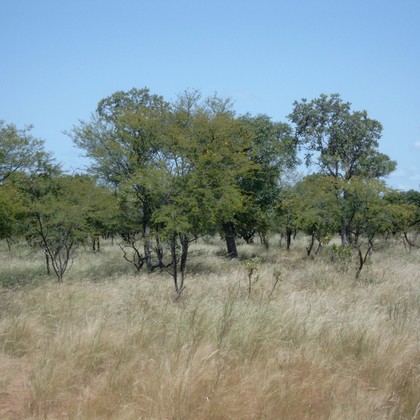
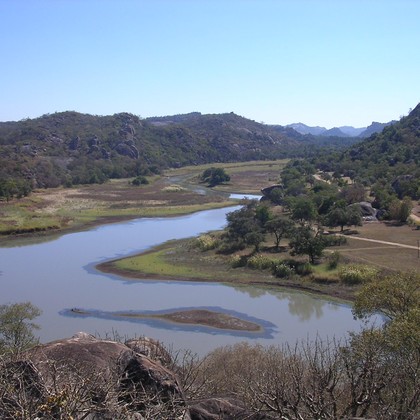
Mopane woodland, dry thornveld and open mixed woodland with bare ground beneath the trees, also around camps and villages. It forages mainly on the ground, probing sand and dung with the bill for termites, ant larvae, beetle larvae and grasshoppers. It nests in natural tree cavities, which the female seals.
Where the bird is most at home, classified by the vegetation units of southern Africa.

Range and movements
In the north and east of the region: northern and north-eastern Namibia, Botswana, Zimbabwe, southern Zambia and Malawi, southern Angola, Mozambique south of the Zambezi, the Eswatini lowveld and north-eastern South Africa (Limpopo, Mpumalanga and northern KwaZulu-Natal). Replaced in north-western Namibia by Damara Red-Billed Hornbill. Hardly found beyond; the range lies almost entirely within the region.
- Resident
- Summer visitor (c. Oct–Mar)
- Winter visitor (c. Apr–Sep)
- Passage (Mar–Apr, Oct–Nov)
- dark = core range, pale = thinly spread
How and when to look
Numerous all year in Kruger, especially in the northern mopane, and in the parks of Zimbabwe and Botswana. Watch for birds scratching about on bare ground around camp sites. In northern Namibia it pays to check the eye of every red-billed hornbill, since Damara Red-Billed Hornbill occurs nearby.
Conservation status
Not assessed separately by the IUCN; it is included in Red-Billed Hornbill in the broad sense (Tockus erythrorhynchus, Least Concern). Common in its range. It may decline locally through the felling of large nest trees and during prolonged drought, when breeding attempts fail.
Scientific name
Tockus rufirostris | (Sundevall, 1850)
Sundevall described the species in 1850 as Buceros rufirostris; because it was later moved to another genus, the author and year stand in brackets. The genus Tockus was introduced in 1830 by Lesson. Tockus is onomatopoeic, imitating the tocking, ticking sound of these hornbills' call. rufirostris is Latin for 'red-billed', from rufus, 'red', and rostrum, 'bill'. The specimen the first description was based on came from Not stated.