All species › Hoopoes and hornbills › Hornbills › Damara Red-Billed Hornbill
Damara Red-Billed Hornbill | Tockus damarensis
Damaratok | Toco de Damara
The Damara Red-Billed Hornbill is the red-billed hornbill of the arid north-west of Namibia and south-western Angola. It was long treated as a subspecies of the red-billed hornbill and is best identified by its white face and dark eye.

Voice
A fast series of clucking notes, kok-kok-kok-kokokokok, accelerating and swelling; while calling the bird bows its head and raises its wings, unlike Southern Red-Billed Hornbill.
Recording: Bram Vogels — CC BY-NC-SA 4.0 · converted to mono · xeno-canto
Identification
About 42 cm, with a slender, curved red bill; in the male the base of the lower mandible is dark. Head and face are largely white, with a dark grey crown and hindneck and little or no streaking on the ear coverts. The iris is dark brown. The upperparts are blackish-brown with rows of white spots on the coverts and a white back stripe, the underparts white. The tail is dark with white tips.
Confusion species
Southern Red-Billed Hornbill (Tockus rufirostris) has a yellow iris, pink to grey skin around the eye and clear black streaking from the ear coverts to the side of the neck. Around Etosha both species and intermediates occur. Monteiro's Hornbill (Tockus monteiri) is larger, with a grey-brown head, a white wing panel and white outer tail feathers.
Habitat
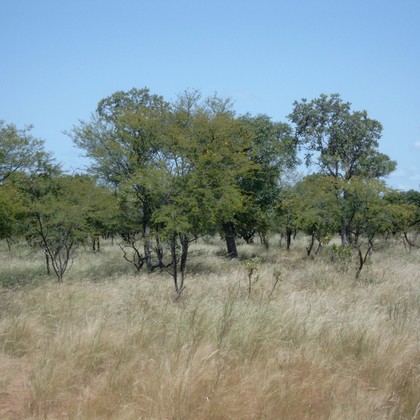
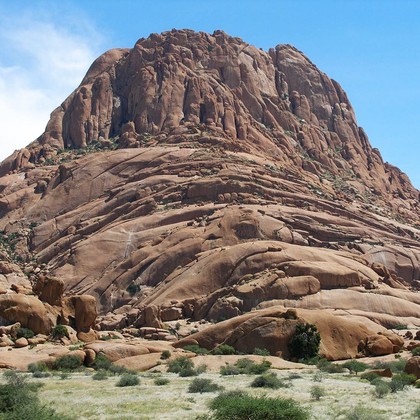
Dry, open thornveld and mopane scrub on sand or gravel, rocky hills and dry riverbeds with trees. It forages mainly on the ground for termites, ants, larvae and grasshoppers, and often accompanies parties of dwarf mongooses. It nests in tree cavities.
Where the bird is most at home, classified by the vegetation units of southern Africa.
Range and movements
Near-endemic to the region: north-western Namibia, from the Kaokoveld and Damaraland to the western edge of Etosha and the Erongo area, and south-western Angola (Namibe and the Huíla lowlands). To the east it meets and intergrades with Southern Red-Billed Hornbill.
- Resident
- Summer visitor (c. Oct–Mar)
- Winter visitor (c. Apr–Sep)
- Passage (Mar–Apr, Oct–Nov)
- dark = core range, pale = thinly spread
How and when to look
Easily seen in the mopane and thorn scrub of Damaraland and the Kaokoveld, and in western Etosha. Check the eye and face of every red-billed hornbill in Namibia: a dark eye and white face point to this species, a yellow eye and streaked ear coverts to Southern Red-Billed Hornbill.
Conservation status
Not threatened; fairly common within its limited range. It lives largely in sparsely populated dry country and faces little direct pressure, though prolonged drought can depress breeding sharply.
Scientific name
Tockus damarensis | (Shelley, 1888)
Shelley described the species in 1888 as Lophoceros damarensis; because it was later moved to another genus, the author and year stand in brackets. The genus Tockus was introduced in 1830 by Lesson. Tockus is onomatopoeic, imitating the tocking, ticking sound of these hornbills' call. damarensis refers to Damaraland in Namibia, where the first specimen was collected. The specimen the first description was based on came from Otjimbingwe, Namibia.