All species › Passerines › Sylvia warblers › African Hill Babbler
African Hill Babbler | Sylvia abyssinica
Afrikaanse grijskop | Curruca Abisinia
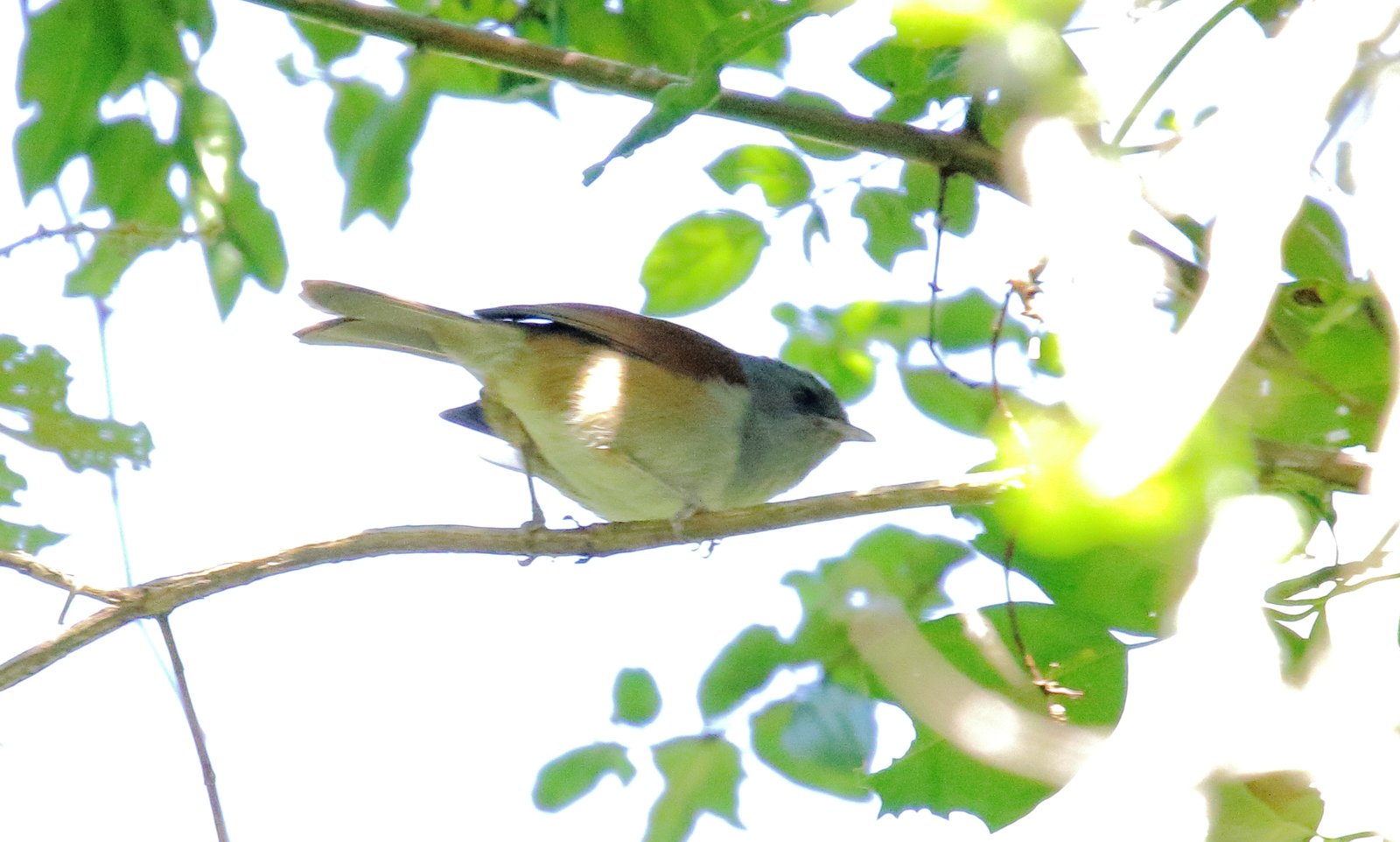
The African Hill Babbler is a skulking forest bird with a grey head and a rufous-brown back, which in the region occurs only in a few isolated montane forests: in western Angola and around the Nyika in northern Malawi and Zambia. Long regarded as a babbler, it has proved to be genetically related to the Sylvia warblers.
Voice
The song is a rich, melodious series of whistles in separate phrases with marked changes in pitch, reminiscent of a thrush or an oriole, chew-weedeloo…teeoo-choo. The bird often sings hidden in dense vegetation. The call is a rasping chrrr and a soft chatter.
Recording: He Wenjin/文进 — CC BY-NC-SA 4.0 · converted to mono · xeno-canto
Identification
13–15 cm, a compact, rather short-tailed bird. Head, nape and breast are grey; the throat is paler greyish-white, with fine grey streaks in the birds of Malawi and Mozambique. Back, wings and tail are warm rufous-brown and contrast clearly with the grey head. The belly is pale grey to whitish, the flanks and undertail-coverts olive-brown. The bill is dark, the eye reddish-brown, the legs grey. The sexes are alike. It lives in pairs close to the ground, hidden among creepers and undergrowth.
Confusion species
Evergreen Forest Warbler Bradypterus lopezi is uniformly dark brown with no grey head, has a long, often fanned tail and keeps even closer to the forest floor. White-Starred Robin Pogonocichla stellata is spotted in juvenile plumage and as an adult has a slate-grey head with small white spots and yellow underparts. Eurasian Blackcap Sylvia atricapilla, a scarce winter visitor to the same forests, is greyer above and has a sharply defined black or red-brown cap. The species is best distinguished by its rich, thrush-like song.
Habitat
Montane evergreen forest, especially the undergrowth of forest edges, clearings, wooded ravines and secondary forest with creepers and scrub, mostly above 1500 m. It forages up to a few metres above the ground for insects and also eats berries.
Where the bird is most at home, classified by the vegetation units of southern Africa.

Range and movements
In Angola in the montane forests of the western highlands, notably the Namba Mountains and Atome in Cuanza Sul and Mount Moco in Huambo, south to Huíla. In Malawi in the north, mainly on the Nyika and at Uzumara; in Zambia only on the Zambian side of the Nyika; in Mozambique on the Njesi Plateau in Niassa. Beyond the region in the highlands of East and Central Africa, from Tanzania and Kenya to Ethiopia and the Albertine Rift, and on Mount Cameroon and Bioko.
- Resident
- Passage (Mar–Apr, Oct–Nov)
- dark = core range, pale = thinly spread
How and when to look
All year. The forest patches around Chelinda and the Zovo Chipolo and Manyanjere forests on the Nyika, and Mount Moco in Angola, are the best sites. Listen in the early morning for the rich, thrush-like song at the forest edge and wait patiently: the bird usually shows only briefly among the creepers.
Conservation status
Not threatened; the IUCN lists it under the older name Pseudoalcippe abyssinica. It has a large range in East Africa, but in the region it is confined to a few small, isolated montane forests; on Mount Moco in Angola in particular the remaining forest is under heavy pressure from cutting and fire.
Scientific name
Sylvia abyssinica | (Rüppell, 1840)
Rüppell described the species in 1840 as Drymophila abyssinica; because it was later moved to another genus, the author and year stand in brackets. The genus Sylvia was introduced in 1769 by Scopoli. Sylvia is Modern Latin silvia, a woodland nymph, related to silva 'wood'; the name passed to small songbirds of scrub and undergrowth. abyssinica is Latin for 'of Abyssinia', the old name for Ethiopia, where the species was discovered. The specimen the first description was based on came from Simien Mountains, northern Ethiopia.