All species › Passerines › Sylvia warblers › Bush Blackcap
Bush Blackcap | Sylvia nigricapillus
Kaapse zwartkop | Curruca Sudafricana
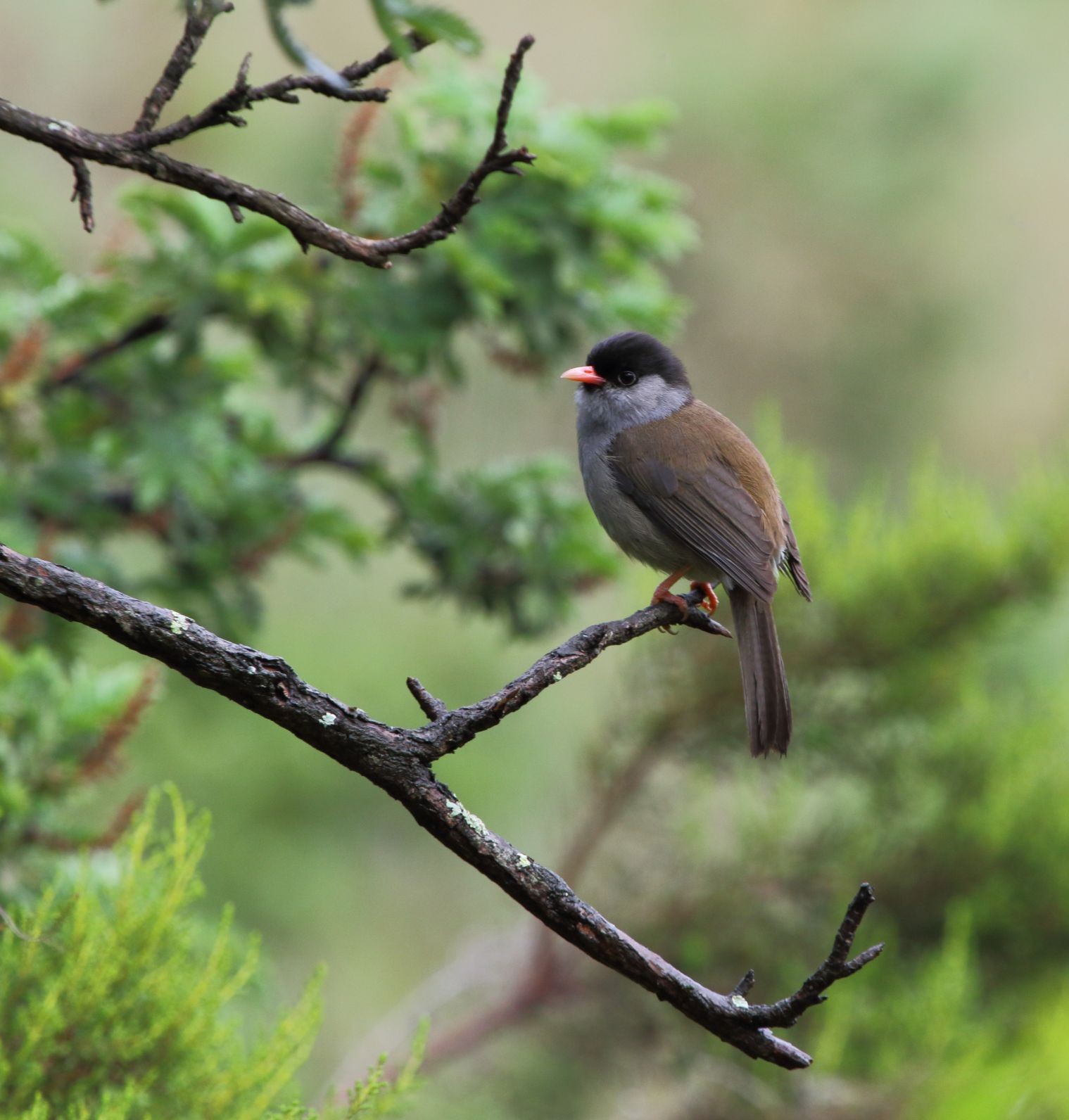
The Bush Blackcap is a large grey forest bird with a black cap and a pink bill, found only in the montane forests of eastern South Africa and in Eswatini. It was long placed with the bulbuls or the babblers, but is a relative of the Eurasian Sylvia warblers.
Voice
The song is a rich, melodious and varied series of whistles and warbling phrases, reminiscent of a bulbul or a thrush, often with mimicry, choo-chiweloo-cheewee. It sings mainly in spring and summer, from September to January, often from cover. It also gives a rattling chrrr and a soft chik.
Recording: Raphaël Nussbaumer — CC BY-NC-SA 4.0 · converted to mono · xeno-canto
Identification
16–18 cm. The crown and the head to below the eye are black, forming a sharply defined cap. Throat and cheeks are pale grey to greyish-white, the upperparts plain slate-grey, the underparts pale grey with a white belly. The bill is conspicuously pink to coral-red, the legs pink and the eye dark. The sexes are alike. Juveniles have a brownish-black cap and a duller, brownish bill. It moves quietly and rather sluggishly through the mid-stratum and canopy and often stays long in one fruiting tree.
Confusion species
Common Bulbul Pycnonotus barbatus has a brownish-black crested head, a black bill, brown upperparts and yellow undertail-coverts. Eurasian Blackcap Sylvia atricapilla, a rare vagrant to the region, is much smaller, with a grey bill and a cap that does not reach below the eye. Chestnut-Vented Warbler Curruca subcoerulea is smaller and slimmer, with a pale eye, a streaked throat and a rufous vent, and lives in dry scrub.
Habitat
Edges and clearings of montane evergreen forest, wooded ravines, riverine forest in mountain valleys and bramble scrub near forest, mostly between 900 and 2000 m. In winter some birds move down to lower-lying forest and thicket. It eats mainly fruit and berries, with insects.
Where the bird is most at home, classified by the vegetation units of southern Africa.

Range and movements
Only in South Africa and Eswatini. In the Eastern Cape in the Amatola Mountains (Hogsback) and the forested slopes of the former Transkei; in KwaZulu-Natal in the forests of the Midlands and the Drakensberg foothills, such as Karkloof; in Mpumalanga along the eastern escarpment; in Limpopo in the forests of Magoebaskloof, Woodbush and the Wolkberg and in the Soutpansberg; in Eswatini in the north-western highlands. The species does not occur outside the region.
- Resident
- Summer visitor (c. Oct–Mar)
- dark = core range, pale = thinly spread
How and when to look
All year, best in spring (October–December) when the bird is singing. Magoebaskloof and Woodbush, Hogsback and Karkloof are reliable sites. Wait at a fruiting tree at the forest edge: the bird can sit feeding quietly and half hidden for a long time, and is then recognised by the pink bill sooner than by the black cap.
Conservation status
Vulnerable. The population is small and fragmented across isolated montane forests and is declining through logging, fire, overgrazing of forest edges and the expansion of plantation forestry. In well-protected forests, such as at Magoebaskloof and in the Amatolas, the species is still fairly common locally.
Scientific name
Sylvia nigricapillus | (Vieillot, 1818)
Vieillot described the species in 1818 as Turdus nigricapillus; because it was later moved to another genus, the author and year stand in brackets. The genus Sylvia was introduced in 1769 by Scopoli. Sylvia is Modern Latin silvia, a woodland nymph, related to silva 'wood'; the name passed to small songbirds of scrub and undergrowth. nigricapillus is Latin for 'black-capped', from niger, 'black', and capillus, 'hair of the head' — for the Bush Blackcap's black head. The specimen the first description was based on came from Bruintjies Hoogte near Somerset East, Eastern Cape, South Africa.