All species › Passerines › Thrushes › Spotted Ground Thrush
Spotted Ground Thrush | Geokichla guttata
Natallijster | Zorzal Moteado
The Spotted Ground Thrush is a shy, boldly patterned ground thrush of coastal and lowland forest, working quietly through the leaf litter. It is one of the most sought-after forest birds of eastern South Africa and a globally threatened species.
Voice
The song is a soft, melodious series of short, clear whistled phrases with pauses, sometimes including mimicry, usually given from a mid-level branch at dusk or dawn. The call is a thin, high tsee and a soft chuk.
Recording: Gareth K. — CC BY-NC-SA 4.0 · converted to mono · xeno-canto
Identification
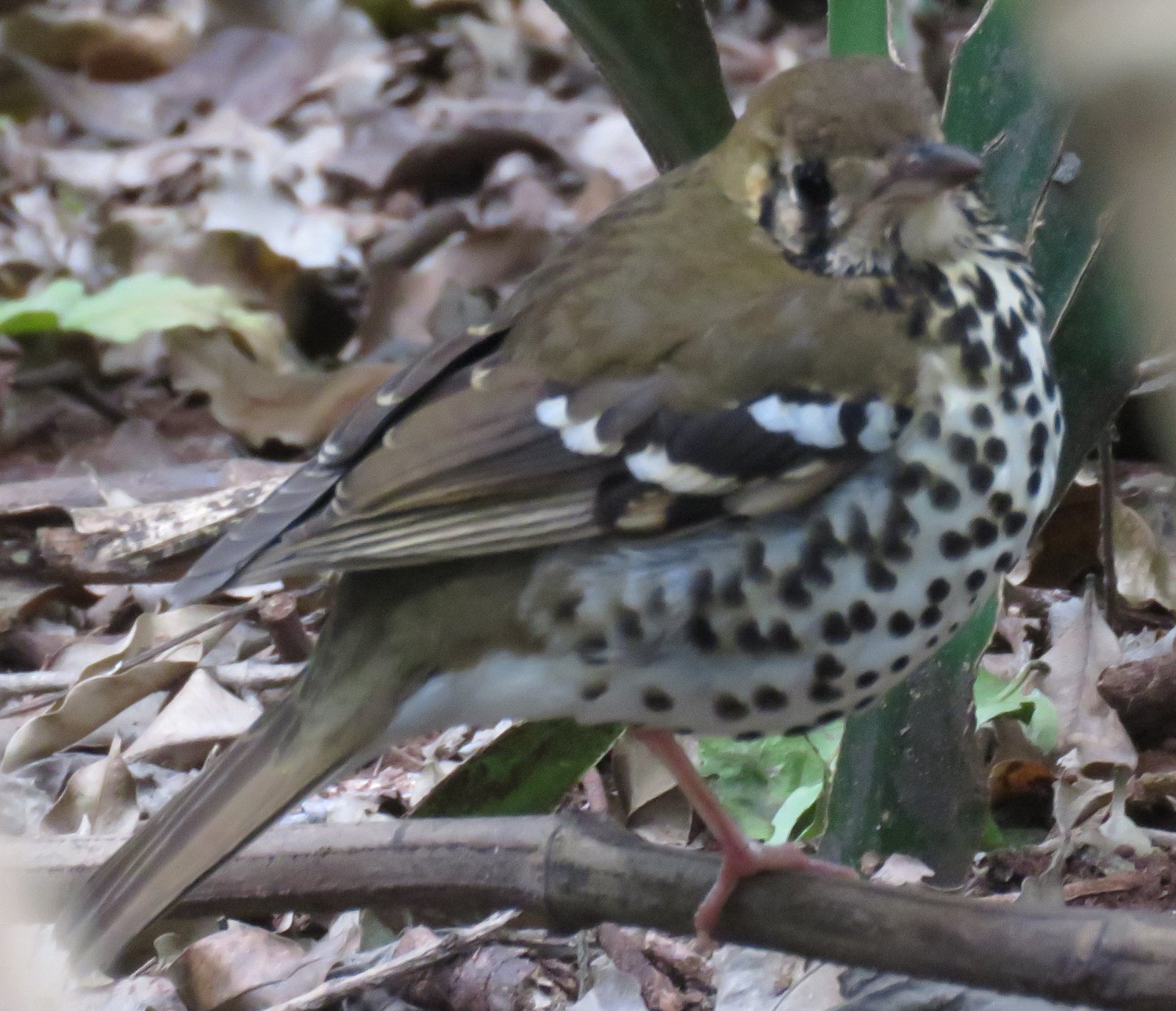
22–23 cm. Upperparts olive-brown, the wings darker with two conspicuous rows of white tips to the coverts. The underparts are white with round black spots on breast and flanks. The head is strongly marked: white face with a vertical black bar through the eye, a black bar behind the ear coverts and a black malar stripe. In flight the underwing shows a black-and-white band. Bill dark with a pale base to the lower mandible, legs pinkish. The sexes are alike. Juveniles are browner with pale streaks on the upperparts.
Confusion species
Groundscraper Thrush (Turdus litsitsirupa) has similarly spotted underparts and face pattern, but is larger, grey-brown without white wing bars, stands upright in open savanna and shows rufous wings in flight. Orange Ground Thrush (Geokichla gurneyi) also has white wing bars but a plain orange throat and breast without spots. Kurrichane Thrush (Turdus libonyana) has only black malar stripes, orange flanks and an orange bill.
Habitat
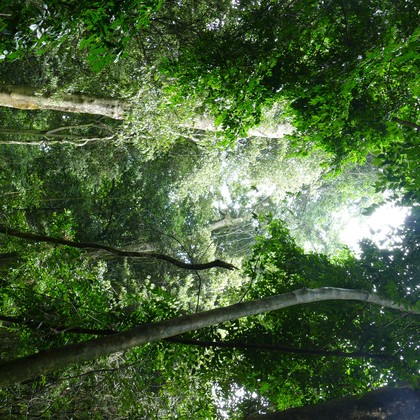
The floor of undisturbed coastal, sand and lowland forest with a deep leaf layer and sparse undergrowth; in Malawi and Mozambique also mid-altitude and montane forest. Forages on the ground by flicking over leaves for insects, snails and worms. The nest is in a tree fork a few metres up.
Where the bird is most at home, classified by the vegetation units of southern Africa.

Range and movements
In South Africa it breeds in the coastal and lowland forests of the Eastern Cape (roughly East London to Pondoland) and southern KwaZulu-Natal; in winter many birds move to the coastal forests of KwaZulu-Natal north to Zululand. A separate population lives in southern Malawi and adjacent Mozambique, with scattered records from central Mozambique. Beyond the region, isolated populations in the coastal forests of Kenya and Tanzania and in South Sudan and eastern DR Congo.
- Resident
- dark = core range, pale = thinly spread
How and when to look
In winter (May–September) the coastal forests in and around Durban are the best bet, for example Pigeon Valley and the Umhlanga forests; in summer try the Dwesa-Cwebe and Mkambati area in the Eastern Cape. Walk very slowly along forest paths and listen for the rustle of turned leaves; the bird often freezes and is then hard to see despite its pattern.
Conservation status
Vulnerable. The population is small and fragmented and is declining through loss of coastal and lowland forest to development, agriculture, logging and tourism. In South Africa the remaining forest patches in urban areas are important wintering sites.
Scientific name
Geokichla guttata | (Vigors, 1831)
Vigors described the species in 1831 as Turdus guttatus; because it was later moved to another genus, the author and year stand in brackets. The genus Geokichla was introduced in 1836 by Müller. Geokichla combines the Greek gē, 'earth, ground', with kikhlē, 'thrush' — 'ground thrush', for the habit of foraging on the forest floor. guttata is Latin for 'spotted, speckled' — for the round black spots on the breast and flanks. The specimen the first description was based on came from Durban, KwaZulu-Natal, South Africa.