All species › Falcons › Falcons › African Hobby
African Hobby | Falco cuvierii
Afrikaanse boomvalk | Alcotán Africano
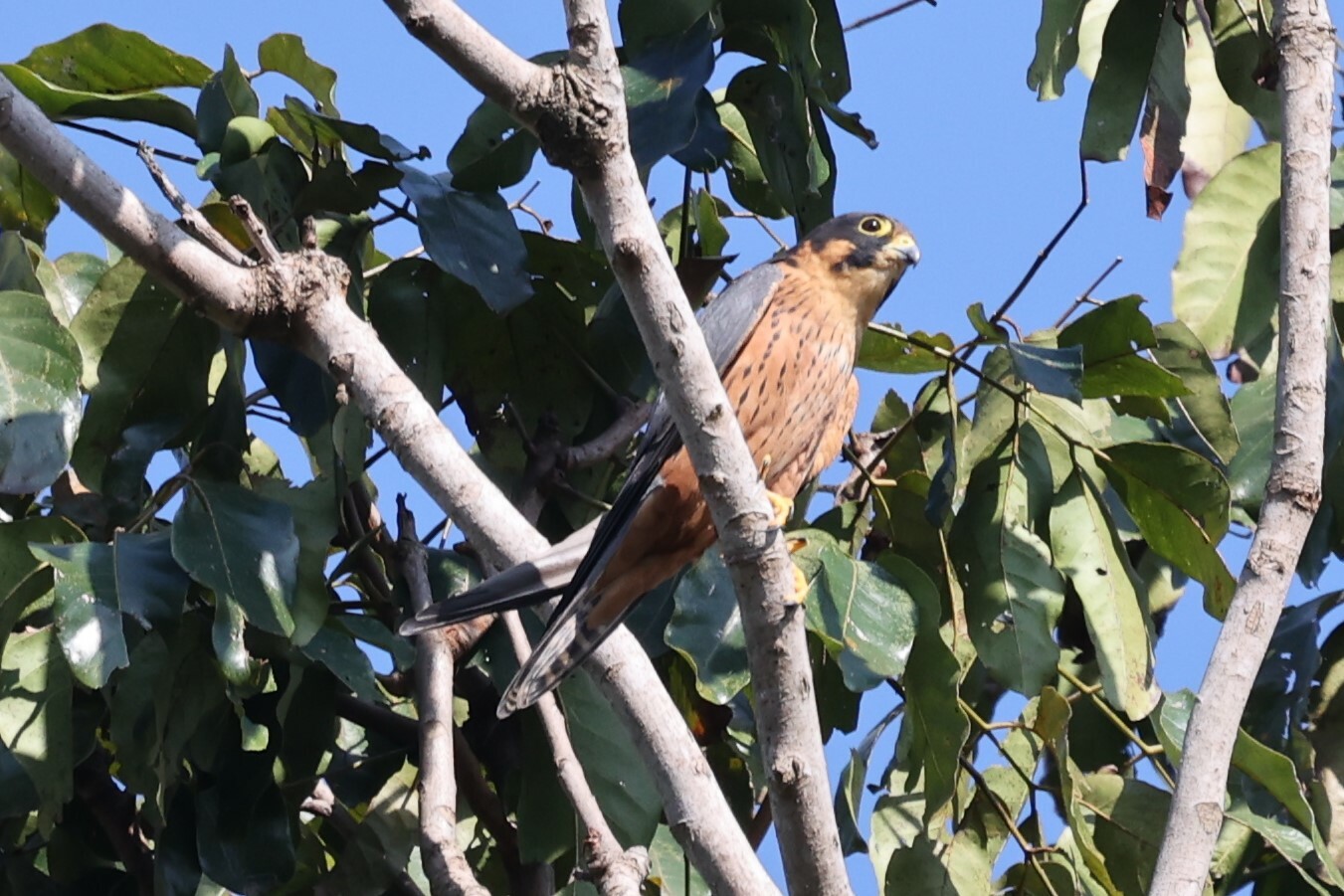
The African Hobby is a small, dark falcon with deep rufous underparts, a fast aerial hunter of insects, birds and bats. In southern Africa it is mainly a bird of the moist woodlands of the north, and everywhere unobtrusive and scarce.
Voice
A high, rapid kee-kee-kee-kee and a high kew, mainly around the nest and when hunting at dusk.
Recording: Paul Lenrumé — CC BY-NC-SA 4.0 · converted to mono · xeno-canto
Identification
About 28 cm, compact with long, pointed wings and a fairly short tail. The upperparts are dark slate to blackish, the head darker with a broad black moustache. Throat and cheeks are pale rufous, the rest of the underparts deep rufous with fine black shaft streaks. The underwing is rufous and finely barred. Cere, eye-ring and legs are yellow. The juvenile is browner above and more heavily streaked below.
Confusion species
Eurasian Hobby (Falco subbuteo) has white cheeks and a white, heavily streaked breast, with rufous only on the trousers. Taita Falcon (Falco fasciinucha) is stockier, with a white throat, rufous nape patches and a greyer back, and is tied to cliffs. Lanner Falcon (Falco biarmicus) is much larger, with a rufous crown and pale underparts.
Habitat
Moist open woodland and miombo, riverine forest, forest edges and well-wooded towns and villages, often near water. It hunts mainly at dawn and dusk in fast, agile flight for flying termites and other insects, swallows, swifts and bats. It breeds in the dry season (August to November) in old nests of crows and raptors, or in a palm.
Where the bird is most at home, classified by the vegetation units of southern Africa.



Range and movements
In the region mainly in Angola, Zambia, Malawi and northern Mozambique; scarce in Zimbabwe and northern Botswana, and a rare summer visitor to north-eastern South Africa (Limpopo, Mpumalanga, KwaZulu-Natal). Elsewhere widespread in sub-Saharan Africa, from Senegal to Ethiopia.
- Summer visitor (c. Oct–Mar)
- Passage (Mar–Apr, Oct–Nov)
- dark = core range, pale = thinly spread
How and when to look
At dusk over riverine forest and villages in Zambia or Malawi, look for a dark falcon hunting among swarms of termites and swifts. With a perched bird, use the rufous cheek and throat to separate it from Eurasian Hobby.
Conservation status
Not threatened, but scarce and poorly known at the southern edge of its range. The species adapts well to well-wooded settlements; insecticide use may locally affect prey availability.
Scientific name
Falco cuvierii | Smith, 1830
Smith described the species in 1830 and placed it straight away in the genus where it still stands. The genus Falco was introduced in 1758 by Linnaeus. Falco is the Latin word for 'falcon', possibly related to falx, 'sickle', for the curved shape of the claws or wings. cuvierii honours the French naturalist Georges Cuvier (1769–1832), founder of comparative anatomy. The specimen the first description was based on came from South Africa (not specified).