All species › Passerines › Monarch flycatchers › African Paradise Flycatcher
African Paradise Flycatcher | Terpsiphone viridis
Afrikaanse paradijsmonarch | Monarca Colilargo Africano
The African Paradise Flycatcher is a small, restless bird with a blue-black head and a rufous back, but the male is above all conspicuous for the long, ribbon-like central tail feathers that ripple behind it at every hop. It is one of the most widespread and familiar woodland birds of the region, and across much of the interior a herald of summer.

Voice
The call is a rasping, scolding zweet-zweet or shwee-shwee, often the first sign of its presence. The song is a rapid, cheerful series of clear notes, twee-tiddle-ee-tee-tee, heard mostly in the breeding season.
Recording: Tim Cockcroft — CC BY-NC-SA 4.0 · converted to mono · xeno-canto
Identification
17–41 cm; the body measures 17–20 cm, and the breeding male adds tail streamers of up to about 20 cm. Head, short crest and throat are glossy blue-black, with a bare cobalt-blue eye-ring and a blue bill. Back, wings and tail are warm rufous, the breast and belly slate-grey, paler towards the undertail coverts. The female is duller, with a shorter crest, a narrower eye-ring and no elongated tail feathers. Outside the breeding season the male often loses the streamers. A white morph, with white back and tail, is rare in the region and mostly seen in the north-east. The bird is constantly on the move and fans its tail.
Confusion species
Blue-Mantled Crested Flycatcher Trochocercus cyanomelas has a similar crest and blue eye-ring but is grey above and white below, with no rufous and no tail streamers. In northern Angola, Red-Bellied Paradise Flycatcher Terpsiphone rufiventer, with rufous-orange underparts, Rufous-Vented Paradise Flycatcher Terpsiphone rufocinerea, with rufous undertail coverts, and Bates's Paradise Flycatcher Terpsiphone batesi, with grey underparts and usually a short tail, occur; where they meet, intermediate birds are found too.
Habitat
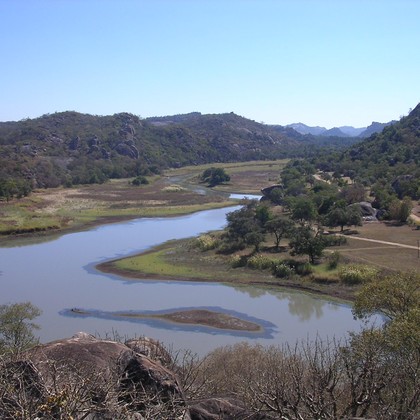
Riverine forest, forest edge, open woodland with tall trees, coastal forest, and also gardens, parks and plantations in towns. In dry country it is tied to rivers with tall trees. It hawks flying insects from a perch in the middle and lower levels of the canopy. The nest is a small cup bound with cobweb on a thin horizontal twig, often over water.
Where the bird is most at home, classified by the vegetation units of southern Africa.


Range and movements
Widespread in Angola, Zambia, Malawi, Mozambique and Zimbabwe, in northern and eastern Botswana and in northern and north-eastern Namibia (Kavango and the Zambezi Region). In South Africa and Eswatini mainly in the east and north, along the coast to the Eastern Cape and along wooded rivers into the Western Cape; absent from the arid Karoo, the Kalahari and the Namib. Beyond the region it occurs across almost all of sub-Saharan Africa and in south-western Arabia.
- Resident
- Summer visitor (c. Oct–Mar)
- Winter visitor (c. Apr–Sep)
- Passage (Mar–Apr, Oct–Nov)
- dark = core range, pale = thinly spread
How and when to look
Best from October to March, when males carry full tail streamers and sing loudly. Listen for the scolding call in riverine forest or a well-wooded garden; the nest over a stream or pond can often be watched at close range without disturbing the birds.
Conservation status
Not threatened; common and in many districts increasing thanks to tree planting in gardens and towns. No large-scale threats are known.
Scientific name
Terpsiphone viridis | (Müller, 1776)
Müller described the species in 1776 as Muscicapa viridis; because it was later moved to another genus, the author and year stand in brackets. The genus Terpsiphone was introduced in 1827 by Gloger. Terpsiphone comes from the Greek terpsis, 'delight', and phōnē, 'voice' — for the pleasant song of paradise flycatchers. viridis is Latin for 'green' — for the blue-green metallic gloss on head and breast. The specimen the first description was based on came from Senegal.