All species › Passerines › Monarch flycatchers › Bates's Paradise Flycatcher
Bates's Paradise Flycatcher | Terpsiphone batesi
Bates' paradijsmonarch | Monarca Colilargo de Bates
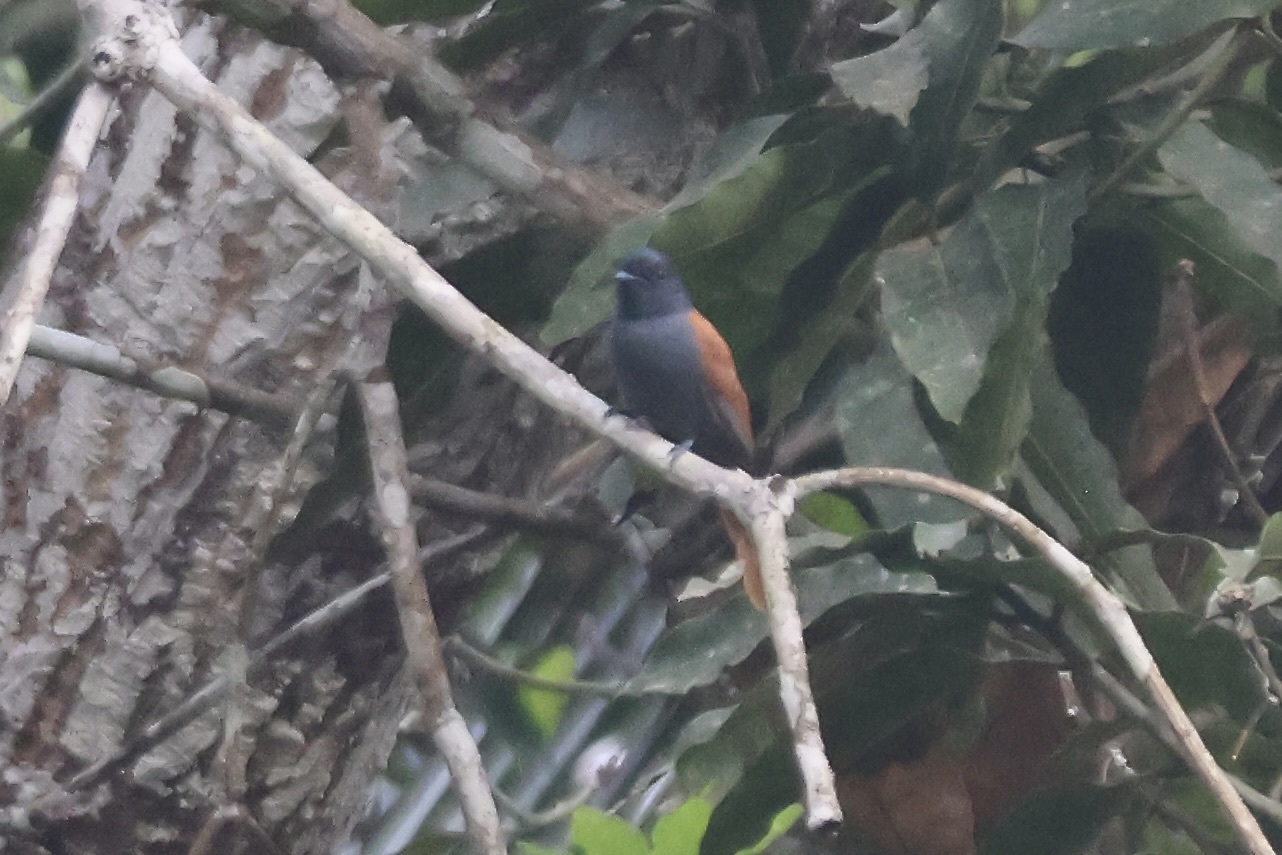
Bates's Paradise Flycatcher is a paradise flycatcher of the Central African rainforests that reaches the region only in northern Angola. It combines a rufous back with a grey head and underparts, and lacks the prominent crest of its relatives. For a long time it was treated as a subspecies of Red-Bellied Paradise Flycatcher.
Voice
A scolding, rasping chwee-chwee, similar to that of related paradise flycatchers, and a short, clear series of whistles as song.
Recording: Bram Piot — CC BY-NC-SA 4.0 · converted to mono · xeno-canto
Identification
18–28 cm; about 18 cm without tail extensions, males with elongated central tail feathers up to 28 cm. In Angola males often carry such streamers, but they are shorter than in African Paradise Flycatcher. The head is dark slate-grey with a blue gloss, with no crest or only a very short one, and a narrow blue eye-ring. Throat, breast and belly are blue-grey, the undertail coverts grey. Back, wings and tail are bright rufous. The sexes are similar; the female is slightly duller and always short-tailed.
Confusion species
Rufous-Vented Paradise Flycatcher Terpsiphone rufocinerea has a darker, glossy black head with a distinct crest, rufous undertail coverts and, in the male, always elongated tail feathers. Red-Bellied Paradise Flycatcher Terpsiphone rufiventer is rufous-orange below. African Paradise Flycatcher Terpsiphone viridis has a black crested head, grey breast and broad blue eye-ring, and lives more in open woodland and riverine forest. Where these species occur together, intermediates are reported; a safe identification then needs a good view of the head, undertail coverts and tail.
Habitat
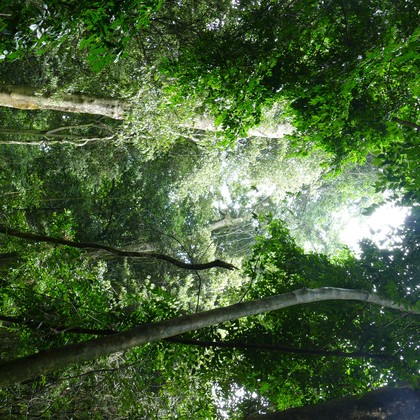
The understorey and mid-canopy of humid lowland forest and gallery forest, also old secondary forest and forest edge. It hawks flying insects from a perch and often joins mixed-species foraging flocks.
Where the bird is most at home, classified by the vegetation units of southern Africa.

Range and movements
In the region only in north-western and northern Angola (subspecies bannermani), in rainforest and gallery forest. Beyond the region from Cameroon and south-western Central African Republic through Equatorial Guinea, Gabon and Congo-Brazzaville to much of the Democratic Republic of the Congo.
- Resident
- dark = core range, pale = thinly spread
How and when to look
Year-round. In the forests of northern Angola, look for mixed flocks in the mid-canopy and listen for the scolding call. With every rufous paradise flycatcher, check the colour of the belly and undertail coverts and the crest.
Conservation status
Not threatened; widespread in the Central African forest zone. In Angola its habitat is shrinking through deforestation, but the overall population is not considered threatened.
Scientific name
Terpsiphone batesi | Chapin, 1921
Chapin described the species in 1921 and placed it straight away in the genus where it still stands. The genus Terpsiphone was introduced in 1827 by Gloger. Terpsiphone comes from the Greek terpsis, 'delight', and phōnē, 'voice' — for the pleasant song of paradise flycatchers. batesi honours the American naturalist and collector George Latimer Bates (1863–1940), who worked for many years in Cameroon. The specimen the first description was based on came from Medje, Ituri, DR Congo.