All species › Passerines › Monarch flycatchers › Blue-Headed Crested Flycatcher
Blue-Headed Crested Flycatcher | Trochocercus nitens
Blauwkopkuifmonarch | Monarca Brillante
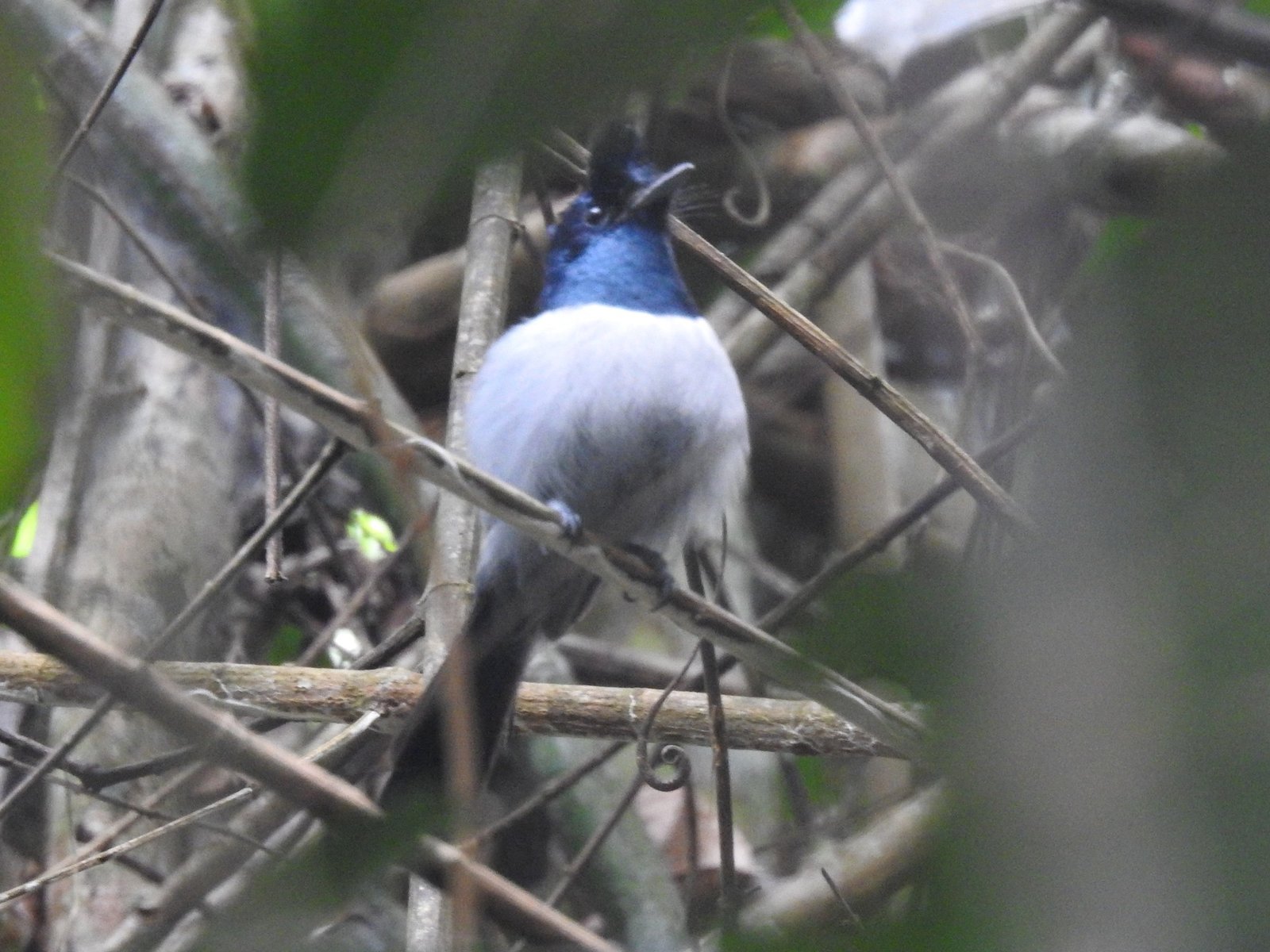
The Blue-Headed Crested Flycatcher is a slate-grey monarch with a glossy blue-black head and a short crest that lives in the understorey of the Central African rainforest. In our region it only occurs in northern Angola, where its restless movements and fanned tail are part of mixed bird parties.
Voice
A fast, descending series of clear whistles, wee-wee-wee-wooo, and a rasping, nasal scold, chwee-chwee or zwaa, which is often the first sign that the bird is nearby.
Recording: Rod Cassidy — CC BY-NC-SA 4.0 · converted to mono · xeno-canto
Identification
17–18 cm, slender with a fairly long tail. The male has the head, crest, throat and breast glossy blue-black, sharply demarcated from the slate-grey back and the pale grey belly; wings and tail are dark greyish-black. A narrow blue eye-ring is visible at close range. The female has a smaller, glossy black cap but a grey throat and breast, so the black is confined to the crown and face. Juveniles are duller and browner grey. It moves quickly and jerkily, fans its tail and droops its wings.
Confusion species
The female African Paradise Flycatcher Terpsiphone viridis has a rufous back and tail. White-Tailed Blue Flycatcher Elminia albicauda is smaller, pale blue with much white in the tail, and lives in woodland and gallery forest in the highlands. Ashy Flycatcher Fraseria caerulescens lacks a crest and a black head and sits more quietly. Blue-Mantled Crested Flycatcher Trochocercus cyanomelas, which does not occur in Angola, has a white belly and a white wing bar.
Habitat
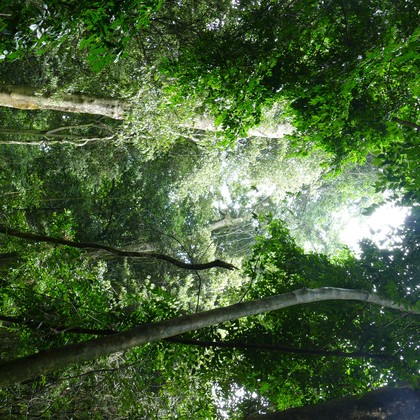
The lower and middle strata of humid lowland and lower montane forest, primary and secondary, gallery forest along rivers and dense growth in shady ravines. It searches actively among the leaves for small insects and catches them in short flights; it often moves with mixed bird parties.
Where the bird is most at home, classified by the vegetation units of southern Africa.

Range and movements
Within the region only in northern Angola: in Cabinda, the forests of the north-western interior and the escarpment forests. Outside the region from Guinea and Sierra Leone east through the West and Central African rainforest to South Sudan, Uganda and extreme north-western Tanzania.
- Resident
- dark = core range, pale = thinly spread
How and when to look
Year-round in the forests of northern Angola. Listen in the understorey for the rasping scold and wait at a mixed bird party; the bird stays low and moves fast, but often returns to the same spot.
Conservation status
Not threatened; widespread and locally common in the Central African rainforest. In Angola the species is tied to the remaining lowland and escarpment forest, which is being fragmented by logging and farming.
Scientific name
Trochocercus nitens | Cassin, 1859
Cassin described the species in 1859 and placed it straight away in the genus where it still stands. The genus Trochocercus was introduced in 1851 by Cabanis. Trochocercus comes from the Greek trokhos, 'round, circular', and kerkos, 'tail' — literally 'round-tail'. nitens is Latin for 'shining', for the male's glossy blue-black head. The specimen the first description was based on came from Sette Cama, Gabon.