All species › Passerines › Monarch flycatchers › Blue-Mantled Crested Flycatcher
Blue-Mantled Crested Flycatcher | Trochocercus cyanomelas
Kaapse kuifmonarch | Monarca Morado Meridional
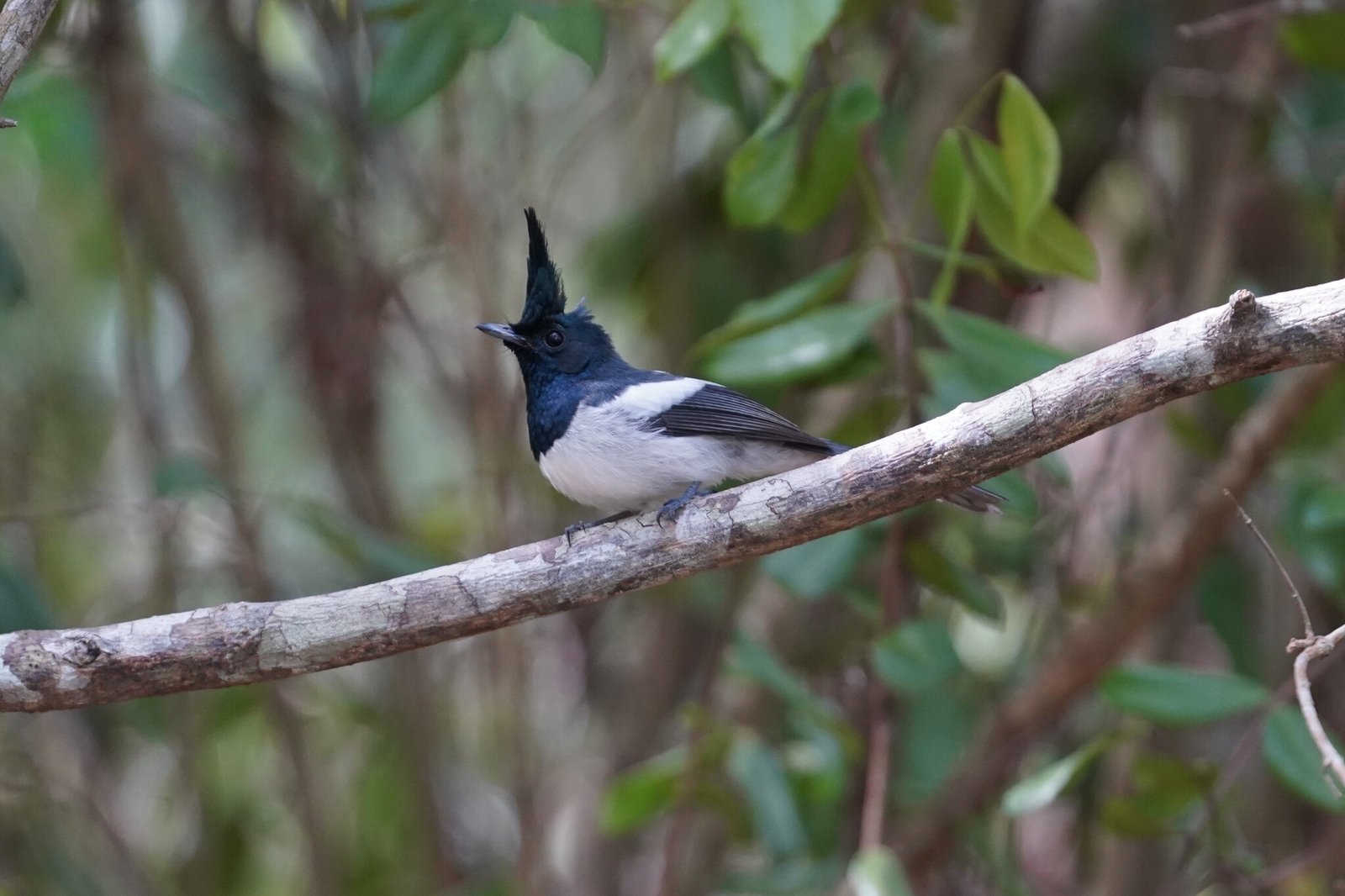
The Blue-Mantled Crested Flycatcher is a small, lively forest bird with a glossy black head and crest, a blue-grey back and a white belly. It moves restlessly through the understorey, constantly fanning its tail, and gives a sharp, rasping scold that is a familiar sound of indigenous forest along the east coast.
Voice
A sharp, rasping zwee-zwaa or chwee-chwaa, often repeated, and as song a series of clear, descending whistles, wee-wee-wee-woo. The scold is often the best clue for finding the species in the understorey.
Recording: Walter Wallner — CC BY-NC-SA 4.0 · converted to mono · xeno-canto
Identification
17–18 cm, slender with a long, graduated tail. The male has the head, crest and throat glossy blue-black; the back and scapulars are blue-grey, the wings dark with a narrow white wing bar, and the belly and undertail coverts bright white. The tail is dark slate-grey. The female has a grey head with a darker crown and crest, a grey throat and breast and a white belly, also with the white wing bar. Juveniles resemble the female but are browner. It often hangs in the foliage with drooped wings and raised crest.
Confusion species
The female African Paradise Flycatcher Terpsiphone viridis has a rufous back and tail and grey underparts. White-Tailed Crested Flycatcher Elminia albonotata of the montane forests of Zimbabwe and Malawi is grey with much white in the tail and a white belly without a black throat. Cape Batis Batis capensis is smaller, with a short tail, a yellow eye and a breast band. In northern Angola, Blue-Headed Crested Flycatcher Trochocercus nitens replaces this species; it has a grey belly.
Habitat
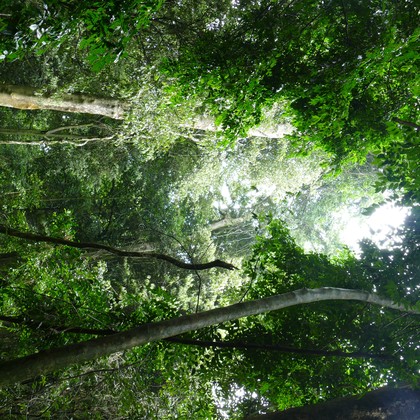
The lower and middle strata of indigenous forest: Afromontane forest, mistbelt forest, evergreen coastal and dune forest, riverine forest and dense growth in ravines. It searches actively for small insects among the leaves and catches them in short flights. In winter some move to lower forest and the coast, and the species then readily joins mixed bird parties.
Where the bird is most at home, classified by the vegetation units of southern Africa.


Range and movements
In South Africa from the forests of the Garden Route in the Western Cape east through the Eastern Cape, KwaZulu-Natal and Eswatini to the escarpment forests of Mpumalanga and Limpopo; further in eastern Zimbabwe (Nyanga, Vumba, Chimanimani), in forest and coastal areas of Mozambique, in the montane forests of Malawi and north-eastern Zambia. Outside the region north through Tanzania to Kenya and southern Somalia.
- Resident
- Summer visitor (c. Oct–Mar)
- Winter visitor (c. Apr–Sep)
- Passage (Mar–Apr, Oct–Nov)
- dark = core range, pale = thinly spread
How and when to look
Year-round in forests such as Knysna, Karkloof, Dlinza or the Vumba. Listen for the rasping scold and look low in the understorey for a bird with a fanned tail; it often responds inquisitively to soft pishing. In winter it is also found in the coastal forests of KwaZulu-Natal.
Conservation status
Not threatened and fairly common in suitable forest. The species depends on indigenous forest with a well-developed understorey and disappears where this is cleared or replaced by plantations; fragmentation of small forest patches is a local risk.
Scientific name
Trochocercus cyanomelas | (Vieillot, 1818)
Vieillot described the species in 1818 as Muscicapa cyanomelas; because it was later moved to another genus, the author and year stand in brackets. The genus Trochocercus was introduced in 1851 by Cabanis. Trochocercus comes from the Greek trokhos, 'round, circular', and kerkos, 'tail' — literally 'round-tail'. cyanomelas comes from the Greek kuanos, 'dark blue', and melas, 'black' — for the blue-black head and crest. The specimen the first description was based on came from Knysna district, Western Cape, South Africa.