All species › Woodpeckers and allies › Woodpeckers › African Piculet
African Piculet | Verreauxia africana
Afrikaanse dwergspecht | Carpinterito Africano
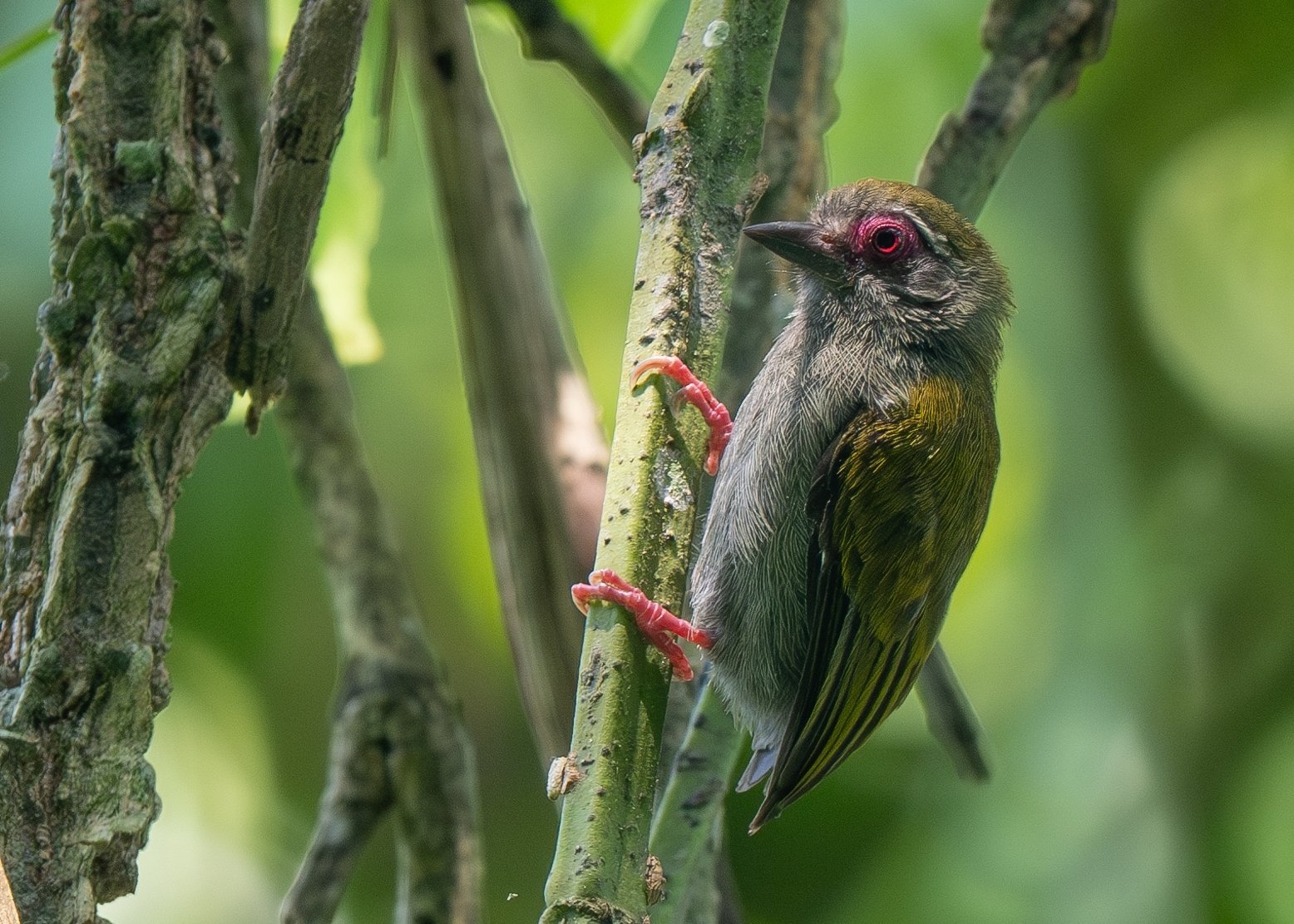
The African Piculet, weighing less than ten grams, is the smallest woodpecker in Africa. It belongs to the equatorial rainforest and within the region occurs only in northern Angola, where it creeps like a mouse through dense tangles and creepers.
Voice
A very high, thin, rapid trill, tseeseeseeseesee, and sharp tseet calls, often taken for an insect. It drums quickly and softly on thin stems and creepers.
No recording with a suitable Creative Commons licence is available for this species yet.
Identification
About 8 cm, almost tailless, with a short pointed bill. Upperparts olive-green; head and underparts slate-grey. A patch of bare red skin surrounds the eye and the legs are pink to red, which stands out at close range. The male has a rufous forehead, the female a grey one. Juveniles are duller, with less red around the eye.
Confusion species
Its tiny size and short tail make it more likely to be confused with a songbird than a woodpecker. Tinkerbirds such as Speckled Tinkerbird (Pogoniulus scolopaceus) are larger and spotted, with a thicker bill. Crombecs also have short tails but are brown or yellow below and lack the red eye-ring. Other woodpeckers in the region are much larger and have stiff supporting tails.
Habitat
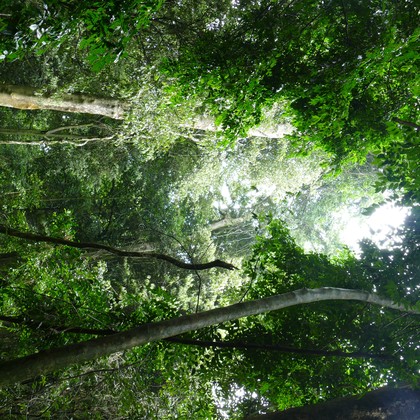
Dense secondary lowland forest, forest edge, clearings with young regrowth, creepers and thickets, also old plantations. It forages low among stems, thin twigs and bamboo, chipping small holes to extract beetle larvae and ants. It nests in a self-excavated cavity in a dead stem or branch.
Where the bird is most at home, classified by the vegetation units of southern Africa.

Range and movements
In the region only in northern and north-western Angola, including Cabinda, on the edge of the Congo Basin. Beyond the region in the lowland forest of West and Central Africa, from Liberia and Ghana through Cameroon and Gabon to DR Congo and western Uganda.
How and when to look
In dense thickets along forest edges listen for the high trill and the soft drumming; the bird moves fast and low and is more often heard than seen. It sometimes joins mixed foraging flocks of small songbirds.
Conservation status
Not threatened and widespread in Central Africa; it tolerates secondary forest well. Within the region it is known from few sites and is poorly studied.
Scientific name
Verreauxia africana | (Verreaux & Verreaux, 1855) (GBIF: Sasia africana)
Verreaux & Verreaux described the species in 1855 as Sasia africana; because it was later moved to another genus, the author and year stand in brackets. The genus Verreauxia was introduced in 1856 by Hartlaub. Verreauxia honours the French natural-history dealers Jules (1807–1873) and Édouard Verreaux (1810–1868); Hartlaub (1856) made Sasia africana, described by Jules Verreaux, the type of the genus. africana is Latin for 'African' — the only piculet of mainland Africa. The specimen the first description was based on came from Gabon.