All species › Woodpeckers and allies › Woodpeckers › Buff-Spotted Woodpecker
Buff-Spotted Woodpecker | Pardipicus nivosus
Termietenspecht | Pito Nevado
The Buff-Spotted Woodpecker is a small, dark forest woodpecker that keeps out of sight and forages mainly in vines and undergrowth for ants and termites. Within the region it occurs only in the far north-west, where the Congo rainforest reaches its limit.

Voice
A fast, slightly descending trill, trrrrrrr, and a thin nasal tsheep or kwee; the contact note is soft and often missed. It drums rarely and weakly.
Recording: BurBenj — CC BY-NC-SA 4.0 · converted to mono · xeno-canto
Identification
About 16 cm, small and compact, with a short tail and a fairly long grey bill. The upperparts are plain dark olive-brown, sometimes with faint pale spotting on the wing-coverts. The underparts are olive-brown, densely marked with round pale buff to off-white spots, which give the species its English name. The head is olive-brown with fine pale streaks on cheek and throat and no distinct ear-patch. The male has a red hind crown and nape, the female a wholly olive-brown crown. Juveniles are duller, with less crisp spotting.
Confusion species
Brown-Eared Woodpecker (Pardipicus caroli) is larger, with a striking chestnut-brown ear-patch and finer, denser spotting. Cardinal Woodpecker (Dendropicos fuscescens) has a barred back and streaked underparts and lives in open woodland. African Piculet (Verreauxia africana) is much smaller and greyer, with a short stiff tail and no spotting on the belly.
Habitat
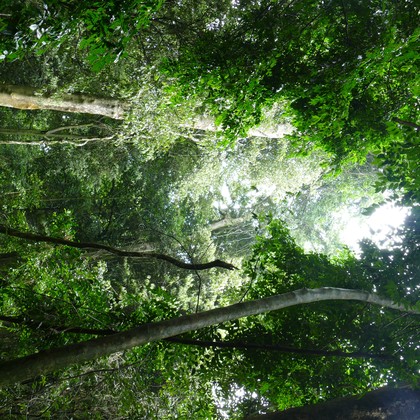
Rainforest edges, gallery forest, old secondary growth and dense thickets rich in lianas, mostly in the lower and middle storeys. It forages quietly on thin branches and vines and breaks into the nests of tree-dwelling ants and termites, its staple food. The nest is a hole in dead wood or in an arboreal termite nest.
Where the bird is most at home, classified by the vegetation units of southern Africa.

Range and movements
Within the region confined to north-western Angola (Cabinda, Uíge and Cuanza Norte), north-eastern Angola (Lunda) and the far north-west of Zambia around Mwinilunga. Beyond the region from Senegal through West and Central Africa to Uganda and western Kenya, and south through the DR Congo.
How and when to look
Search liana-rich forest edges and gallery forest in north-western Zambia or northern Angola, and watch for a small dark woodpecker travelling with mixed foraging flocks of forest birds. The soft tsheep note is often the only clue; wait for the bird to work out onto a thin branch.
Conservation status
Not threatened and common in its core range. On the fringe within the region it is scarce and little studied; clearance of gallery forest and rainforest edges is the main local threat.
Scientific name
Pardipicus nivosus | (Swainson, 1837)
Swainson described the species in 1837 as Dendromus nivosus; because it was later moved to another genus, the author and year stand in brackets. The genus Pardipicus was introduced in 1854 by Bonaparte. Pardipicus comes from the Latin pardus, 'leopard', and picus, 'woodpecker' — 'leopard woodpecker', for the densely spotted underparts. nivosus is Latin for 'snowy', from nix, 'snow' — for the pale spots on the underparts. The specimen the first description was based on came from West Africa (not further specified).