All species › Woodpeckers and allies › Woodpeckers › Brown-Eared Woodpecker
Brown-Eared Woodpecker | Pardipicus caroli
Bruinoorspecht | Pito Orejipardo
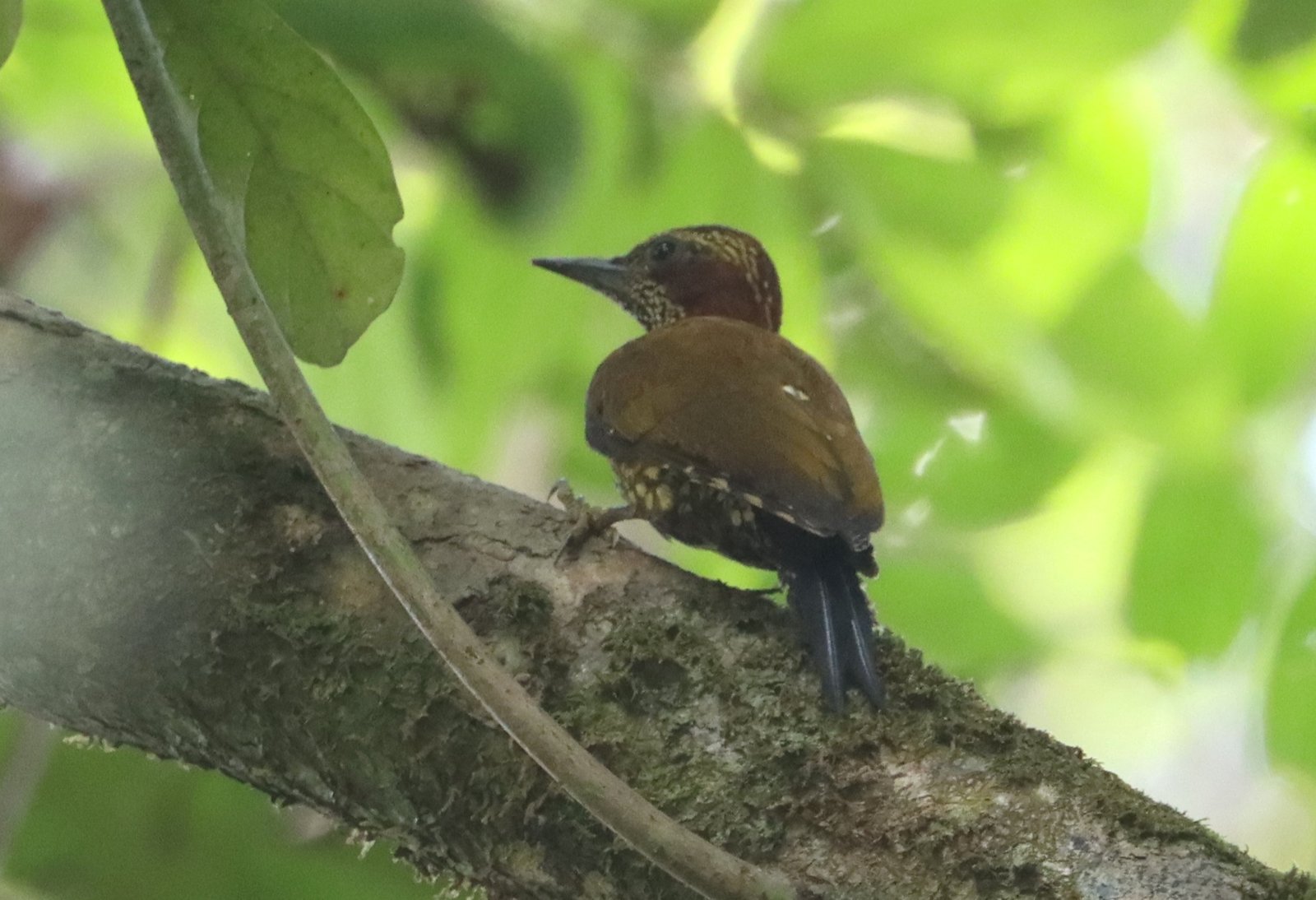
The Brown-Eared Woodpecker is a shy woodpecker of dense forest with creepers, reaching only the northern edge of the region. It gives itself away mainly by its long, plaintive whistle, which suggests some other kind of bird more than a woodpecker.
Voice
A long, plaintive, descending whistle, wheeeeeeu, lasting two to three seconds and repeated at intervals, and a soft chuk. It rarely drums.
Recording: Rod Cassidy — CC BY-NC-SA 4.0 · converted to mono · xeno-canto
Identification
About 19 cm. Upperparts dark olive-green with fine pale spots on the wings; tail dark brown with white spots on the outer feathers. The head is dark, with a large plain dark brown ear patch that gives the face a masked look, and a pale, finely speckled throat. Underparts olive-brown, densely covered with pale buff spots. The male has a red hindcrown, the female does not. The bill is bluish-grey.
Confusion species
Buff-Spotted Woodpecker (Pardipicus nivosus) is smaller, with a yellowish-green back, an olive, unspotted head without a brown ear patch and more lightly spotted underparts. Golden-Tailed Woodpecker (Campethera abingoni) is streaked rather than spotted below and the male has a red moustache. Cardinal Woodpecker (Dendropicos fuscescens) is much smaller, with a barred back.
Habitat
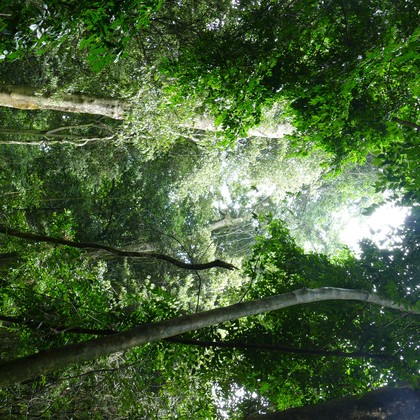
Dense primary and secondary lowland forest, gallery forest and overgrown forest edge with many creepers, also old plantations. It searches mainly for ants and other small invertebrates in the lower and middle storeys among creepers and branches, often slowly and inconspicuously.
Where the bird is most at home, classified by the vegetation units of southern Africa.

Range and movements
In the region only on the northern edge: northern Angola and the extreme north-west of Zambia, mainly in gallery forest around Mwinilunga. Beyond the region through the forest zone of West and Central Africa, from Guinea and Sierra Leone through Cameroon and DR Congo to Uganda, western Kenya and north-western Tanzania.
- Resident
- dark = core range, pale = thinly spread
How and when to look
In gallery forest listen for the long, plaintive whistle and then search patiently in the shady mid-storey. The bird moves little and hides behind creepers; it sometimes joins mixed foraging flocks.
Conservation status
Not threatened and fairly common in Central Africa. Rare and local in the region, and dependent on the survival of gallery forest.
Scientific name
Pardipicus caroli | (Malherbe, 1852)
Malherbe described the species in 1852 as Chloropicus Caroli; because it was later moved to another genus, the author and year stand in brackets. The genus Pardipicus was introduced in 1854 by Bonaparte. Pardipicus comes from the Latin pardus, 'leopard', and picus, 'woodpecker' — 'leopard woodpecker', for the densely spotted underparts. caroli is the Latin genitive of Carolus, 'Charles', and honours the French ornithologist Charles Lucien Bonaparte (1803–1857). The specimen the first description was based on came from Gabon.