All species › Cranes, rails and allies › Rails and crakes › African Rail
African Rail | Rallus caerulescens
Afrikaanse waterral | Rascón Cafre
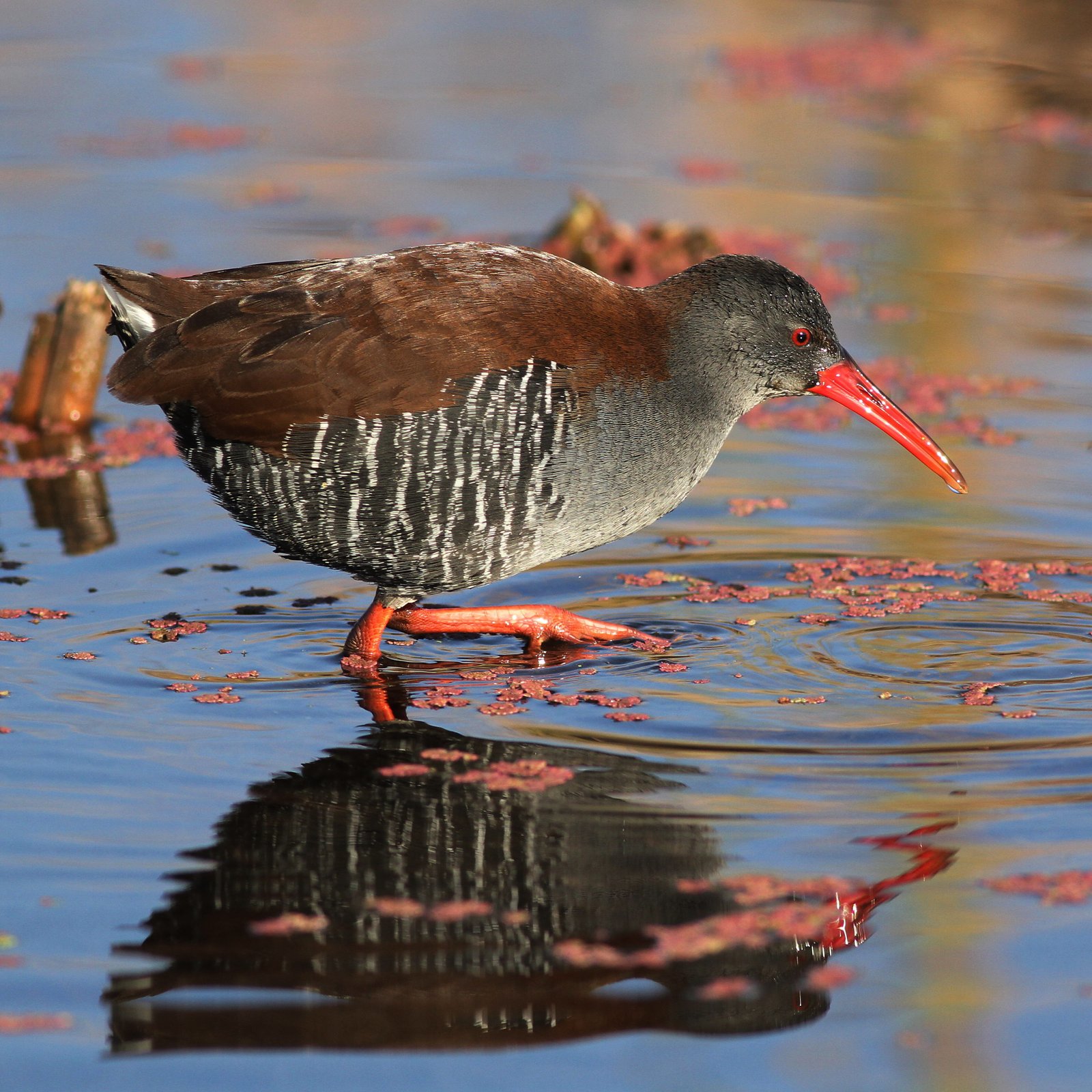
The African Rail is the large, long-billed rail of the reedbeds and sedge marshes of southern and eastern Africa. It lives concealed in dense marginal vegetation, but in the early morning often steps briefly onto open mud, flicking its tail.
Voice
A high, piercing, descending trill, krrrii-krii-krii-kri-kri, often given in duet by a pair and heard most at dusk. Also sharp, metallic creek calls and a soft growling.
Recording: Jaap van der Waarde — CC BY-NC-SA 4.0 · converted to mono · xeno-canto
Identification
About 36 cm including the long bill. The bill is bright red, long and slightly decurved; the legs are red. The upperparts are plain olive-brown without markings, and the face, foreneck and breast slate-grey, with a paler throat. The flanks and belly are crisply barred black and white and the undertail coverts white, well visible when the short tail is flicked up. The sexes are alike. Juveniles are duller brown with a dark bill, a pale throat and faint barring on the flanks.
Confusion species
The African Crake (Crecopsis egregia) also has a blue-grey breast and barred flanks, but has a short, stout bill and a streaked brown back, and lives in grassland. The Black Crake (Zapornia flavirostra) is all black with a yellow bill. The Striped Crake (Aenigmatolimnas marginalis) is smaller, brown with pale edgings and has a short greenish bill. A long red bill on a rail of this size is diagnostic in the region.
Habitat
Dense reedbeds, sedge marshes, bulrushes and flooded tall grass along dams, rivers and vleis, from the lowlands high into the mountains. It forages at the edge of the vegetation and on floating plants for insects, worms, snails, frogs and small fish. The nest is a cup of plant material low in the vegetation, often over water.
Where the bird is most at home, classified by the vegetation units of southern Africa.

Range and movements
Widespread in the east and north of the region: South Africa (mainly the east and the Highveld, locally in the Western and Southern Cape), Lesotho, Eswatini, Zimbabwe, Mozambique, Malawi, Zambia, the Okavango Delta and northern Botswana, the Caprivi in Namibia, and Angola. Absent from the arid west. Beyond the region in East and Central Africa to Ethiopia and eastern Congo.
- Resident
- Summer visitor (c. Oct–Mar)
- Winter visitor (c. Apr–Sep)
- Passage (Mar–Apr, Oct–Nov)
- dark = core range, pale = thinly spread
How and when to look
Best at sunrise from a hide or a dam wall with a reed fringe: the bird then briefly steps out of cover to forage on the mud edge. The trill reveals where it is; after that, wait quietly. Well-known sites include the Highveld marshes and reed edges in the Okavango Delta.
Conservation status
Not threatened and locally fairly common. It suffers from the draining of vleis, the burning of reedbeds in the breeding season and overgrazing of margins, but benefits elsewhere from dams and sewage works with a good reed fringe.
Scientific name
Rallus caerulescens | Gmelin, 1789
Gmelin described the species in 1789 and placed it straight away in the genus where it still stands. The genus Rallus was introduced in 1758 by Linnaeus. Rallus is the name English ornithologists such as Willughby and Albin already used for the water rail before Linnaeus; the precise origin of the word is uncertain. caerulescens is Latin for 'bluish' — for the blue-grey throat and breast. The specimen the first description was based on came from Cape of Good Hope.