All species › Cranes, rails and allies › Rails and crakes › Spotted Crake
Spotted Crake | Porzana porzana
Porseleinhoen | Polluela Pintoja
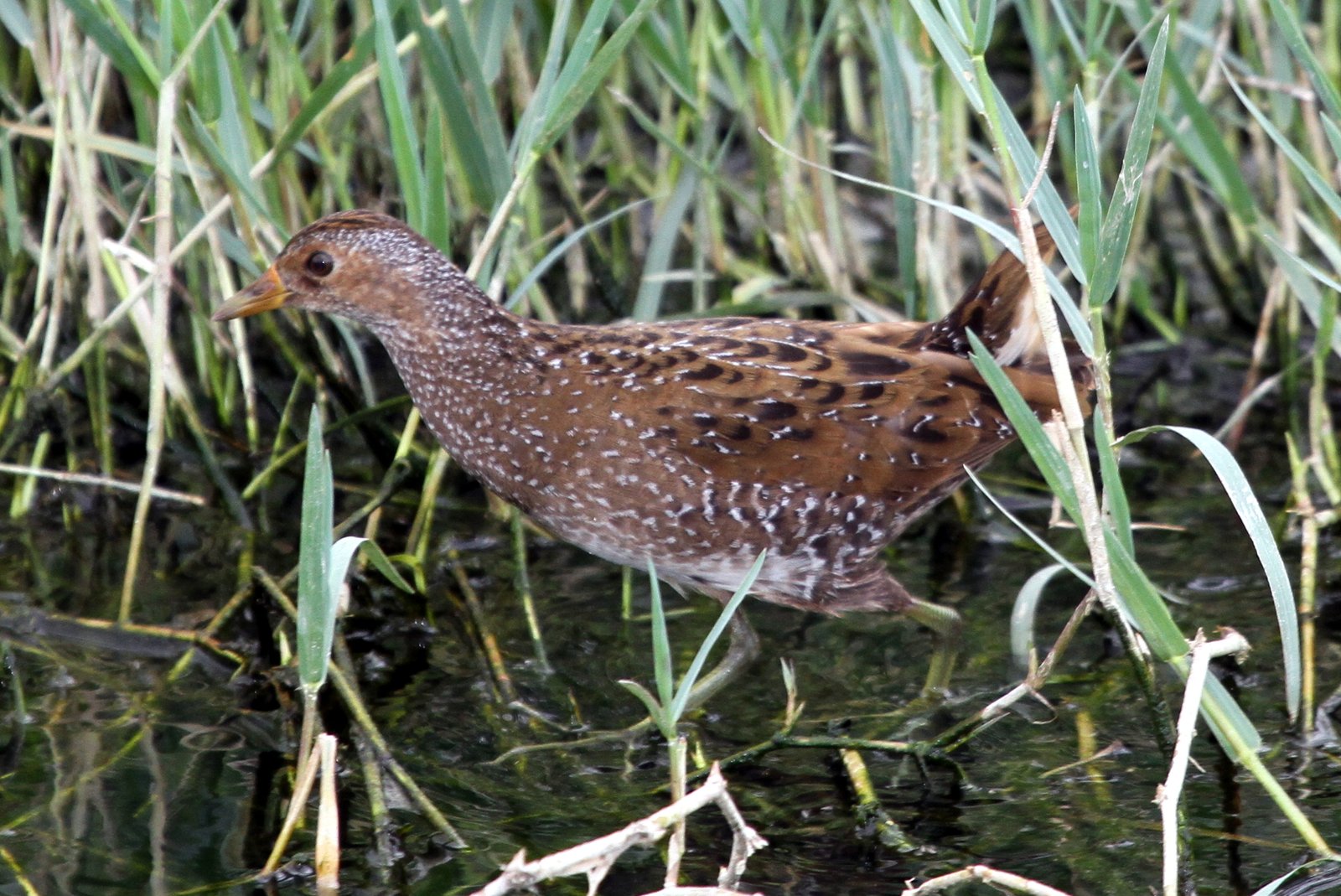
The Spotted Crake is a small, finely white-spotted rail that breeds in Eurasia and winters in small numbers south into southern Africa. It is seldom seen here, usually as a single bird on the mud edge of a marsh after good rains.
Voice
Usually silent in Africa. At times a short, sharp kek or a soft croak. The whiplash call, hwit, repeated at night, is well known on the breeding grounds but is rarely heard here.
Recording: János Schadl — CC BY-NC-SA 4.0 · shortened to the first 60 s, mono · xeno-canto
Identification
About 23 cm, compact, with a short yellow bill with a red base. The upperparts are olive-brown with black feather centres and fine white streaks and spots; the head, neck and breast are grey to brownish grey, densely peppered with white dots. The flanks are brown with white barring and the undertail coverts plain buff, a good feature when the bird flicks its tail. The legs are greenish. Outside the breeding season the grey of the head is browner and the bill base duller. Juveniles have a browner head with less grey.
Confusion species
The Little Crake (Zapornia parva) and Baillon's Crake (Zapornia pusilla) are smaller, lack the dense white spotting on head and breast and have no buff undertail; Baillon's has a black-and-white barred undertail. The Striped Crake (Aenigmatolimnas marginalis) has pale longitudinal streaks instead of spots, a greenish bill and a rufous undertail. The African Crake (Crecopsis egregia) has a blue-grey, unspotted breast and crisply barred flanks.
Habitat
Shallow freshwater marshes with a mosaic of low reeds, sedges, flooded grass and open mud, the margins of temporary vleis, floodplains and sewage works. It eats aquatic insects, larvae, small snails and seeds, often at the edge of vegetation.
Where the bird is most at home, classified by the vegetation units of southern Africa.

Range and movements
Scarce and irregular, mainly in the north of the region: Zambia, Zimbabwe, Malawi, northern Botswana (Okavango) and north-eastern Namibia, with scattered records in northern and eastern South Africa (Gauteng, Limpopo, KwaZulu-Natal) and in Mozambique and Angola. It breeds from Western Europe to Central Asia and winters mainly in sub-Saharan Africa and South Asia.
- Summer visitor (c. Oct–Mar)
- Passage (Mar–Apr, Oct–Nov)
- dark = core range, pale = thinly spread
How and when to look
After a wet season, from January to March, search the mud edges of shallow vleis and sewage ponds, preferably early in the morning and from a hide. Watch for the tail flicks showing the buff undertail. Records in South Africa are rare enough to report to the local rarities committee.
Conservation status
Not globally threatened, but it has declined in parts of Europe through the loss of shallow marshes. In southern Africa its presence depends strongly on rainfall and on the survival of temporary vleis and floodplains.
Scientific name
Porzana porzana | (Linnaeus, 1766)
Linnaeus described the species in 1766 as Rallus Porzana; because it was later moved to another genus, the author and year stand in brackets. The genus Porzana was introduced in 1816 by Vieillot. Porzana is a Latinised Venetian folk name for the small crakes. The species name repeats the genus name. The specimen the first description was based on came from France.