All species › Cranes, rails and allies › Rails and crakes › Purple Swamphen
Purple Swamphen | Porphyrio porphyrio
Purperkoet | Calamón Común
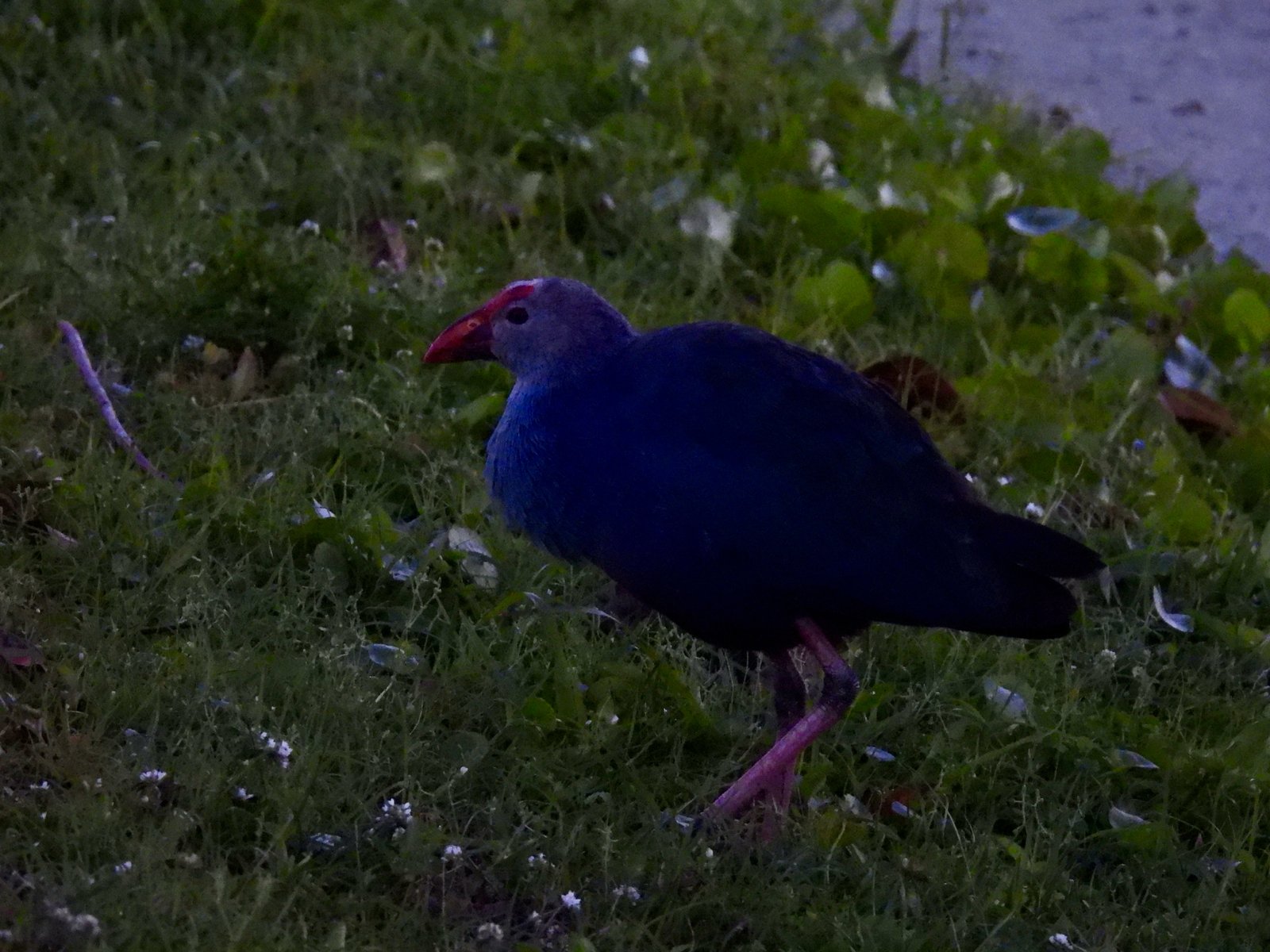
The Purple Swamphen is the largest rail of southern Africa: a hefty, purple-blue marsh bird with a massive red bill, a red frontal shield and long red legs. It clambers through reedbeds and holds food in one foot like a parrot.
Voice
Loud and varied: a shrieking nasal screech, deep hums and grunts, a series of cackling notes and a trumpeting kwaaark, often in duet. It also calls at night.
Recording: Thierry THOMAS — CC BY-NC-SA 4.0 · converted to mono · xeno-canto
Identification
About 46 cm, heavily built. Head, neck and underparts are deep purple-blue, the throat and breast brighter cobalt; back and wings are greenish to olive-brown with a blue gloss. The undertail is bright white and shows when the tail is flicked. The bill is short, deep and scarlet, merging into a large red frontal shield. Legs and toes are long and pinkish to orange-red. The sexes are alike. Juveniles are duller grey-blue with a paler throat and a dark bill with little red.
Confusion species
Allen's Gallinule (Porphyrio alleni) and the Purple Gallinule (Porphyrio martinica) are much smaller and slimmer, with a small bill and a blue, green or pale blue shield. The Common Moorhen (Gallinula chloropus) is smaller, dark grey-brown with a yellow bill tip and a white flank line. The Red-Knobbed Coot (Fulica cristata) is slate-grey with a white bill and shield.
Habitat
Extensive permanent reedbeds and papyrus and bulrush marshes along lakes, dams, rivers and on floodplains, preferably with shallow open water alongside. It eats mainly soft stems and shoots of reeds and bulrushes, held in the foot, but also eggs, nestlings, frogs and snails.
Where the bird is most at home, classified by the vegetation units of southern Africa.

Range and movements
Widespread but local throughout the region wherever suitable reed marshes occur: in South Africa mainly in the east and on the Highveld, along the south coast and in the Western Cape; also in Eswatini, Mozambique, Zimbabwe, Zambia, Malawi, the Okavango and Chobe in Botswana, northern Namibia and Angola; absent from the dry interior. The African population is sometimes treated as a separate species, the African Swamphen; the complex ranges from southern Europe to Madagascar, Asia and Australia.
- Resident
- Summer visitor (c. Oct–Mar)
- Winter visitor (c. Apr–Sep)
- Passage (Mar–Apr, Oct–Nov)
- dark = core range, pale = thinly spread
How and when to look
All year along large reedbeds, best early in the morning when birds feed at the reed edge or walk over low vegetation. Watch from a hide at a reed marsh; the white undertail and the bright red bill give the bird away even when it stands half in cover.
Conservation status
Not threatened and locally common. Sensitive to the draining and burning of reed marshes; sewage ponds and dams fringed with reeds provide substitute habitat.
Scientific name
Porphyrio porphyrio | (Linnaeus, 1758)
Linnaeus described the species in 1758 as Fulica Porphyrio; because it was later moved to another genus, the author and year stand in brackets. The genus Porphyrio was introduced in 1760 by Brisson. Porphyrio is Latin, from the Greek porphuriōn, the classical authors' name for the swamphen, from porphura 'purple'. The specific epithet repeats the genus name. The specimen the first description was based on came from the lands around the western Mediterranean.