All species › Passerines › Chats and flycatchers › African Stonechat
African Stonechat | Saxicola torquatus
Afrikaanse roodborsttapuit | Tarabilla Común
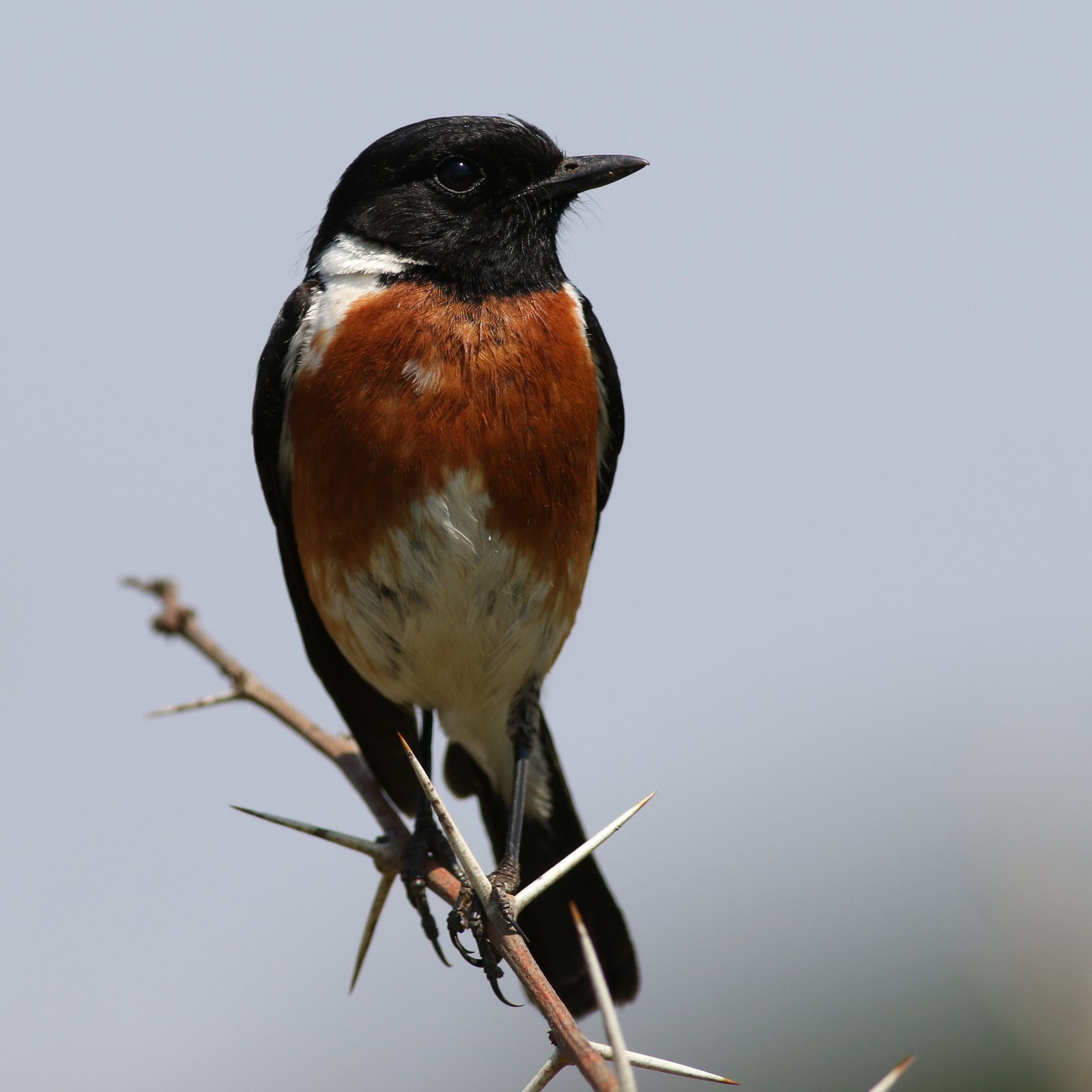
The African Stonechat is the small, compact chat of damp grassland, vleis and montane meadows, sitting upright on a grass stem, post or bush top and repeatedly dropping to the ground. The male, with black head, white neck patch and chestnut breast, is one of the best-known birds of the eastern part of the region.
Click a thumbnail to switch the photo above.
Voice
The call is a sharp weet followed by a hard chak-chak, like two pebbles knocked together, repeated endlessly when anyone approaches the territory. The song is a short, squeaky and scratchy phrase, often from a high perch and sometimes in a brief song flight.
Recording: Bram Piot — CC BY-NC-SA 4.0 · converted to mono · xeno-canto
Identification
13–14 cm, a stocky chat with a short dark tail. The male has a black head and throat, a large white patch on the side of the neck, a chestnut breast fading paler on the belly, a dark, brown-streaked back, a white wing patch and a white rump. The female is brown with dark streaks above, a pale throat, a warm orange-brown breast and a small white wing patch; the rump is pale rufous. After moult males are briefly scaled brown by pale feather fringes. Juveniles are brown and lightly spotted. It sits conspicuously upright, flicks its tail and jerks its wings.
Confusion species
Whinchat (Saxicola rubetra), a Palearctic summer visitor wintering mainly in the north of the region, shows a clear pale supercilium and white patches at the tail base in all plumages; the female stonechat lacks the supercilium and has a plain dark tail. Cisticolas (Cisticola) in the same grassland are slimmer, longer-tailed and less upright. Buff-Streaked Chat (Campicoloides bifasciatus) is larger, has a buff rump and lives on rocky slopes.
Habitat
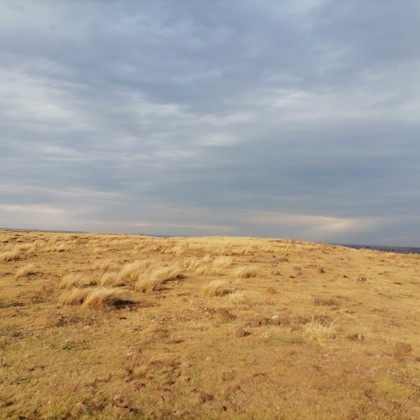
Open, fairly moist grassland, vleis and marsh edges, montane meadows, fynbos, fallow land and the margins of fields and plantations, from sea level high into the Drakensberg. It hunts insects on the ground from a low lookout and returns to the same perch. The cup nest is well hidden in a grass tuft at the foot of a slope or bank.
Where the bird is most at home, classified by the vegetation units of southern Africa.


Range and movements
Widespread in the moister eastern half of the region: virtually all of South Africa except the arid north-west, Lesotho, Eswatini, the highlands of Zimbabwe and Mozambique, Malawi, Zambia and the Angolan plateau; in Namibia and Botswana only locally in the north and east and rare elsewhere. Highland birds partly move to lower ground in winter. Beyond the region across much of sub-Saharan Africa, especially in highlands.
- Resident
- Summer visitor (c. Oct–Mar)
- Winter visitor (c. Apr–Sep)
- Passage (Mar–Apr, Oct–Nov)
- dark = core range, pale = thinly spread
How and when to look
Drive roads through damp grassland or along vleis and watch for small birds on the top strand of a fence or the tip of a tall grass stem. Pairs often hold the same territory for years, so a bird once found is usually there on the next visit too. The strident chak-chak gives it away before the plumage does.
Conservation status
Not threatened. The species is numerous and benefits from open landscapes and extensive grazing. It disappears locally with the draining of vleis, the conversion of grassland to dense plantations and intensive cropping.
Scientific name
Saxicola torquatus | (Linnaeus, 1766)
Linnaeus described the species in 1766 as Muscicapa torquata; because it was later moved to another genus, the author and year stand in brackets. The genus Saxicola was introduced in 1802 by Bechstein. Saxicola is Latin, from saxum 'stone, rock' and -cola 'dweller', from colere 'to inhabit': 'rock dweller', after the open stony ground these birds keep to. torquatus is Latin for 'collared', from torques, 'necklace' — for the male's white neck patches. The specimen the first description was based on came from Cape of Good Hope.