All species › Storks › Storks › African Woolly-Necked Stork
African Woolly-Necked Stork | Ciconia microscelis
Afrikaanse bisschopsooievaar | Cigüeña Lanuda Africana
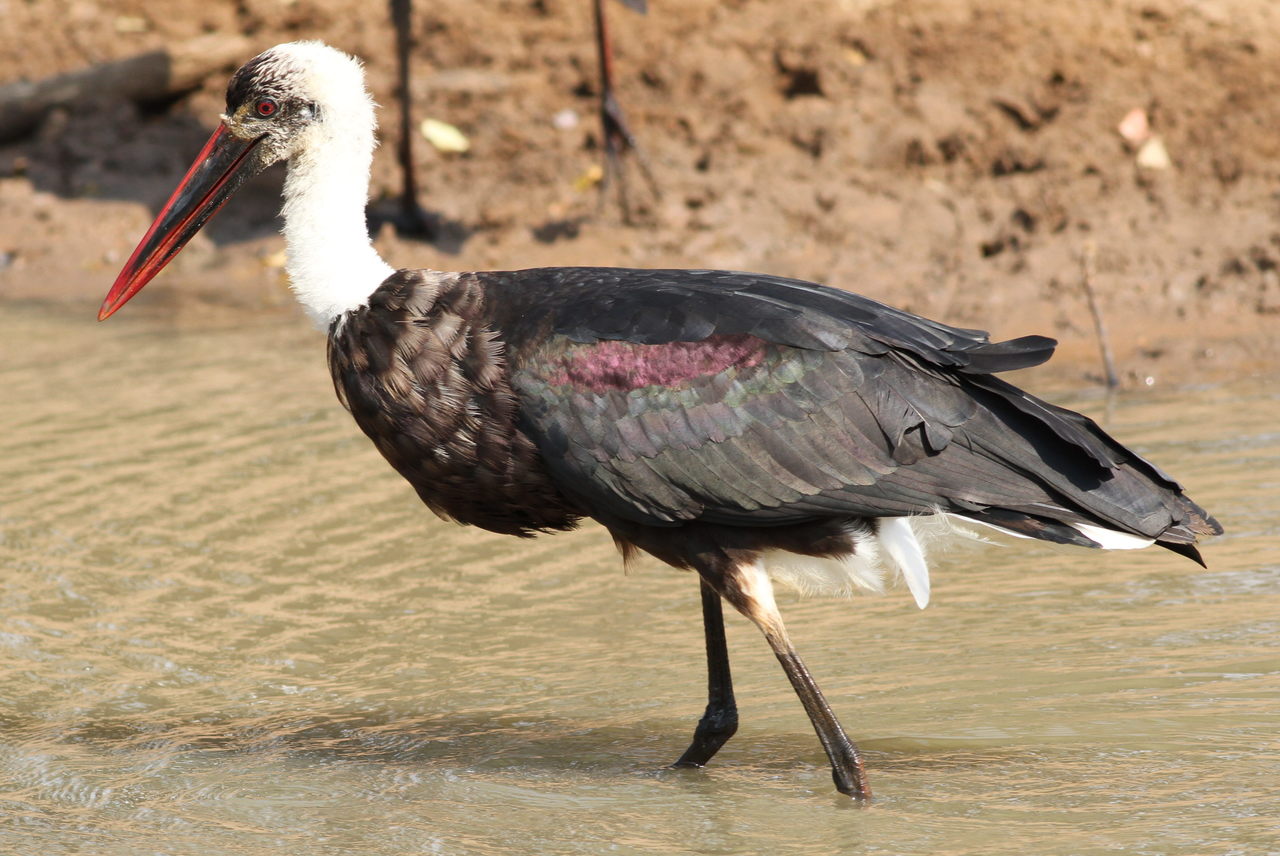
The African Woolly-Necked Stork is a medium-sized, dark stork with a conspicuous white, woolly neck, a black cap and a dark bill with a red tip. It usually lives alone, in pairs or in small groups along rivers, dams and marshes. In KwaZulu-Natal it has expanded strongly into suburban parks and gardens in recent decades.
Voice
Largely silent. Bill-clattering at the nest, and a soft, husky whistle in greeting.
No recording with a suitable Creative Commons licence is available for this species yet.
Identification
75–92 cm. Body and wings glossy black with a purple, coppery and green sheen; the neck is covered in downy, woolly white feathers, the crown with a black cap. The belly and the long white undertail coverts, which project beyond the tail, are white. The bill is blackish with a red tip and edge; the bare face is grey. The legs are dark red to greyish-red. Juveniles are duller brownish-black, with a less pure white neck and a feathered crown. In flight dark with a white neck, white belly and a white, fork-like projecting undertail.
Confusion species
Black Stork Ciconia nigra has a black neck, a red bill and red legs. Abdim's Stork Ciconia abdimii has a dark neck, a blue face and a white back. African Openbill Anastomus lamelligerus is entirely dark, without a white neck. Black-Headed Heron Ardea melanocephala also has a black cap and a white throat, but it is grey and slim and flies with the neck retracted.
Habitat
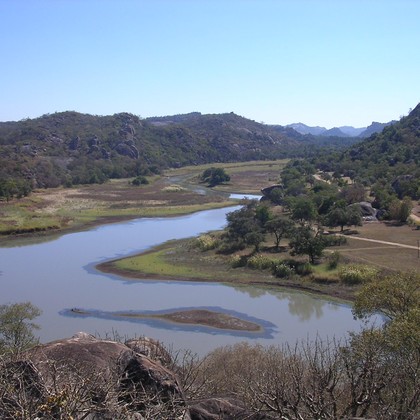
Banks of rivers, dams, pans, floodplains and marshes in savanna and woodland, also coastal flats, mangrove areas and wet grasslands. It eats fish, frogs, crabs, molluscs, large insects and sometimes small reptiles; also follows bush fires. In KwaZulu-Natal nowadays also in suburbs, on lawns and sports fields, where it breeds in alien trees.
Where the bird is most at home, classified by the vegetation units of southern Africa.


Range and movements
The east and north of the region: in South Africa mainly KwaZulu-Natal (including the Durban area) and the lowveld of Mpumalanga and Limpopo, expanding into the Eastern Cape and onto the highveld; further Eswatini, Mozambique, Zimbabwe, Malawi, Zambia, northern Botswana (the Okavango and the Chobe), the Caprivi and Angola. Beyond the region in Africa south of the Sahara, from Senegal to Ethiopia; the related Asian Woolly-Necked Stork lives in South and South-East Asia.
- Resident
- Summer visitor (c. Oct–Mar)
- Winter visitor (c. Apr–Sep)
- Passage (Mar–Apr, Oct–Nov)
- dark = core range, pale = thinly spread
How and when to look
The suburbs and nature reserves around Durban and in inland KwaZulu-Natal, where the species has become confiding, or the rivers of the Kruger National Park. Look for a dark stork with a white neck walking slowly along a bank or across a lawn.
Conservation status
Not threatened. In South Africa the species has increased and expanded, largely through its use of alien trees for nesting in suburbs, and it is no longer regarded as threatened there. Elsewhere in the region it is threatened by loss of wetlands and disturbance at the nest.
Scientific name
Ciconia microscelis | Gray, 1848
Gray described the species in 1848 and placed it straight away in the genus where it still stands. The genus Ciconia was introduced in 1760 by Brisson. Ciconia is the Latin word for 'stork'. microscelis comes from the Greek mikros, 'small', and skelos, 'leg' — for the relatively short legs. The specimen the first description was based on came from Africa (not specified).