All species › Storks › Storks › Saddle-Billed Stork
Saddle-Billed Stork | Ephippiorhynchus senegalensis
Zadelbekooievaar | Jabirú Africano
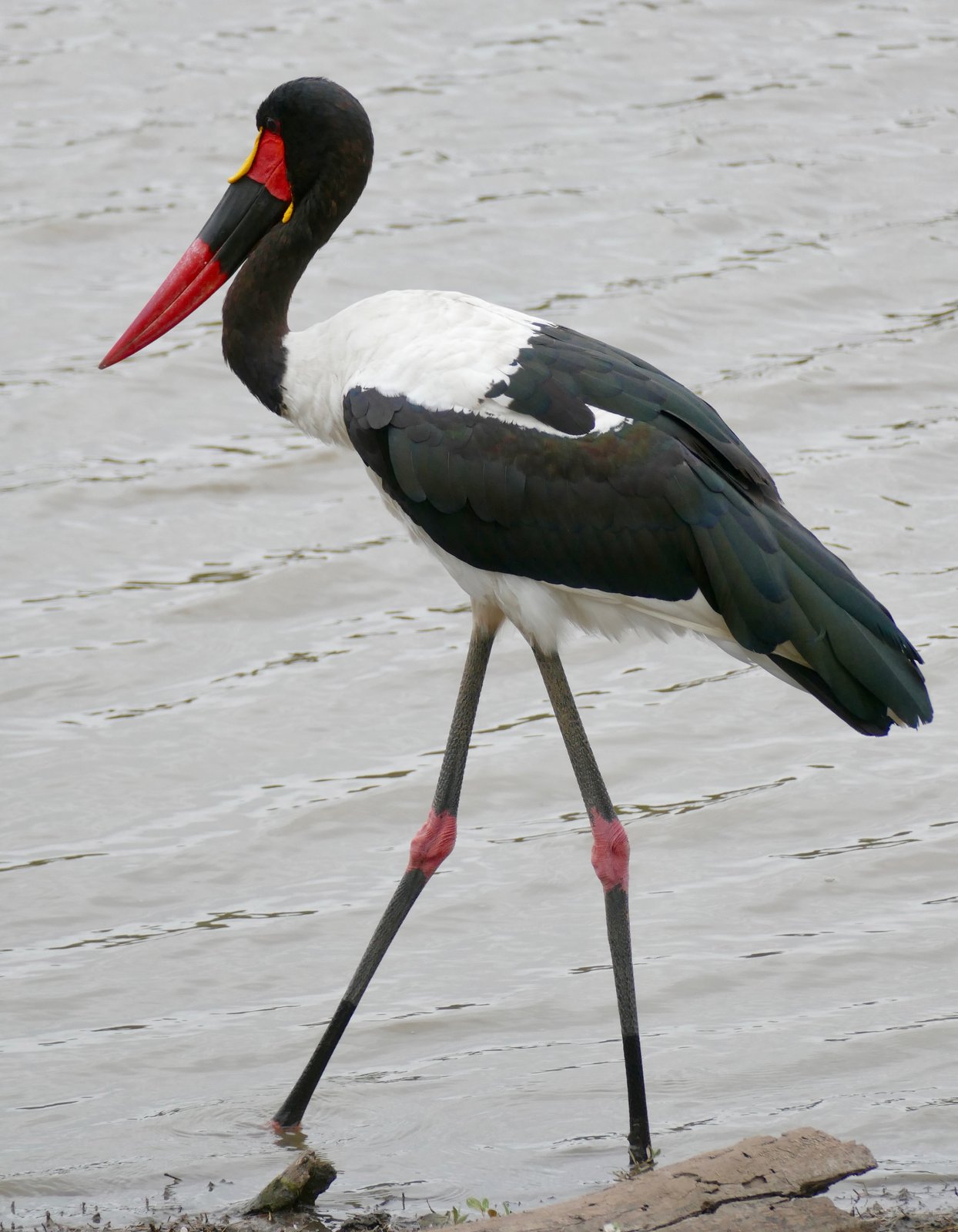
The Saddle-Billed Stork is the tallest stork in Africa and carries a heavy, slightly upturned bill that is red with a broad black band and, at the base, a yellow shield — the saddle that gives it its name. It almost always walks shallow water alone or in pairs and does not form flocks.
Voice
Virtually silent. At the nest and in greeting the pair clatter their bills loudly; otherwise at most a hoarse hiss. In flight the wingbeats are audible at close range.
No recording with a suitable Creative Commons licence is available for this species yet.
Identification
142–150 cm, wingspan 2.4 to 2.7 metres. Head, neck, back, wings and tail are glossy blue-black, breast and belly white; in flight the wing is white with a broad black leading and trailing edge. The bill is enormous, red with a black band and a yellow saddle-shaped shield on top of the base. The legs are black with conspicuous pink joints and toes. The sexes differ in eye colour: the female has a yellow iris, the male a dark brown one with two small yellow wattles at the bill base. Juveniles are grey-brown with a dull, unbanded bill. In flight the neck droops slightly and the legs project far beyond the tail; the bird soars on slow, deep wingbeats.
Confusion species
No other stork in the region has this bill. In flight the black-and-white pattern can suggest Yellow-Billed Stork Mycteria ibis, but that species is largely white with a yellow, decurved bill and a red face, and is considerably smaller. Marabou Stork Leptoptilos crumenifer is grey with a bare head and a throat pouch. Abdim's Stork Ciconia abdimii is much smaller and glossed green.
Habitat
Large floodplains, permanent rivers, lake shores, seasonal pans and marshes in savanna. It wades slowly through shallow water and takes fish, frogs, crabs and aquatic insects, often by sweeping the bill through the water by touch. Nesting requires large trees: a broad stick platform high in a dead or living tree near water.
Where the bird is most at home, classified by the vegetation units of southern Africa.

Range and movements
Thinly and widely spread over the region's major water systems: the Okavango Delta and the Chobe in Botswana, the Caprivi and the northern rivers of Namibia, the Zambezi valley and the Zimbabwean lowveld, the floodplains of Mozambique, the Kafue, Bangweulu and Luangwa in Zambia, and on into Malawi and Angola. In South Africa it is restricted to the Kruger National Park and adjacent lowveld rivers, with a very small population. Beyond the region it occurs across the savanna belt of Africa, from Senegal and the Gambia to Ethiopia and Sudan.
- Resident
- Summer visitor (c. Oct–Mar)
- Winter visitor (c. Apr–Sep)
- Passage (Mar–Apr, Oct–Nov)
- dark = core range, pale = thinly spread
How and when to look
The dry season, May to October, when the water retreats and fish concentrate in shrinking pools. In the morning, scan the edge of a floodplain or a river channel for a single bird or a pair wading slowly. Eye colour gives the sex away: yellow in the female, dark brown with yellow wattles in the male.
Conservation status
Near Threatened on the Red List; raised from Least Concern in 2025 because of small and declining subpopulations. The loss and regulation of floodplains by dams and irrigation, felling of large nest trees, disturbance at the nest, drowning in fishing nets and poisoning are given as causes. In South Africa only a few tens of pairs remain and the species is nationally listed as endangered.
Scientific name
Ephippiorhynchus senegalensis | (Shaw, 1800)
Shaw described the species in 1800 as Mycteria Senegalensis; because it was later moved to another genus, the author and year stand in brackets. The genus Ephippiorhynchus was introduced in 1855 by Bonaparte. Ephippiorhynchus comes from the Greek ephippion, 'saddle', and rhynchos, 'bill' — for the yellow, saddle-shaped shield at the base of the bill. senegalensis is Latin for 'of Senegal', the country where the species was first described. The specimen the first description was based on came from Senegal.