All species › Passerines › Chats and flycatchers › Angola Slaty Flycatcher
Angola Slaty Flycatcher | Melaenornis brunneus
Angolese drongovliegenvanger | Papamoscas Angoleño
The Angola Slaty Flycatcher is a brown flycatcher found only in the highlands and along the escarpment of Angola. It is one of the endemics for which birders travel to west-central Angola, yet it remains a little-studied species.

Voice
Poorly known. High, thin seet calls and a soft, short song of high whistles and scratchy notes.
Recording: Ken Behrens — CC BY-NC-SA 4.0 · converted to mono · xeno-canto
Identification
15–16 cm, a fairly large, upright flycatcher. The upperparts are dark earth-brown, and the throat and breast are also plain brown, sharply demarcated from a white belly. There is an inconspicuous pale eye-ring and paler lores. Bill and legs are black. The sexes are alike; juveniles are lightly spotted above and scaled on the breast. It sits quietly on a low branch at a forest edge and drops to the ground or catches insects in the air.
Confusion species
African Dusky Flycatcher (Muscicapa adusta) is smaller and greyer brown, with faint breast streaking and no sharp border between brown breast and white belly. Pale Flycatcher (Agricola pallidus) is about the same size but much paler sandy brown, with dull white underparts that grade paler, and lives in open woodland. The all-black Southern Black Flycatcher (Melaenornis pammelaina) occurs in the same areas but lacks the white belly.
Habitat
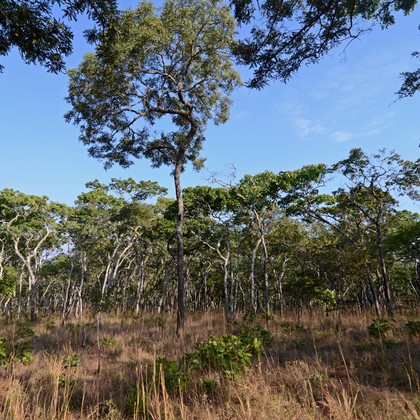
Forest edges and clearings in Afromontane forest, gallery forest and wooded ravines along the escarpment, and adjacent dense miombo with an open understorey, roughly between 800 and 2200 m. It forages from a low lookout perch for insects on the ground.
Where the bird is most at home, classified by the vegetation units of southern Africa.

Range and movements
Endemic to Angola and thus to the region: along the western escarpment in Cuanza Sul (including the Kumbira forest and the Gabela area) and on the central plateau in Huambo and Bié, including the forest patches on Mount Moco. The species occurs nowhere else.
- Resident
- dark = core range, pale = thinly spread
How and when to look
Look for it along forest edges at Kumbira and in the ravines with forest patches on Mount Moco, together with other Angolan endemics. Watch for a dark brown flycatcher with a brown breast band and a white belly sitting low and quietly at the forest edge.
Conservation status
Not threatened, but its fragmented habitat is under pressure from logging, agriculture and fire in the Angolan highlands and along the escarpment. Many of the remaining forest fragments are unprotected.
Scientific name
Melaenornis brunneus | (Cabanis, 1886)
Cabanis described the species in 1886 as Dioptrornis brunnea; because it was later moved to another genus, the author and year stand in brackets. The genus Melaenornis was introduced in 1840 by Gray. Melaenornis combines the Greek melas, feminine melaina, 'black', with ornis, 'bird' — for the all-black plumage of the type species. brunneus is New Latin for 'brown' — for the brown plumage. The specimen the first description was based on came from Pungo Andongo, Malanje, Angola.