All species › Passerines › Chats and flycatchers › Grey-Throated Tit-Flycatcher
Grey-Throated Tit-Flycatcher | Fraseria griseigularis
Grijskeelvliegenvanger | Papamoscas Gorjigrís
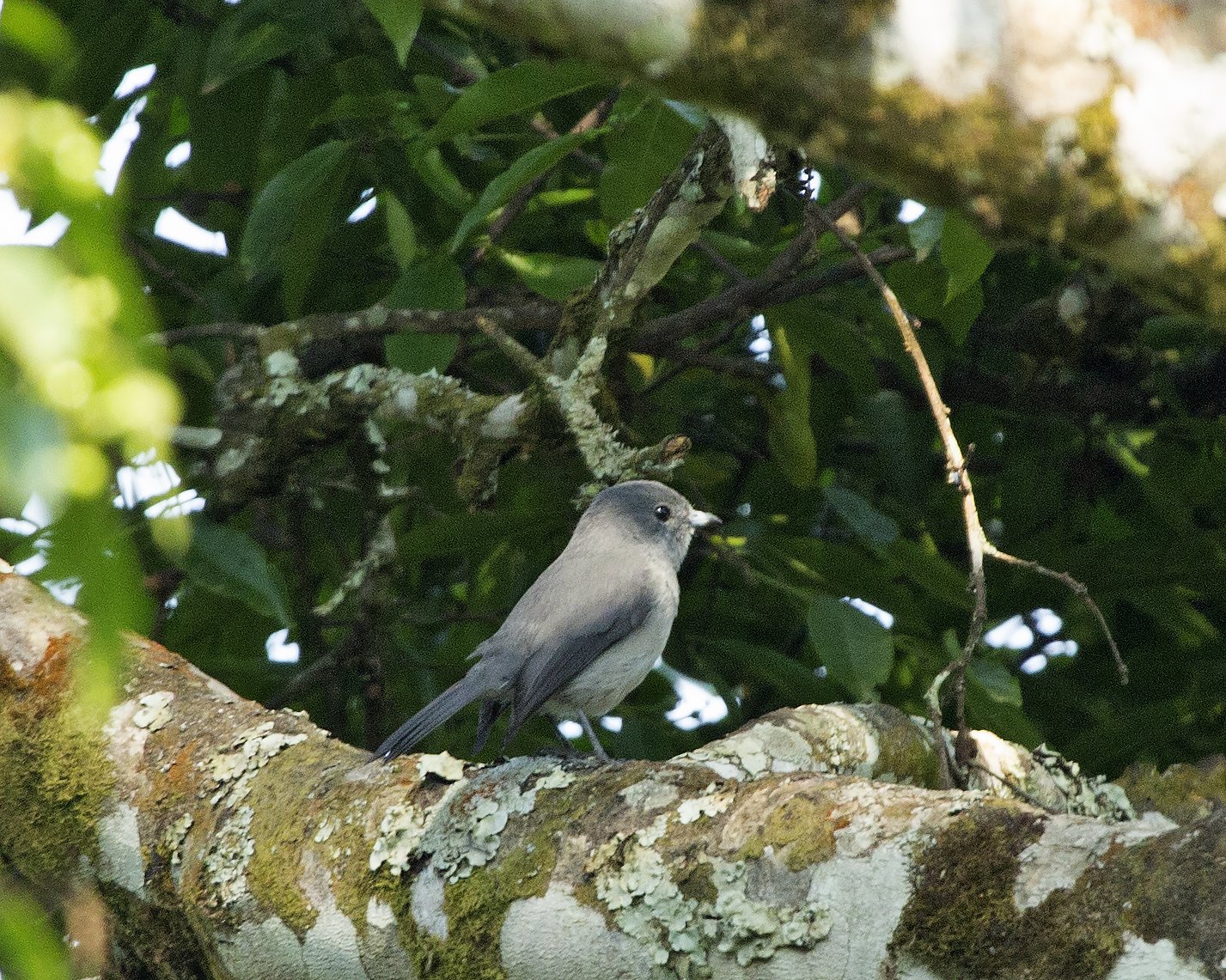
The Grey-Throated Tit-Flycatcher is a small, grey flycatcher of lowland rainforest, which within the region occurs only in north-western Angola. Like Grey Tit-Flycatcher, it moves through the foliage like a tit and constantly fans its tail.
Voice
High, thin, whistled notes, often in a short descending series; poorly described from this region. The call is a thin tsee, often the first clue in the dense canopy.
No recording with a suitable Creative Commons licence is available for this species yet.
Identification
A small flycatcher of 13 cm. The upperparts are slate grey, throat and breast pale grey and the belly white, so the grey throat merges seamlessly into the grey breast. Pale lores and a narrow pale eye-ring give the head a soft expression. The bill is short and dark, the legs dark. The sexes are alike. It forages actively in the mid-storey and canopy, often in mixed flocks, spreading its tail and swinging it from side to side.
Confusion species
Grey Tit-Flycatcher (Fraseria plumbea) has a white throat and conspicuous white outer tail feathers and lives mainly in woodland and riverine forest, not dense rainforest. Ashy Flycatcher (Fraseria caerulescens) is larger, with a white stripe above the lores, and sits more quietly on a lookout at the forest edge. Cassin's Flycatcher (Muscicapa cassini) is larger, perches on branches over running water and has a white throat with a grey breast band.
Habitat
Moist lowland rainforest and gallery forest, especially the mid-storey, canopy and forest edges; also in shady old coffee plantations under tall forest trees.
Where the bird is most at home, classified by the vegetation units of southern Africa.


Range and movements
Within the region only in north-western Angola, in Cabinda and the forest areas of the northern interior. Beyond it from south-eastern Nigeria and Cameroon through the Congo Basin to south-western Uganda and north-western Tanzania; a separate subspecies lives in West Africa from Liberia to Ghana.
How and when to look
Search the rainforest of north-western Angola for mixed foraging flocks and look for a small grey bird moving through the foliage with its tail spread. The grey rather than white throat and the forest habitat separate it from Grey Tit-Flycatcher.
Conservation status
Not threatened. The species is widespread in the central African rainforest. In Angola it depends on the remaining forest areas, where logging and conversion to farmland are the main threats.
Scientific name
Fraseria griseigularis | (Jackson, 1906)
Jackson described the species in 1906 as Alseonax griseigularis; because it was later moved to another genus, the author and year stand in brackets. The genus Fraseria was introduced in 1854 by Bonaparte. Fraseria is named after the English zoologist Louis Fraser (1810–1866), naturalist on the Niger expedition of 1841–1842. griseigularis combines the Latin griseus, 'grey', with gula, 'throat' — for the grey throat. The specimen the first description was based on came from Kibiran, Toro, Uganda.