All species › Passerines › Chats and flycatchers › Grey Tit-Flycatcher
Grey Tit-Flycatcher | Fraseria plumbea
Meesvliegenvanger | Papamoscas Carbonero
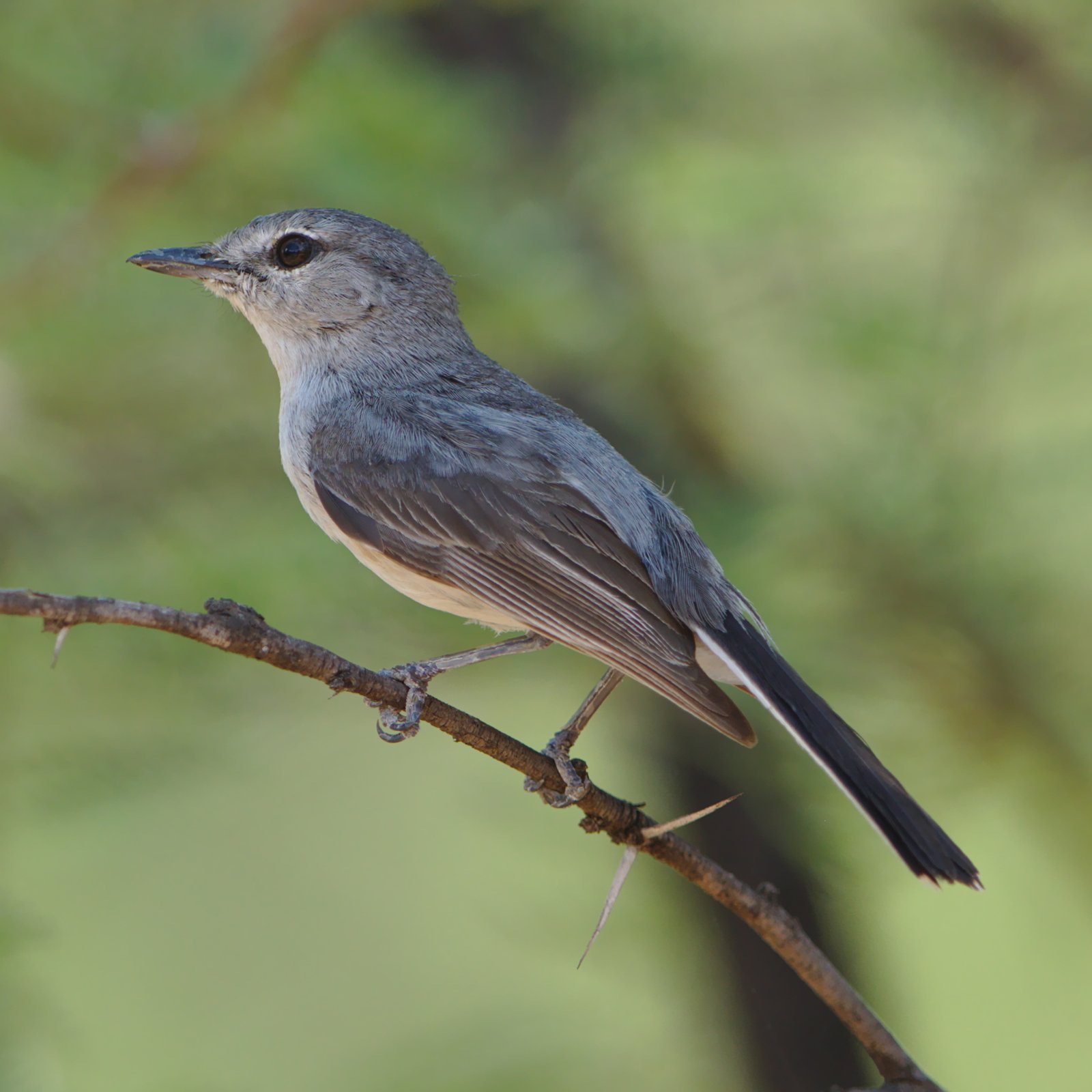
The Grey Tit-Flycatcher is a small, grey flycatcher of woodland that moves through the foliage like a tit. It constantly spreads its tail and swings it from side to side, flashing the white outer tail feathers. Often it first gives itself away by its plaintive, trilling whistle.
Voice
A plaintive, softly trilling whistle of two or three notes, such as trree-trree or a high, falling tooo-wheeu, often the first sign of its presence. There is also a thin tsip.
No recording with a suitable Creative Commons licence is available for this species yet.
Identification
A small flycatcher of 14 cm. The upperparts are uniform bluish grey, the underparts pale grey, becoming off-white on throat and belly. White lores and a broken white eye-ring give the head a ‘spectacled’ look. The tail is dark with white outer edges and white tips, which show best when fanned. Bill and legs are dark. The sexes are alike. It forages actively in the mid-storey and canopy, often in mixed flocks, gleaning insects from leaves and twigs more than catching them in the air.
Confusion species
Ashy Flycatcher (Fraseria caerulescens) is larger, lacks white in the tail and sits more quietly and upright on a lookout; it lives mainly in riverine and coastal forest. Grey-Throated Tit-Flycatcher (Fraseria griseigularis) of the rainforest of north-western Angola has a grey throat and breast. Grey Penduline Tit (Anthoscopus caroli) is much smaller, with a fine pointed bill, and does not fan its tail. African Dusky Flycatcher (Muscicapa adusta) is browner and sits still on a perch.
Habitat
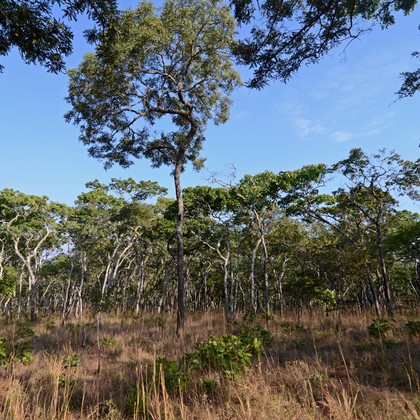
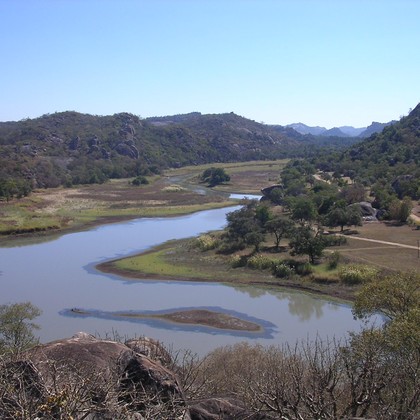
Miombo, mixed and open woodland, riverine forest and forest edges, also large trees in coastal forest and around farmsteads. Keeps to the mid-storey and canopy of trees.
Where the bird is most at home, classified by the vegetation units of southern Africa.

Range and movements
Widespread but nowhere numerous in Angola, Zambia, Malawi, Mozambique and Zimbabwe, northern Botswana and north-eastern Namibia, and in South Africa in Limpopo, Mpumalanga and KwaZulu-Natal; also in Eswatini. Beyond the region in savanna and woodland from Senegal to Ethiopia and south through East Africa.
- Resident
- dark = core range, pale = thinly spread
How and when to look
In miombo and mixed woodland, listen for the plaintive, trilling whistle and then search the mixed foraging flocks for a small grey bird moving through the foliage with its tail spread and swinging. The white tail sides are the best field mark.
Conservation status
Not threatened. The species is widespread and numbers appear stable, though it occurs at low densities everywhere. Large-scale clearance of miombo and riverine forest causes local declines.
Scientific name
Fraseria plumbea | (Hartlaub, 1858)
Hartlaub described the species in 1858 as Stenostira plumbea; because it was later moved to another genus, the author and year stand in brackets. The genus Fraseria was introduced in 1854 by Bonaparte. Fraseria is named after the English zoologist Louis Fraser (1810–1866), naturalist on the Niger expedition of 1841–1842. plumbea is Latin for 'leaden' — for the lead-grey upperparts. The specimen the first description was based on came from Casamance River, Senegal.