All species › Passerines › Laughingthrushes › Arrow-Marked Babbler
Arrow-Marked Babbler | Turdoides jardineii
Pijlpuntbabbelaar | Turdoide de Jardine
The Arrow-Marked Babbler is the most widespread babbler in the region: a greyish-brown, long-tailed group-living bird that moves through rank bush in noisy parties. The deafening, rising chorus of cackling with which a group announces itself is one of the best-known sounds of the bushveld.
Voice
Groups call in chorus: a fast, rising, harsh cackling, ka-ka-ka-kerra-kerra-kerra, started by several birds at once and ending in a tangle of blaring notes. Also a hoarse, repeated chow as a contact call and a dry rasping alarm.
Recording: African Bioacoustics Community — CC BY-NC-SA 4.0 · converted to mono · xeno-canto
Identification
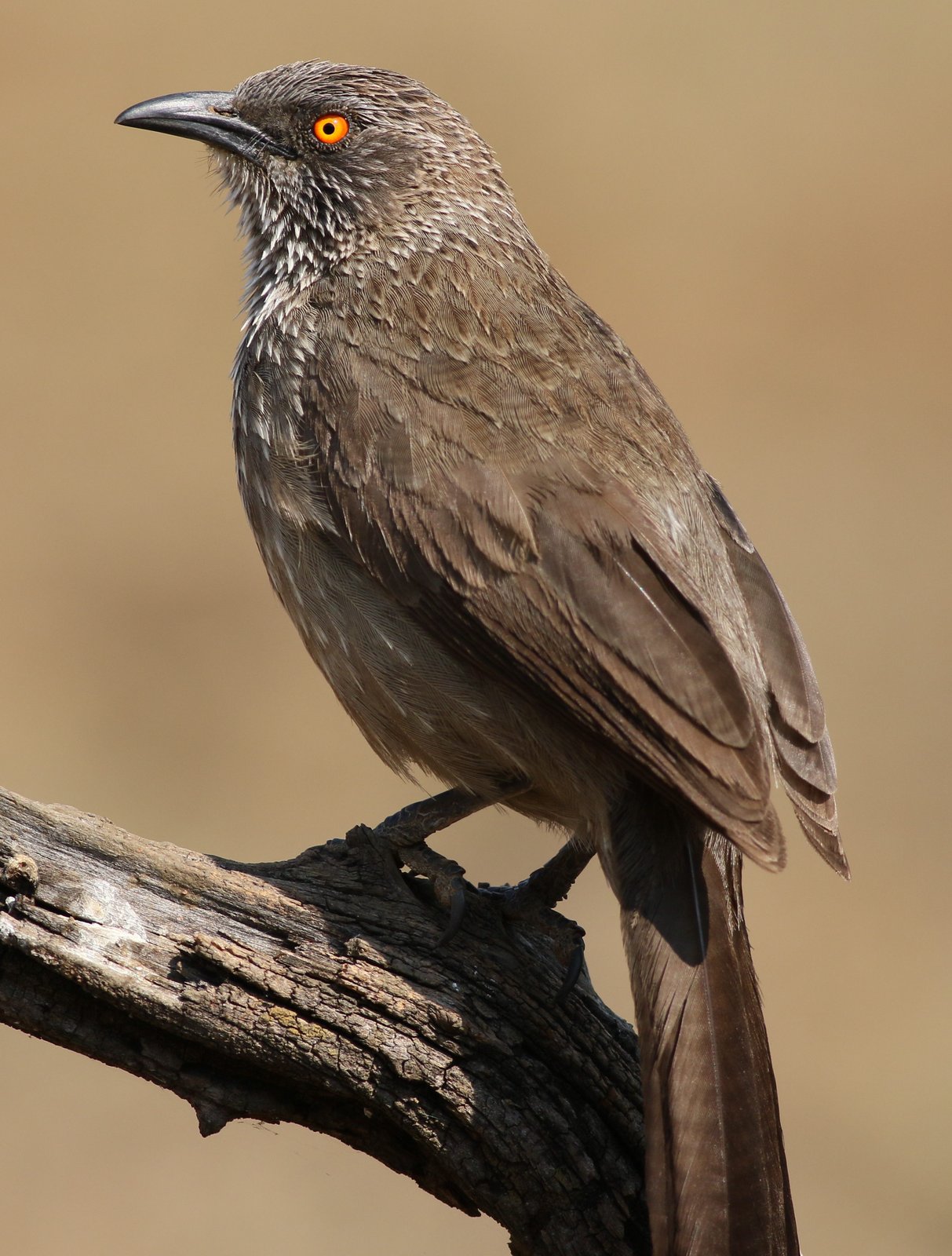
22–25 cm. A robust, greyish-brown babbler with a long, rounded tail, short rounded wings and strong legs. Head, throat and breast are greyish-brown with small white arrowhead-shaped streaks, most obvious on the crown, throat and breast; in poor light the bird looks plain brown. The belly is paler, the back plain brown, wings and tail darker. The eye is conspicuously orange to red, with a narrow yellow inner ring. Bill and legs are black. The sexes are alike; juveniles have a brown eye and hardly any white streaks.
Confusion species
Hartlaub's Babbler Turdoides hartlaubii has a white rump and white undertail-coverts and pale scaling rather than arrowheads; it lives mainly in reedbeds and riverine forest in the north-west. Black-Faced Babbler Turdoides melanops has black lores and a pale yellow eye, and a nasal, querulous call. Bare-Cheeked Babbler Turdoides gymnogenys and Southern Pied Babbler Turdoides bicolor have white heads and occur in drier areas.
Habitat
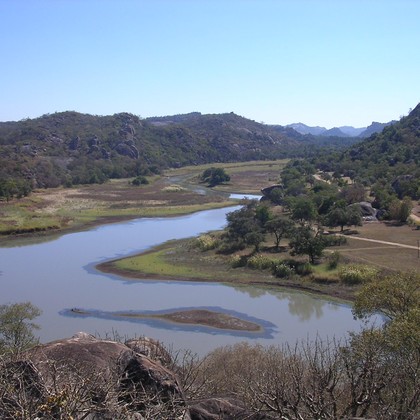
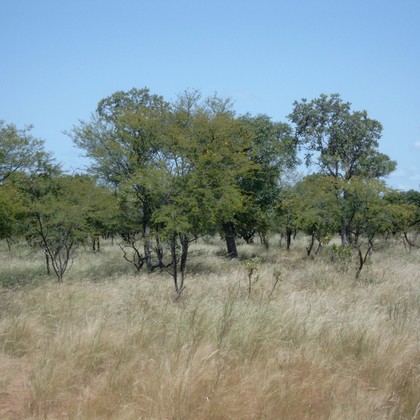
Dense bush and rank growth in all kinds of woodland, riverine forest, reed and bush fringes of rivers, overgrown gardens, plantations and village edges. It lives all year in permanent groups of three to twelve birds that forage together, preen each other and defend the territory jointly. It feeds mainly on the ground among dead leaves on insects, snails and small lizards; it also eats fruit. It breeds cooperatively: helpers feed the young of the dominant pair. The nest is often parasitised by Levaillant's Cuckoo Clamator levaillantii.
Where the bird is most at home, classified by the vegetation units of southern Africa.

Range and movements
Widespread in the north and east of the region: Angola (except the arid south-west), Zambia, Malawi, Mozambique, Zimbabwe, northern and eastern Botswana (Okavango, Chobe), north-eastern Namibia (Kavango and Zambezi Region), Eswatini and in South Africa in Limpopo, Mpumalanga, Gauteng, North West and northern KwaZulu-Natal. Beyond the region from southern DR Congo and Tanzania to Burundi and south-western Kenya.
- Resident
- Summer visitor (c. Oct–Mar)
- Winter visitor (c. Apr–Sep)
- Passage (Mar–Apr, Oct–Nov)
- dark = core range, pale = thinly spread
How and when to look
All year and fairly easy throughout the bushveld: listen for the chorus and wait until the group crosses an opening one by one on short glides. This gives good views of the orange eye and the white arrowheads. In gardens and camps, for example in the Kruger National Park, groups often come close.
Conservation status
Not threatened; common and increasing in many areas as it adapts to gardens and rank farmland. It disappears locally where bush is cleared completely.
Scientific name
Turdoides jardineii | (Smith, 1836)
Smith described the species in 1836 as Cratopus Jardineii; because it was later moved to another genus, the author and year stand in brackets. The genus Turdoides was introduced in 1826 by Cretzschmar. Turdoides comes from the Latin turdus, 'thrush', with the Greek suffix -oidēs, 'resembling' — for the thrush-like build of the babblers. jardineii honours the Scottish naturalist Sir William Jardine (1800–1874), publisher of many ornithological works. The specimen the first description was based on came from rivers north of Kurrichane (near Zeerust), South Africa.