All species › Passerines › Laughingthrushes › Bare-Cheeked Babbler
Bare-Cheeked Babbler | Turdoides gymnogenys
Naaktwangbabbelaar | Turdoide Caricalvo
The Bare-Cheeked Babbler is a near-endemic babbler of arid north-western Namibia and south-western Angola. With its white head, rufous-brown back and bare black skin patch behind the eye, it is one of the sought-after species of Kaokoveld and Damaraland.

Voice
A loud, high, fast chorus of cackling by the whole group, kweeh-kweeh-kweeh-kerr-kerr, that carries far through rocky valleys. Also a hoarse cherr as contact and alarm call.
Recording: Bram Vogels — CC BY-NC-SA 4.0 · converted to mono · xeno-canto
Identification
23–25 cm. A robust babbler with a long tail. Head, neck and underparts are white to creamy white, the flanks sometimes with a rusty wash. Below and behind the eye is a conspicuous bare black skin patch, which looks like a dark cheek at close range. Mantle and back are warm rufous to cinnamon-brown, wings and tail dark brown. The bill is black, the legs dark grey. The sexes are alike; juveniles are browner on head and breast and have a smaller bare patch.
Confusion species
Southern Pied Babbler Turdoides bicolor is wholly white with black wings and tail, without a brown back or bare cheek patch; it lives in open thornveld east of the range of Bare-Cheeked Babbler, with little overlap around Etosha. Black-Faced Babbler Turdoides melanops is dark brown with black lores and a yellow eye. Southern White-Crowned Shrike Eurocephalus anguitimens has a white crown and throat, but greyish-brown underparts and a black eye-mask.
Habitat
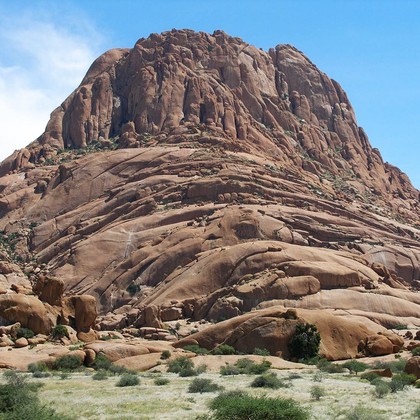
Arid woodland with mopane and other trees on rocky hills and slopes, dense bush and stands of large trees along dry riverbeds, and rocky gorges with figs and bushes; locally also at farms and camps with water. It lives in groups of four to ten birds that forage together on the ground and among rocks, and breed cooperatively.
Where the bird is most at home, classified by the vegetation units of southern Africa.


Range and movements
Within the region in north-western Namibia: Kaokoveld, the Kunene Region and northern Damaraland, east to the western edge of Etosha and the Erongo Mountains, and in south-western Angola: Namibe, Benguela, Huíla and Cunene. Near-endemic to this area; beyond it only a few vagrants.
- Resident
- Summer visitor (c. Oct–Mar)
- Winter visitor (c. Apr–Sep)
- Passage (Mar–Apr, Oct–Nov)
- dark = core range, pale = thinly spread
How and when to look
All year. Good sites are the riverbeds and rocky valleys around Palmwag, Grootberg, Kamanjab and Hobatere, and the surroundings of Opuwo and Epupa Falls. Listen early in the morning for the chorus from the riverside vegetation; groups sometimes come to water at camps.
Conservation status
Not threatened; fairly common in its restricted range. Overgrazing of riverside vegetation and the felling of large trees along dry rivers can degrade the habitat locally.
Scientific name
Turdoides gymnogenys | (Hartlaub, 1865)
Hartlaub described the species in 1865 as Crateropus gymnogenys; because it was later moved to another genus, the author and year stand in brackets. The genus Turdoides was introduced in 1826 by Cretzschmar. Turdoides comes from the Latin turdus, 'thrush', with the Greek suffix -oidēs, 'resembling' — for the thrush-like build of the babblers. gymnogenys comes from the Greek gumnos, 'naked', and genus, 'cheek' — for the bare black skin around the eye. The specimen the first description was based on came from Benguela Province, Angola.