All species › Passerines › Laughingthrushes › Southern Pied Babbler
Southern Pied Babbler | Turdoides bicolor
Eksterbabbelaar | Turdoide Bicolor
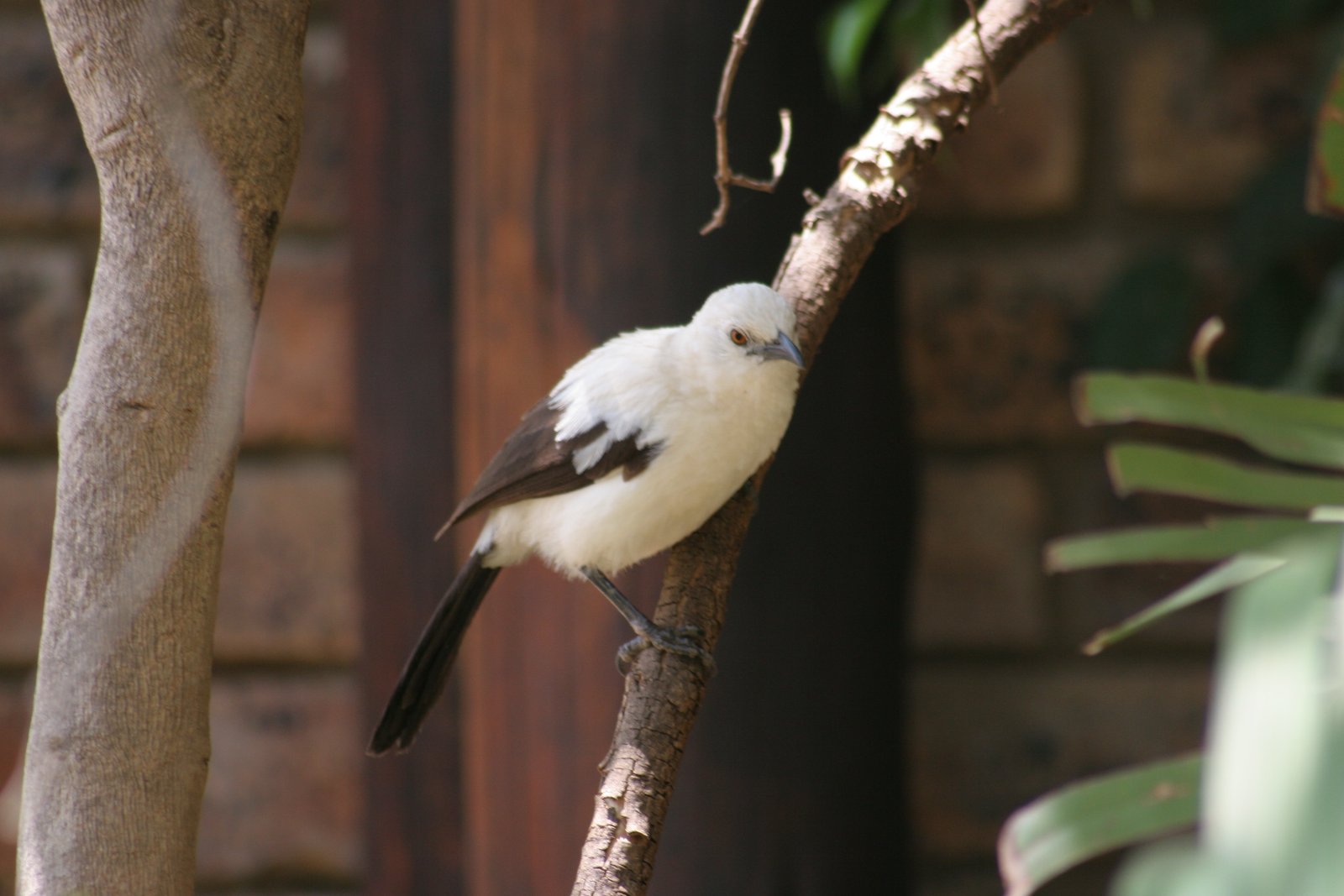
With its snow-white body and black wings and tail, the Southern Pied Babbler is the most striking babbler in the region and a characteristic bird of the Kalahari thornveld. It is endemic to southern Africa and one of the best-studied cooperative breeders in the world.
Voice
A loud, high chorus of cackling, kweer-kweer-kweer-kwerr, by the whole group at once, higher and clearer than that of Arrow-Marked Babbler. While the group forages, a sentinel reassures it with a soft ‘watchman's song’; the alarm is a sharp, blaring cherr.
Recording: Tony Archer — CC BY-NC-SA 4.0 · converted to mono · xeno-canto
Identification
24–26 cm. A robust babbler with a long tail. Head, neck, back and the entire underparts are pure white. The wings and tail are black to blackish-brown and contrast sharply with the white body. The eye is reddish-brown to orange-red, bill and legs black. The sexes are alike. Juveniles are very different: at fledging largely pale brown, becoming blotchy brown-and-white during the first year and finally white; groups containing such mottled young are therefore harder to identify.
Confusion species
Bare-Cheeked Babbler Turdoides gymnogenys in north-western Namibia also has a white head and underparts, but a rufous-brown mantle and back and a bare black skin patch behind the eye; it lives on rocky hills and in dry riverbeds. Southern White-Crowned Shrike Eurocephalus anguitimens has only a white crown and throat, a greyish-brown body and a black eye-mask, and sits upright on lookouts. Brown juvenile Southern Pied Babblers are told from Arrow-Marked Babbler Turdoides jardineii by the company of white group members and the absence of white arrowheads.
Habitat
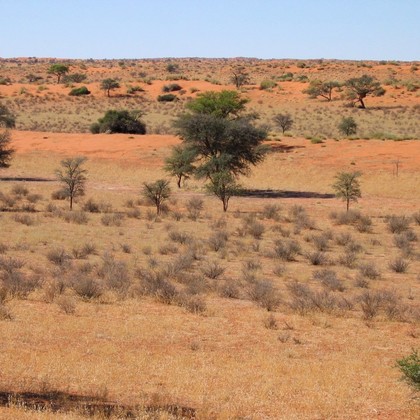
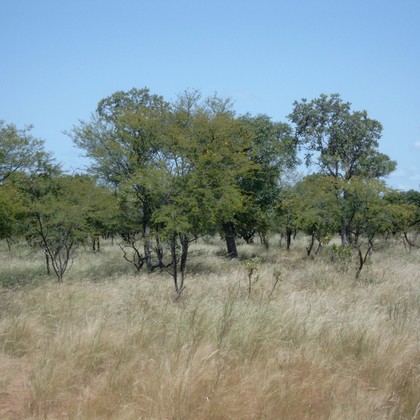
Acacia thornveld and Kalahari savanna with scattered trees and bushes on red sand, also drier mixed savanna and farmland with thorn scrub. Groups of three to fifteen birds forage mainly on the ground, digging in the sand with the bill for larvae, beetles and scorpions, while a sentinel keeps watch from a tree. It breeds cooperatively. The Fork-Tailed Drongo Dicrurus adsimilis follows the groups and uses false alarm calls to steal prey from the babblers.
Where the bird is most at home, classified by the vegetation units of southern Africa.
Range and movements
Endemic to southern Africa. Widespread in Botswana (except the north-east and the Okavango), in central, northern and eastern Namibia, in western and northern South Africa (Northern Cape north of the Orange River, North West, western Limpopo) and in south-western Zimbabwe (Matabeleland). Not found outside the region.
- Resident
- Summer visitor (c. Oct–Mar)
- Winter visitor (c. Apr–Sep)
- dark = core range, pale = thinly spread
How and when to look
All year and fairly easy in the Kalahari. Drive slowly through the thornveld in the Kgalagadi Transfrontier Park, the Central Kalahari or around Kuruman and listen for the high chorus; the white birds are then visible from afar as the group flies from bush to bush. Around the research reserve on the Kuruman River, groups are habituated to people.
Conservation status
Not threatened; common over most of its range. Long-term research on the Kuruman River shows that higher temperatures and longer droughts sharply reduce breeding success, making climate change a real future threat.
Scientific name
Turdoides bicolor | (Jardine, 1831)
Jardine described the species in 1831 as Cratopus bicolor; because it was later moved to another genus, the author and year stand in brackets. The genus Turdoides was introduced in 1826 by Cretzschmar. Turdoides comes from the Latin turdus, 'thrush', with the Greek suffix -oidēs, 'resembling' — for the thrush-like build of the babblers. bicolor is Latin for 'two-coloured' — for the contrast between the white body and the black wings and tail. The specimen the first description was based on came from South Africa (not further specified).