All species › Birds of prey › Hawks, eagles and kites › Augur Buzzard
Augur Buzzard | Buteo augur
Augurbuizerd | Busardo Augur Oriental
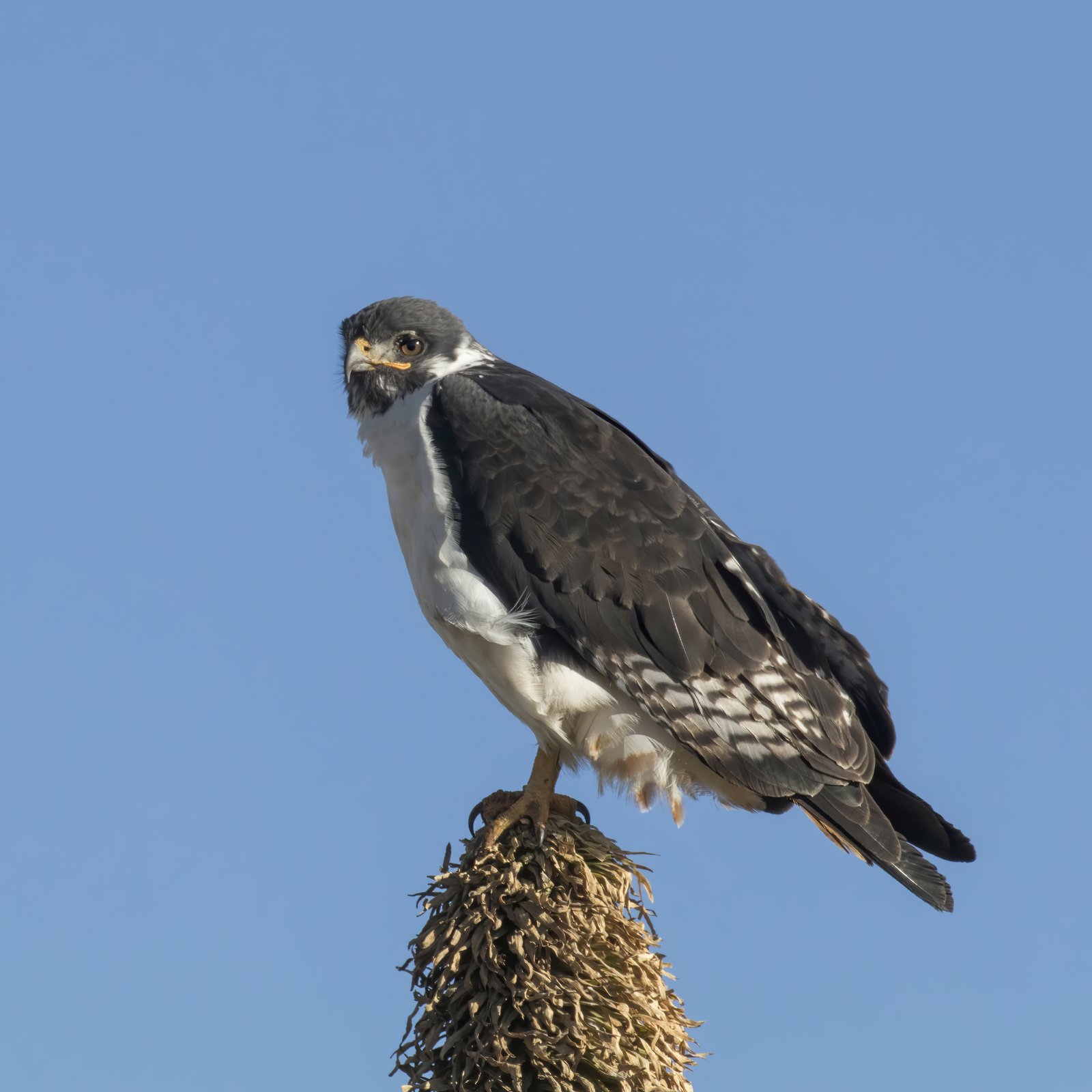
The Augur Buzzard is the large black-and-white buzzard of the East African highlands, which in the region inhabits the granite hills of Zimbabwe, the mountains of Malawi and the rocky uplands of Namibia and Angola. It likes to hang in the wind above a slope and is recognisable from afar by its brilliant white underparts and rufous tail.
Voice
A harsh, hoarse, crow-like a-kow a-kow a-kow, and in display flight a longer, higher a-waaa a-waaa. Often heard when a pair circles together over the territory.
Recording: Andrew Spencer — CC BY-NC-SA 4.0 · converted to mono · xeno-canto
Identification
48–60 cm, wingspan 120–150 cm. A bulky buzzard with broad wings and a short rufous tail with a narrow black subterminal band. Adults are slaty black above, with grey-and-black barred secondaries that form a pale wing panel in flight. The underparts are brilliant white; the female often has a black throat, the male a white one. The underwing is white with black wingtips, a narrow black trailing edge and a small dark carpal patch. A dark morph, more frequent in the north of the range but rare in the region, is entirely black below. Juveniles are brown with creamy to pale brown, lightly streaked underparts and a brown, finely barred tail.
Confusion species
Jackal Buzzard Buteo rufofuscus has a chestnut breast, a black-and-white barred belly and black underwing coverts; the two species meet in Namibia, where the pale morph of Jackal Buzzard can cause confusion. Common Buzzard Buteo buteo is smaller and browner, without the contrasting black and white. Red-Necked Buzzard Buteo auguralis is smaller, with a rufous neck and a dark breast band. Juvenile Augur Buzzards resemble juvenile Steppe Buzzards but are heavier and broader-winged.
Habitat
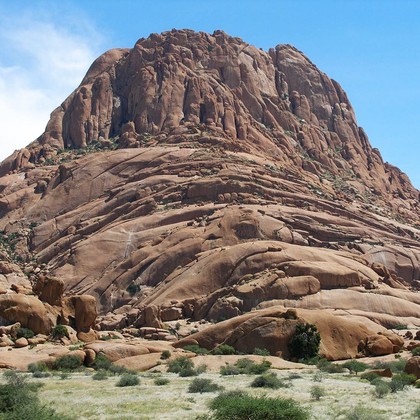
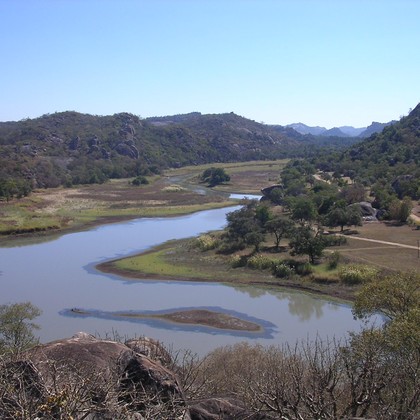
Rocky hills, granite kopjes, mountain slopes and cliffs with open grassland or woodland, from about 1000 m up into the mountains; also farmland and plantations in the highlands. It hunts from a rock, tree or pole, or by hovering in the wind, for rodents, lizards, snakes, young birds and large insects. It nests on a cliff ledge or in a tree on a slope.
Where the bird is most at home, classified by the vegetation units of southern Africa.

Range and movements
In Zimbabwe widespread in the highlands, especially the Matobo Hills, the Eastern Highlands and the granite kopjes of the central plateau; also in Malawi, eastern and northern Zambia, western Mozambique, western and south-western Angola and north-western and central Namibia (from the Kaokoveld to the Khomas and Erongo highlands). In South Africa and Botswana no more than a vagrant. Beyond the region from Ethiopia and Somalia south through East Africa.
- Resident
- dark = core range, pale = thinly spread
How and when to look
The Matobo Hills in Zimbabwe are the classic site: search the bare granite domes for a black-and-white buzzard hanging in the wind above the edge, often in the same area as Verreaux's Eagle. In Namibia it is readily found in the Erongo Mountains and around Spitzkoppe.
Conservation status
Not threatened on the Red List and fairly common in suitable habitat. It benefits locally from forest clearance in the highlands, but suffers from electrocution on power pylons and from poisoning.
Scientific name
Buteo augur | (Rüppell, 1836)
Rüppell described the species in 1836 as Falco (Buteo) Augur; because it was later moved to another genus, the author and year stand in brackets. The genus Buteo was introduced in 1799 by De Lacépède. Buteo is the Latin word for a buzzard. augur is Latin for 'augur, soothsayer' — after the Roman priests who read omens from the flight of birds. The specimen the first description was based on came from Ethiopia.