All species › Birds of prey › Hawks, eagles and kites › Jackal Buzzard
Jackal Buzzard | Buteo rufofuscus
Jakhalsbuizerd | Busardo Augur Meridional
The Jackal Buzzard is a bulky, near-endemic buzzard of southern Africa, named after its barking call, which recalls that of the Black-backed Jackal. It is the characteristic raptor of the Drakensberg, the Cape mountains and the Karoo escarpments, where it hangs on thermals and slope lift or perches on a telephone pole by the road.

Voice
A loud, barking, hoarse kyaaah-ka-ka-ka or wee-a-ka-ka, strikingly like the call of a Black-backed Jackal; the female has a lower voice. It calls mainly during display flights and when disturbed at the nest.
Recording: African Bioacoustics Community — CC BY-NC-SA 4.0 · converted to mono · xeno-canto
Identification
44–53 cm, wingspan 127–143 cm. A heavy buzzard with broad wings and a short, broad tail. Adults are slaty black above, with a rufous to chestnut breast, a black belly finely barred white and a rufous tail with a narrow dark subterminal band. The throat is black and sometimes flecked white. Below, the flight feathers are white with a broad black trailing edge, set against black underwing coverts, so that the wing looks sharply two-toned in flight. A rare pale morph has a white breast. Juveniles are plain rusty brown to cinnamon below, with a faintly barred brown tail, and take two to three years to reach adult plumage. It often hangs motionless in the wind with the wings slightly raised.
Confusion species
Augur Buzzard Buteo augur has a white breast and belly and a white underwing with only black wingtips and trailing edge; it meets the range of Jackal Buzzard in Namibia, where pale birds can be hard to separate. Common Buzzard Buteo buteo, especially the Steppe Buzzard (vulpinus), is smaller, slimmer and browner and lacks the black-and-chestnut pattern. Bateleur Terathopius ecaudatus has a similarly short-tailed silhouette and chestnut back, but glides with a rocking flight on strongly angled wings and has a red face. Forest Buzzard Buteo trizonatus is smaller, paler below and lives in forest.
Habitat
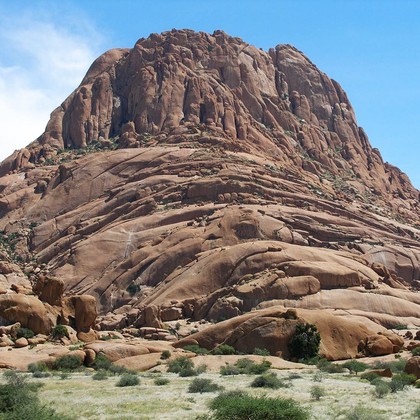
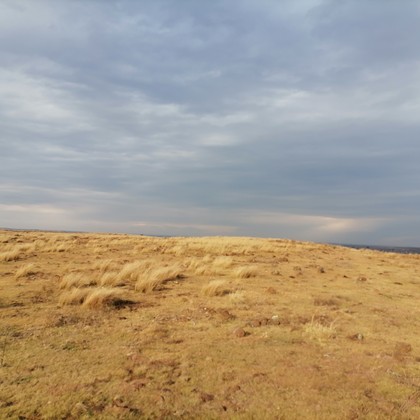
Mountains, cliffs and rocky hills with adjacent grassland, from sea level to above 3000 m in Lesotho; also fynbos, the edges of the Karoo, highveld and farmland with scattered trees or pylons. It hunts from a perch or from the air for rodents, reptiles, lizards, birds and carrion, and is often seen along roads at road-killed animals. It nests on a cliff ledge or in a tall tree.
Where the bird is most at home, classified by the vegetation units of southern Africa.

Range and movements
Almost endemic to the region: across much of South Africa, especially the mountains of the Western and Eastern Cape, the Drakensberg, KwaZulu-Natal, Free State, Mpumalanga and the Limpopo escarpment; numerous in Lesotho, and also in Eswatini, southern and central Namibia, the extreme south-east of Botswana and southern Mozambique. Scarce in the eastern lowlands and in the driest parts of the Northern Cape.
- Resident
- Summer visitor (c. Oct–Mar)
- Winter visitor (c. Apr–Sep)
- Passage (Mar–Apr, Oct–Nov)
- dark = core range, pale = thinly spread
How and when to look
Drive a mountain pass in the Drakensberg, the Eastern Cape or Lesotho and check telephone poles and rocky outcrops: Jackal Buzzards perch conspicuously upright and are often approachable. In flight the two-toned wing pattern with the chestnut breast can be seen from a great distance. In strong slope winds, listen for the barking call of birds hanging above the ridge.
Conservation status
Not threatened on the Red List and common in suitable habitat. Collisions with wind turbines and power lines, electrocution and poisoned baits put out for jackals and feral dogs are the main threats; the growth of wind farms in the Eastern and Western Cape is being monitored closely.
Scientific name
Buteo rufofuscus | (Forster, 1798)
Forster described the species in 1798 as Falco rufofuscus; because it was later moved to another genus, the author and year stand in brackets. The genus Buteo was introduced in 1799 by De Lacépède. Buteo is the Latin word for a buzzard. rufofuscus comes from the Latin rufus, 'rufous', and fuscus, 'dusky' — for the dark upperparts and rufous tail. The specimen the first description was based on came from South Africa.