All species › Passerines › Cisticolas › Banded Prinia
Banded Prinia | Prinia bairdii
Zebraprinia | Prinia Barrada
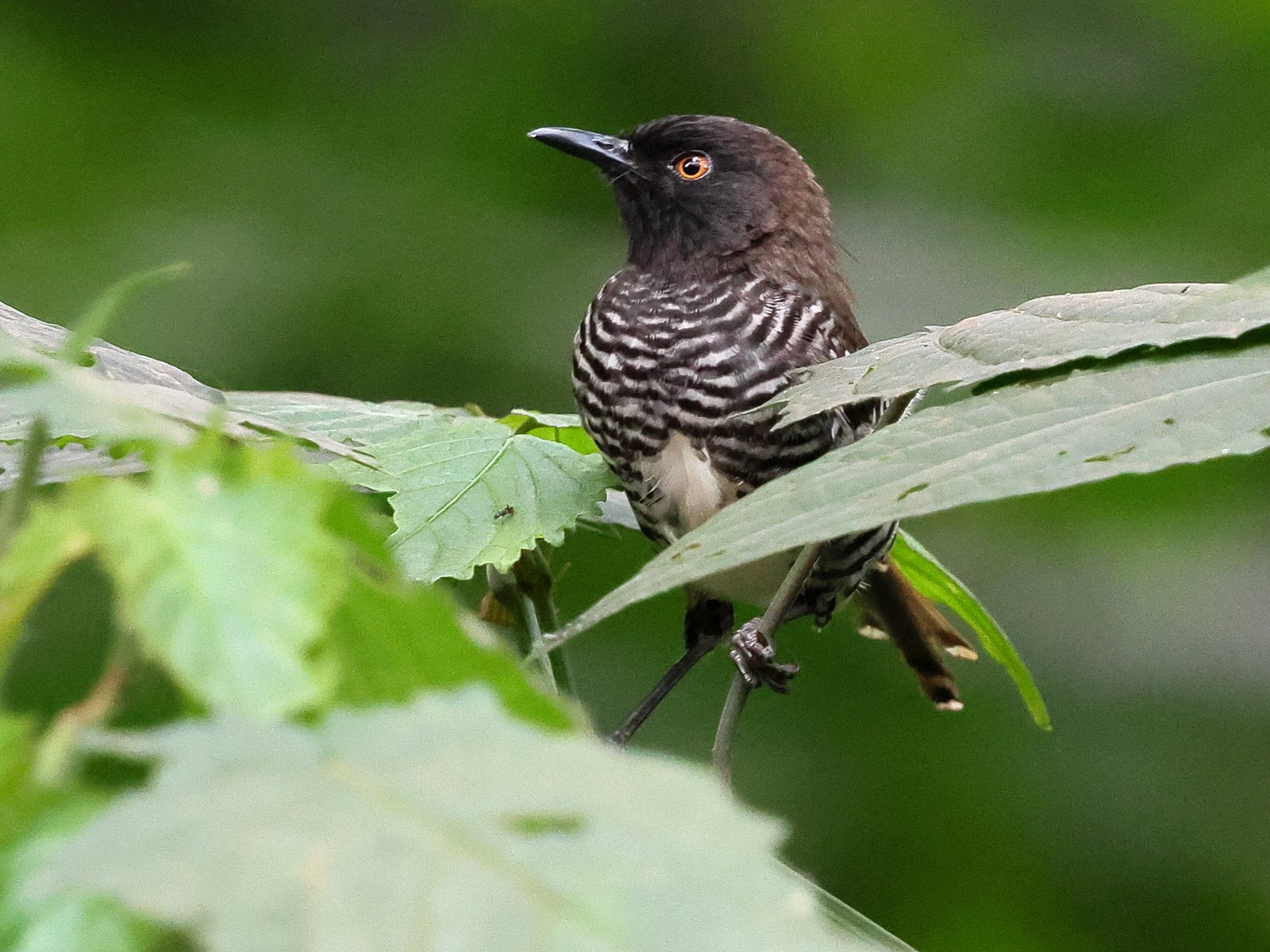
The Banded Prinia is a dark forest prinia with a long tail and a black-and-white barred throat and breast, which moves in pairs or family parties through the undergrowth of moist forest. It is a species of the Central African rainforest; within the region it reaches only the wet forests of north-western Angola, where an endemic subspecies occurs.
Voice
Noisy. The song is a fast, penetrating series of repeated notes, chweep-chweep-chweep or tswi-tswi-tswi, often as a duet in which the partner answers with a rattling chrrr. The contact call is a sharp tchip. The sound is usually the first sign of a party in the undergrowth.
Recording: Jaap van der Waarde — CC BY-NC-SA 4.0 · converted to mono · xeno-canto
Identification
12–13 cm, with a long graduated tail. Head and upperparts are dark sooty brown to almost black, with no supercilium. The wing coverts have conspicuous white tips forming two or three rows of spots on the closed wing, and the tail feathers bear white spots at the tips, so that the spread tail looks spotted. Throat, breast and flanks are white with dense, narrow black bars; the belly is whiter, with a buff tinge to the undertail coverts. The iris is pale yellow to orange, the bill black, the legs pink. The sexes are alike; juveniles are browner and less sharply barred. It constantly flicks and swings its tail.
Confusion species
Not confusable with any other prinia in the region. White-Chinned Prinia Schistolais leucopogon lives at the same Angolan forest edges but is plain slate-grey with a white throat, lacking barring and white wing spots. Bleating Camaroptera Camaroptera brachyura is grey with green wings and a short tail. Barred Wren-Warbler Calamonastes fasciolatus is also barred below, but is brown, short-tailed and lives in dry savanna far from forest. The combination of dark upperparts, barred underparts and white wing spots is diagnostic.
Habitat
Dense undergrowth at the edges of moist lowland forest and gallery forest, in clearings with rank growth, ferns and creepers, along forest tracks and in old clearings with regrowth. It forages from low down to mid-level for small insects, in pairs or parties of three to six birds.
Where the bird is most at home, classified by the vegetation units of southern Africa.

Range and movements
Within the region only in north-western Angola, in the wet forests of the northern escarpment (including Cuanza Norte and Uíge); the subspecies heinrichi occurs there. Beyond the region from south-eastern Nigeria and Cameroon through the Congo Basin to eastern DR Congo, Uganda, Rwanda, Burundi and western Kenya.
- Resident
- dark = core range, pale = thinly spread
How and when to look
Year-round; in Angola search rank forest edges and forest tracks on the north-western escarpment, for example around Ndalatando and in Uíge. Listen for the penetrating duet and wait at a gap in the undergrowth; the birds are inquisitive and often come briefly into view, the spotted tail fanned.
Conservation status
Not threatened. Common over a large range in Central Africa. In Angola the species depends on the remaining wet escarpment forests, which are under pressure from logging, agriculture and coffee cultivation; the very small Angolan range makes the local population vulnerable.
Scientific name
Prinia bairdii | (Cassin, 1855)
Cassin described the species in 1855 as Drymoica Bairdii; because it was later moved to another genus, the author and year stand in brackets. The genus Prinia was introduced in 1821 by Horsfield. Prinia comes from prinya, the Javanese name for Prinia familiaris, the prinia of that island. bairdii honours the American naturalist Spencer Fullerton Baird (1823–1887) of the Smithsonian Institution. The specimen the first description was based on came from Mondah River, Gabon.