All species › Passerines › Cisticolas › Drakensberg Prinia
Drakensberg Prinia | Prinia hypoxantha
Drakensbergprinia | Prinia del Drakensberg
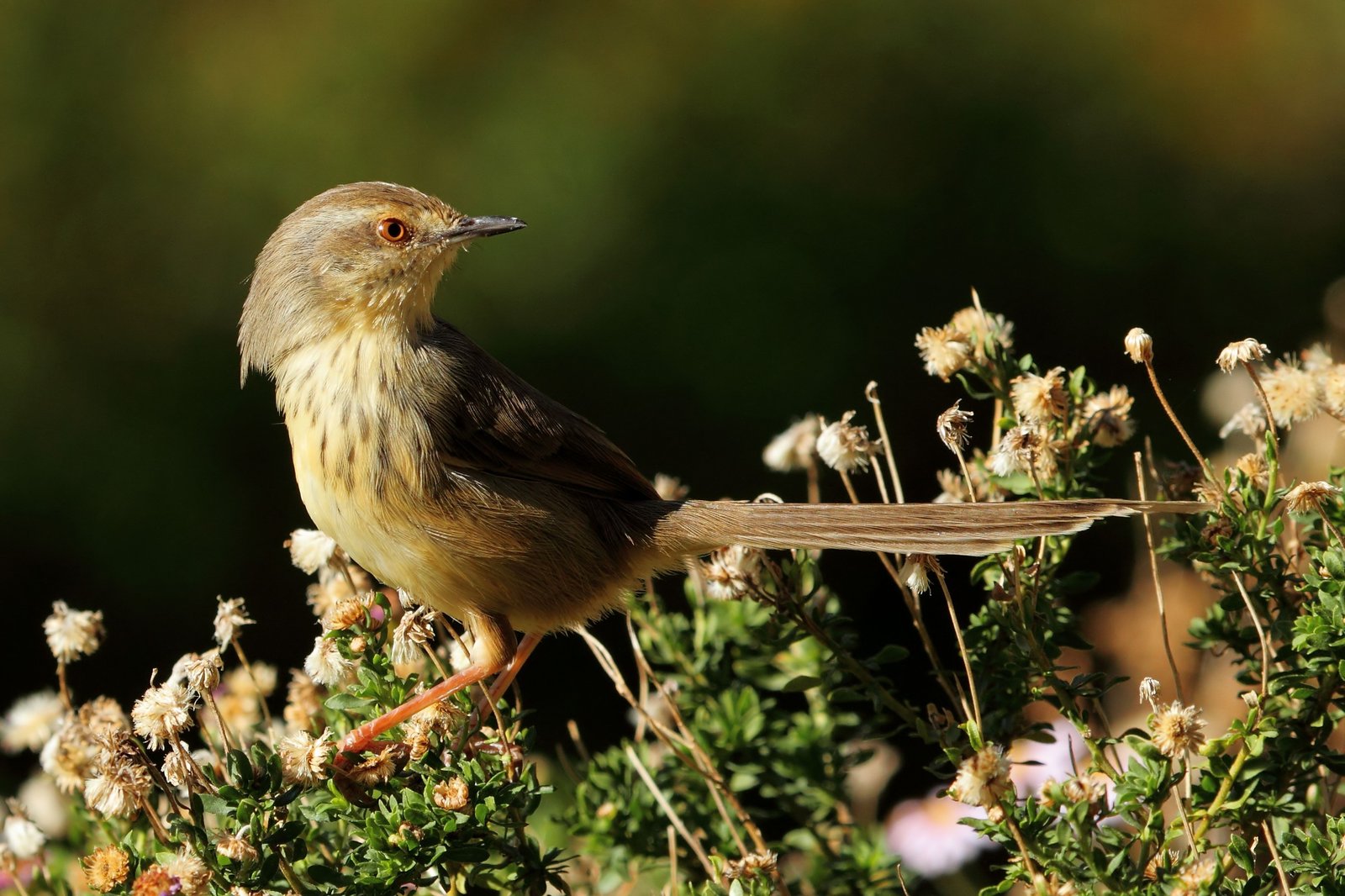
The Drakensberg Prinia is the eastern counterpart of the Karoo Prinia: a long-tailed, streaked prinia of rank growth at forest edges, in gullies and along streams in the mountains and hills of eastern South Africa. It was long treated as a subspecies of Karoo Prinia, but differs in the colour of the underparts, habitat and range. The species occurs nowhere outside South Africa, Lesotho and Eswatini.
Voice
The call is a sharp, repeated cheep-cheep-cheep or tlip-tlip-tlip, and when agitated a rasping chrrrt. The song is a fast series of the same notes, at times running into a dry trill. Pairs keep close contact and often call in turn.
Recording: Daan van der Hoeven — CC BY-NC-SA 4.0 · converted to mono · xeno-canto
Identification
12–14 cm, about half of which is tail. The upperparts are warm olive-brown; the long graduated tail has dark subterminal marks and pale tips to the feathers. A narrow pale supercilium runs behind the eye; the lores are dark. Throat and breast are pale yellow to pale sulphur-yellow with fine, rather sparse dark streaks that fade on the flanks; belly and flanks are warmer yellow to buffy yellow. The iris is pale brown to orange-brown, the bill black, the legs pink. The sexes are alike; juveniles are yellower and almost unstreaked. It often holds the tail cocked and moves briskly through rank growth and scrub.
Confusion species
Karoo Prinia Prinia maculosa is very similar, but has white to off-white underparts with bolder black drop-shaped spots and cooler, greyer upperparts; it lives in fynbos and Karoo scrub further west and south-west, with a narrow contact zone in the Eastern Cape. Black-Chested Prinia Prinia flavicans has a black breast band in breeding plumage and is unstreaked yellow below outside the breeding season; it lives in dry thornveld rather than mountain scrub. Tawny-Flanked Prinia Prinia subflava is unstreaked, with a white throat and tawny flanks. A yellow, finely streaked prinia in montane rank growth in the east is almost always a Drakensberg Prinia.
Habitat
Rank growth, bracken, tall grass and scrub at the edges of Afromontane forest, in wooded gullies and along streams and seeps in montane grassland, extending into overgrown gardens, plantation edges and fallow land. It occurs from about 900 m high into the Drakensberg. It forages low in the vegetation for small insects and spiders, usually in pairs or small family parties.
Where the bird is most at home, classified by the vegetation units of southern Africa.


Range and movements
Within the region in eastern South Africa: the Limpopo escarpment (Soutpansberg, Wolkberg and Magoebaskloof), the Mpumalanga escarpment and eastern Highveld, the eastern Free State, KwaZulu-Natal from the Drakensberg to the midlands, and the Eastern Cape to the Amatola Mountains; also western Eswatini and the valleys and lower margins of Lesotho. Endemic to this area; it occurs nowhere else.
- Resident
- Summer visitor (c. Oct–Mar)
- Winter visitor (c. Apr–Sep)
- Passage (Mar–Apr, Oct–Nov)
- dark = core range, pale = thinly spread
How and when to look
Year-round; good places are Magoebaskloof and Haenertsburg, the Dullstroom and Kaapsehoop area, Golden Gate, the Drakensberg foothills at Giant's Castle and Sani Pass, and Hogsback in the Eastern Cape. Walk a forest edge or a vegetated stream and listen for the sharp cheep; the bird often comes inquisitively to the edge of the rank growth and perches briefly on top of a fern or bush.
Conservation status
Not threatened. Common within its limited range, and locally benefiting from rank growth along plantations and roads. Large-scale afforestation with exotic trees, heavy grazing and frequent burning of grassland reduce suitable habitat elsewhere.
Scientific name
Prinia hypoxantha | (Sharpe, 1877)
Sharpe described the species in 1877 as Drymoeca hypoxantha; because it was later moved to another genus, the author and year stand in brackets. The genus Prinia was introduced in 1821 by Horsfield. Prinia comes from prinya, the Javanese name for Prinia familiaris, the prinia of that island. hypoxantha comes from the Greek hupo, 'below', and xanthos, 'yellow' — for the underparts, yellower than in the related Karoo Prinia. The specimen the first description was based on came from Seymour (formerly Eland's Post), Eastern Cape.