All species › Passerines › Cisticolas › Karoo Prinia
Karoo Prinia | Prinia maculosa
Karooprinia | Prinia del Karoo
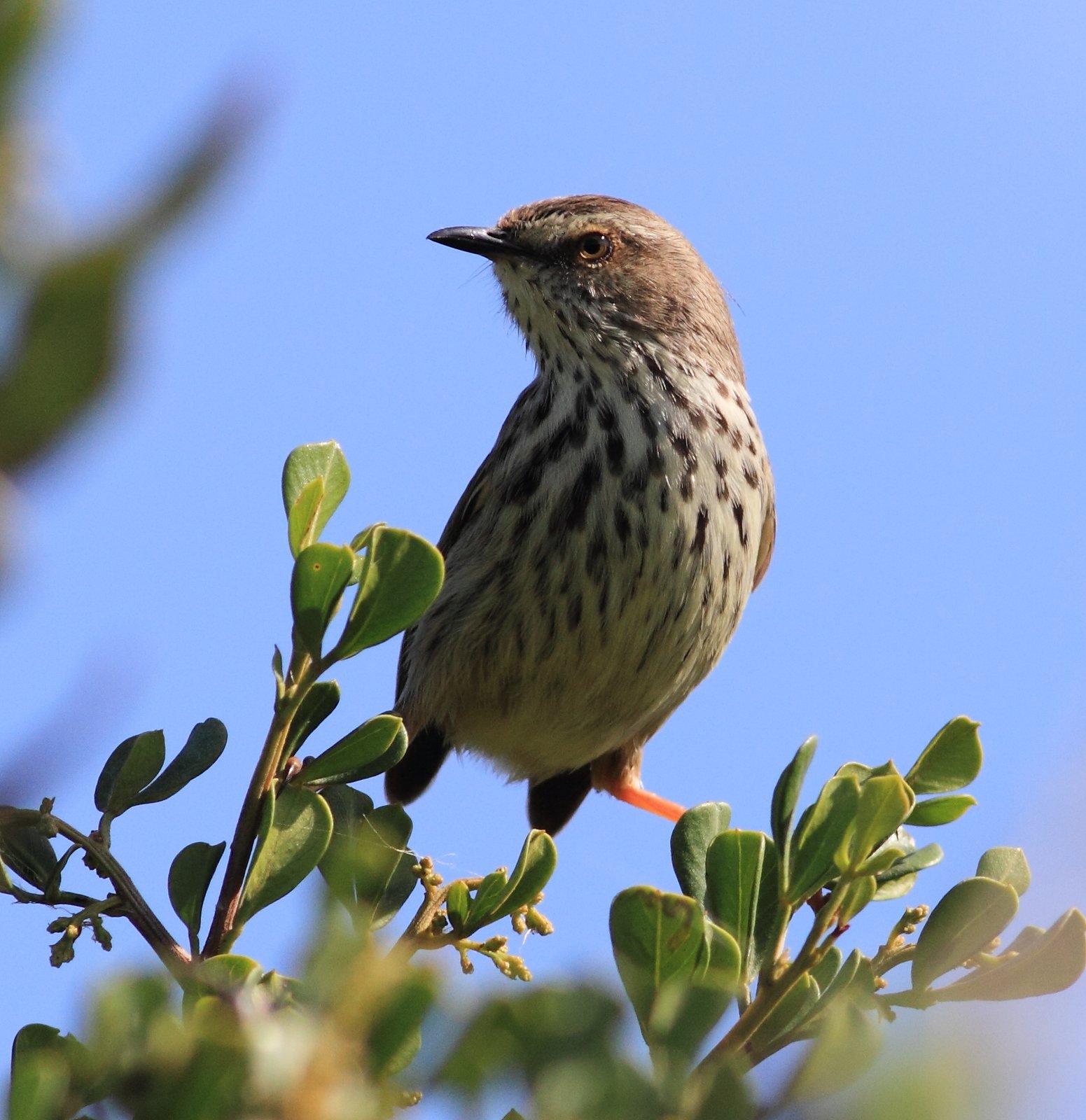
The Karoo Prinia is a brown, long-tailed prinia with heavily streaked, yellowish-white underparts and a pale supercilium, typical of fynbos, renosterveld and Karoo scrub in the south-west. It is endemic to southern Africa. Its eastern counterpart, Drakensberg Prinia, was formerly included in the same species.
Voice
A rapidly repeated, high tit-tit-tit-tit or chleet-chleet-chleet, from the top of a bush with the tail upright, and a dry, crackling zzzt when alarmed. Pairs answer each other constantly.
Recording: Walter Wallner — CC BY-NC-SA 4.0 · converted to mono · xeno-canto
Identification
13–15 cm, about half of which is tail. The upperparts are grey-brown, sometimes with faint dark streaks, with a pale yellowish to white supercilium and a dark loral stripe. The underparts are whitish to pale yellow, heavily streaked and spotted on throat and breast with black streaks and drops that become finer on the flanks; lower belly and undertail coverts are washed buffy yellow. The iris is pale brown to yellow-brown, the bill dark, the legs pinkish-brown. The long tail has dark spots before the pale tips. The sexes are alike; juveniles are yellower and less heavily streaked.
Confusion species
Drakensberg Prinia Prinia hypoxantha of the eastern escarpment and the Drakensberg is warmer brown above, brighter yellow below and more finely streaked, and lives in rank growth and bracken at forest edges and in sheltered grassland; where the two meet, as in the Eastern Cape, habitat and colour are the best guide. Namaqua Warbler Phragmacia substriata is more finely streaked, has rufous wings and flanks and lives in riverine growth. Black-Chested Prinia Prinia flavicans has unstreaked yellow underparts, with a black band in breeding plumage. Cape Grassbird Sphenoeacus afer is much larger, with a rufous crown and a streaked back. Bold breast streaks on a long-tailed brown bird in open scrub point to Karoo Prinia.
Habitat
Fynbos, renosterveld, strandveld and coastal fynbos, Karoo scrub and the bush along dry riverbeds, up onto mountain slopes and into gardens. It forages low in bushes for insects, usually in pairs or family groups.
Where the bird is most at home, classified by the vegetation units of southern Africa.


Range and movements
Within the region in the Western Cape, the Northern Cape (mainly the south and west, including Namaqualand), the west and centre of the Eastern Cape, south-western Free State and Lesotho, and in the far south of Namibia along the Orange River. Nowhere outside southern Africa.
- Resident
- Winter visitor (c. Apr–Sep)
- dark = core range, pale = thinly spread
How and when to look
Year-round and common in the Cape fynbos; good sites are West Coast National Park, the Cape of Good Hope and the Karoo reserves. A singing bird often sits on top of a bush and gives good views; then look for the bold breast streaks and the pale supercilium.
Conservation status
Not threatened. Common over much of the south-west of the region. Conversion of renosterveld and fynbos to cropland and the spread of alien trees cost habitat locally, but the species also uses gardens and rough margins.
Scientific name
Prinia maculosa | (Boddaert, 1783)
Boddaert described the species in 1783 as Motacilla maculosa; because it was later moved to another genus, the author and year stand in brackets. The genus Prinia was introduced in 1821 by Horsfield. Prinia comes from prinya, the Javanese name for Prinia familiaris, the prinia of that island. maculosa is Latin for 'spotted', for the darkly streaked breast. The specimen the first description was based on came from Cape of Good Hope; later fixed as Swellendam, Western Cape.