All species › Passerines › Cisticolas › Black-Chested Prinia
Black-Chested Prinia | Prinia flavicans
Zwartborstprinia | Prinia Pechinegra
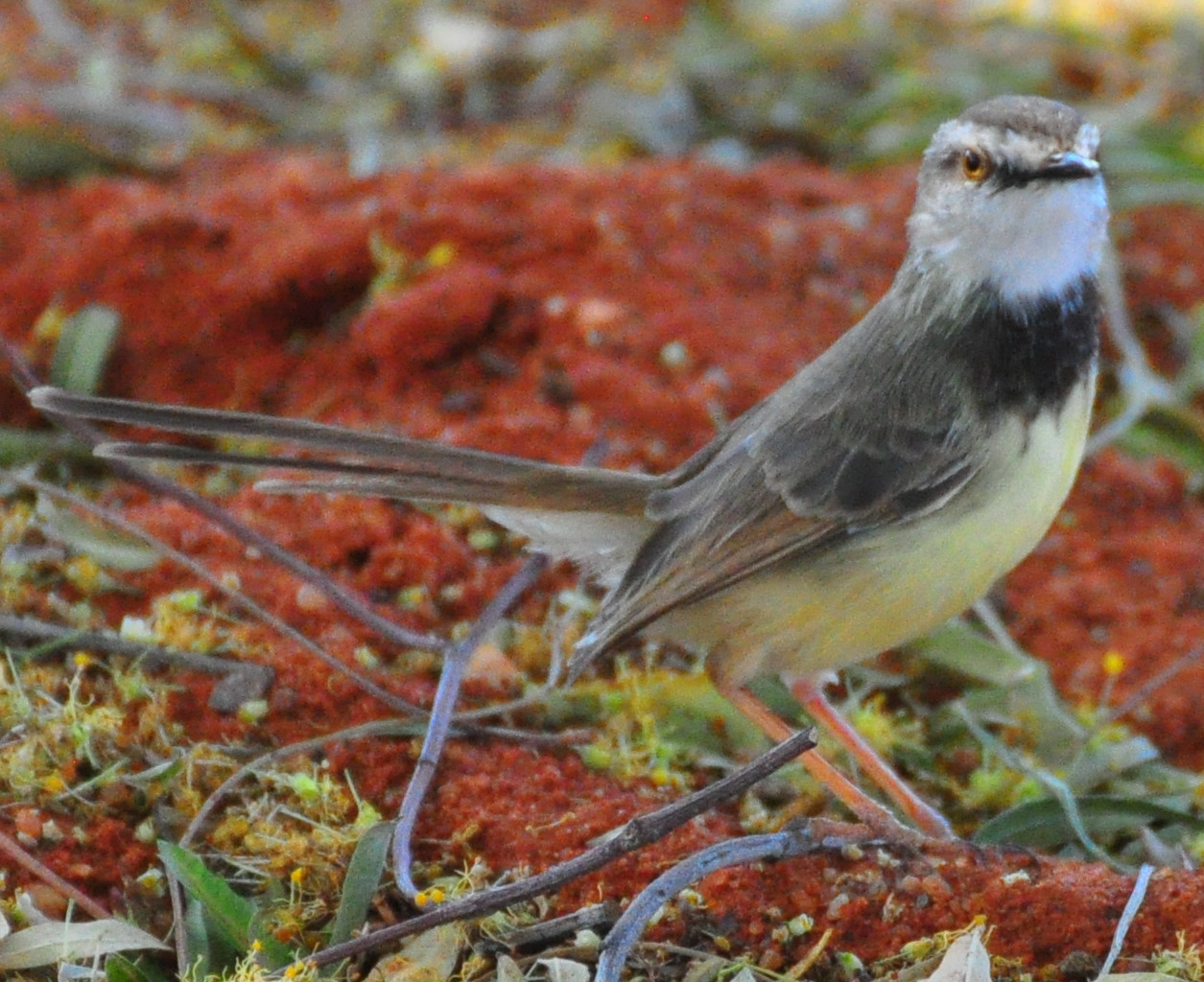
The Black-Chested Prinia is the prinia of the dry western savanna and the Karoo: in breeding plumage a grey-brown warbler with bright yellow underparts and a broad black breast band. Outside the breeding season the band disappears and a yellow, long-tailed bird remains. The species is almost entirely confined to the region.
Voice
Noisy: a fast, repeated dry zrrt-zrrt-zrrt and a clear chip-chip-chip or tcheet-tcheet, from a bush with the tail upright. When alarmed a sharp, nasal scolding. Pairs call to each other a great deal.
Recording: Yoann Blanchon — CC BY-NC-SA 4.0 · converted to mono · xeno-canto
Identification
13–15 cm, with a long graduated tail often held upright or cocked over the back. The upperparts are grey-brown, with a white to pale yellow supercilium and a dark loral stripe. In breeding plumage the throat is white and a broad black band crosses the breast, sharply set off against the yellow belly and flanks. In non-breeding plumage the band is absent or reduced to a few dark spots, and the whole underparts are yellow to buffy yellow. The iris is pale brown to orange-brown, the bill black, the legs pink. The sexes are alike; juveniles are yellow below and unmarked.
Confusion species
Hard to confuse in breeding plumage. Rufous-Eared Warbler Malcorus pectoralis also has a narrow black breast band, but has rufous ear coverts, white underparts and a streaked back, and runs on the ground in the Karoo. Without its band Black-Chested Prinia resembles Tawny-Flanked Prinia Prinia subflava, but that is white with tawny flanks, not yellow, and has rufous wing edges. Karoo Prinia Prinia maculosa has a heavily streaked throat and breast. Yellow-Bellied Eremomela Eremomela icteropygialis is smaller, with a short tail and yellow only on the lower belly. Yellow underparts, a long tail and the dry habitat point to Black-Chested Prinia outside the breeding season too.
Habitat
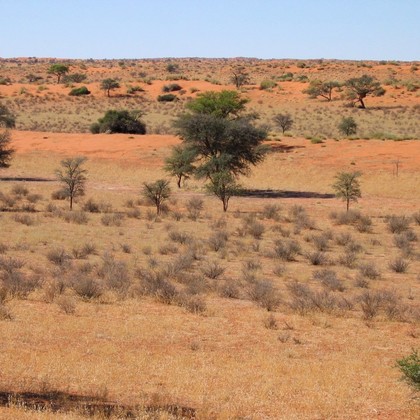
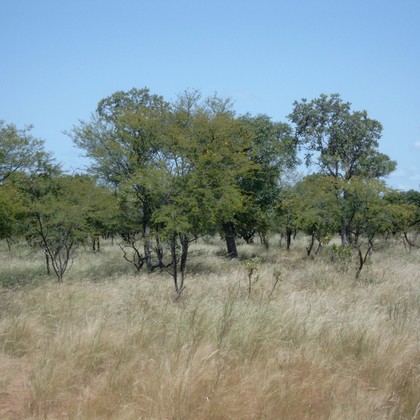
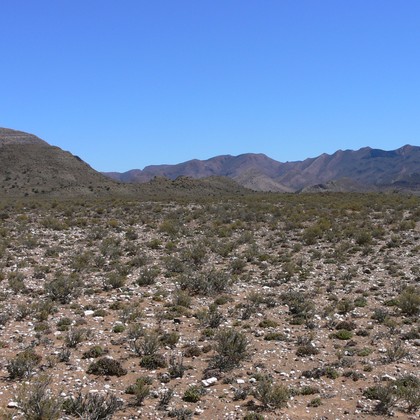
Dry savanna and thornveld, Kalahari scrub, Nama Karoo with bushes, dry riverbeds with scrub, and also gardens, farmyards and field margins in dry areas. It forages low in bushes and rank growth for insects, usually in pairs.
Where the bird is most at home, classified by the vegetation units of southern Africa.
Range and movements
Within the region in south-western Angola (Namibe, Huíla and Cunene), in almost all of Namibia except the barren Namib, in Botswana (mainly the centre, south and west), in south-western Zimbabwe, and in South Africa in the Northern Cape, North West, Free State, Gauteng, western Limpopo and the interior Karoo. Nowhere outside southern Africa.
- Resident
- Winter visitor (c. Apr–Sep)
- Passage (Mar–Apr, Oct–Nov)
- dark = core range, pale = thinly spread
How and when to look
Year-round; common in the Kalahari and in Namibia, for example around Windhoek and in Kgalagadi Transfrontier Park, and in Angola at, among others, the Tundavala escarpment near Lubango. In spring and summer the breeding plumage with its black band is at its best; in winter look for the yellow underparts and the long, cocked tail.
Conservation status
Not threatened. Common and widespread in the dry savanna and scrub of the region, and tolerant of grazing and settlement.
Scientific name
Prinia flavicans | (Vieillot, 1820)
Vieillot described the species in 1820 as Sylvia flavicans; because it was later moved to another genus, the author and year stand in brackets. The genus Prinia was introduced in 1821 by Horsfield. Prinia comes from prinya, the Javanese name for Prinia familiaris, the prinia of that island. flavicans is Latin for 'yellowish, turning yellow', for the yellow underparts. The specimen the first description was based on came from southern Africa; later restricted to Namaqualand.