All species › Passerines › Sunbirds › Bannerman's Sunbird
Bannerman's Sunbird | Cyanomitra bannermani
Bannermans honingzuiger | Suimanga de Bannerman
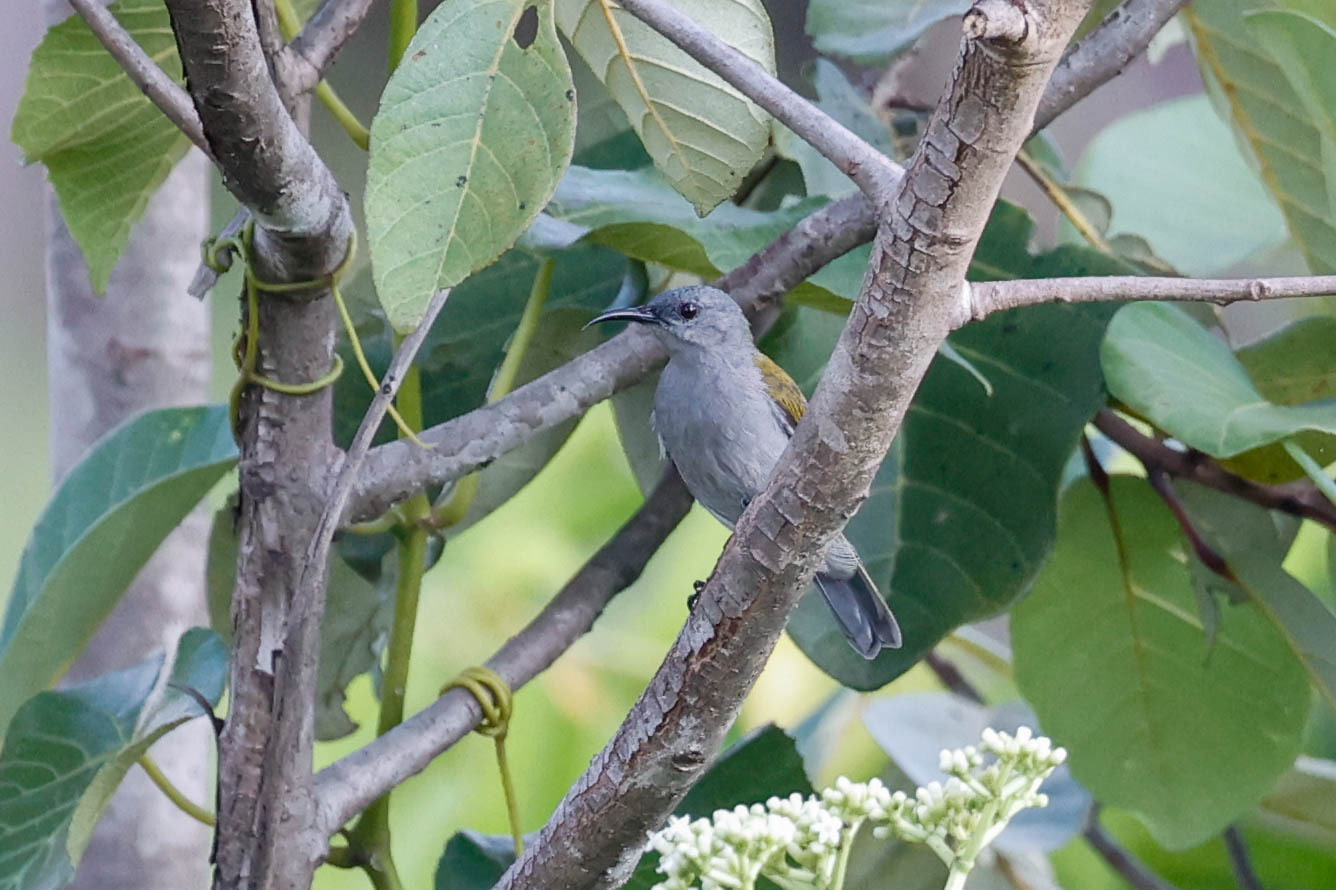
Bannerman's Sunbird is a little-known sunbird of the gallery and swamp forests (mushitu) on the plateau of north-western Zambia, Angola and southern Congo-Kinshasa. It closely resembles Green-Headed Sunbird and is identified mainly by range and habitat.
Voice
A sharp tchip and a dry tchit-tchit as contact calls. The song is a high, fast, thin twitter recalling that of Green-Headed Sunbird, delivered from the mid-storey of the forest.
No recording with a suitable Creative Commons licence is available for this species yet.
Identification
13 to 14 cm, with a long, decurved bill. The male has a glossy hood covering head, throat and upper breast that looks blue in most light, sometimes green; back and wings are olive-green, the belly grey. Yellow pectoral tufts show in display. The female has olive-green upperparts, grey underparts and an almost plain head with at most some gloss on the crown. Juveniles are duller olive with a yellowish throat.
Confusion species
Green-Headed Sunbird (Cyanomitra verticalis) is the main pitfall: in the male of that species the gloss is confined to head and throat and the breast is dark grey, and the female has a clearly glossy head above a grey throat. The two species occur together locally in Angola and Zambia, so a good view of head gloss and breast is needed. Olive Sunbird (Cyanomitra olivacea) lacks any gloss.
Habitat
Evergreen gallery forest along rivers, swamp forest (mushitu) and dense forest edges on the plateau, as well as adjacent thicket and clearings with flowering trees. It seeks nectar and insects in the mid-storey and at the forest edge, often singly or in pairs.
Where the bird is most at home, classified by the vegetation units of southern Africa.

Range and movements
Within the region in north-western Zambia (Mwinilunga, Solwezi and surroundings) and in the interior of Angola, mainly in Malanje, Cuanza Sul and the Lunda provinces, with scattered records in Moxico. Beyond the region only in southern Congo-Kinshasa, in Katanga and nearby.
- Resident
- dark = core range, pale = thinly spread
How and when to look
The mushitu forests around Mwinilunga and the source of the Zambezi in north-western Zambia are the best-known site; other plateau specialities occur here too. Work the edges of gallery forest quietly in the morning and, for every glossy sunbird, note how far the gloss extends onto the breast.
Conservation status
Not threatened. The species has a limited range but is considered stable. Clearance of gallery forest, fires that damage forest edges and conversion to farmland are local threats.
Scientific name
Cyanomitra bannermani | Grant & Mackworth-Praed, 1943
Grant & Mackworth-Praed described the species in 1943 and placed it straight away in the genus where it still stands. The genus Cyanomitra was introduced in 1853 by Reichenbach. Cyanomitra comes from the Greek kuanos, 'dark blue, greenish blue', and mitra, 'headband, diadem' — for the glossy blue or green head or throat of many species. bannermani honours the British ornithologist David Armitage Bannerman (1886–1979), an authority on the birds of West Africa. The specimen the first description was based on came from Kayoyo, southern DR Congo.