All species › Passerines › Sunbirds › Green-Headed Sunbird
Green-Headed Sunbird | Cyanomitra verticalis
Groenkophoningzuiger | Suimanga Cabeciverde
The Green-Headed Sunbird is a fairly large, green-and-grey sunbird of forest edges and riverine forest in the north of the region. Both sexes have a glossy head, which sets it apart among the sunbirds: the female, too, can be recognised by its head.
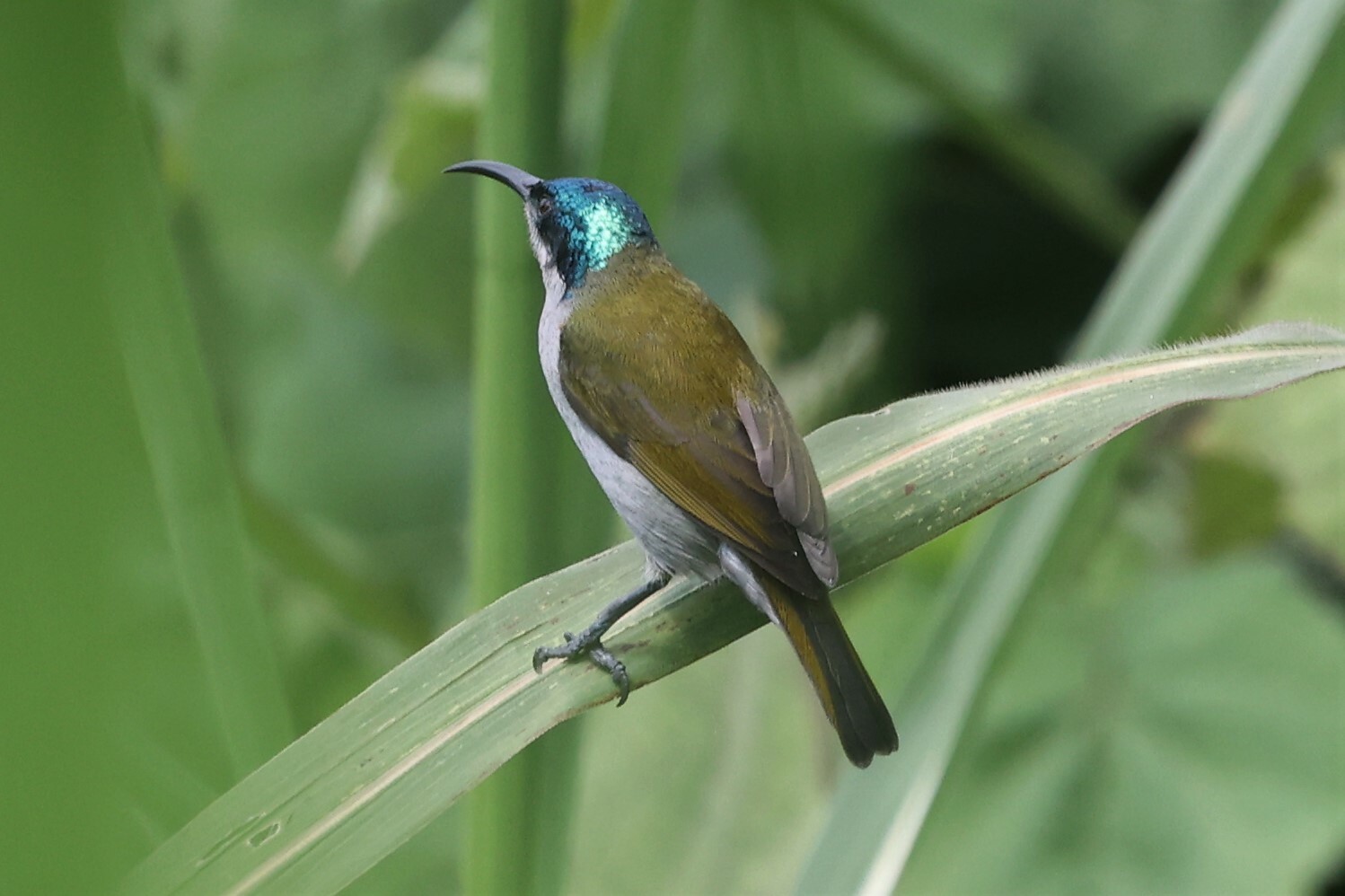
Click a thumbnail to switch the photo above.
Voice
A sharp, loud tchip or tcheep, often in series. The song is a short, fast, high twitter of high notes interspersed with harsh metallic tones, delivered from a tree crown or bush at a forest edge.
Recording: isaac kilusu — CC BY-NC-SA 4.0 · converted to mono · xeno-canto
Identification
13 to 14 cm, with a long, decurved bill. The male has a glossy head and throat that look green to blue-green depending on the light, an olive-green back and wings and dark grey underparts; the yellow pectoral tufts are usually hidden. The female also has a glossy crown and head sides, but a grey throat and pale grey underparts. Juveniles are olive with a dull head and a yellowish wash on the throat.
Confusion species
Bannerman's Sunbird (Cyanomitra bannermani) of the Zambian–Angolan plateau is very similar; the male's gloss extends onto the upper breast, and the female has an almost plain head without gloss. Blue-Throated Brown Sunbird (Cyanomitra cyanolaema) is dark brown with blue gloss only on the forehead and throat. Olive Sunbird (Cyanomitra olivacea) lacks any gloss on the head.
Habitat
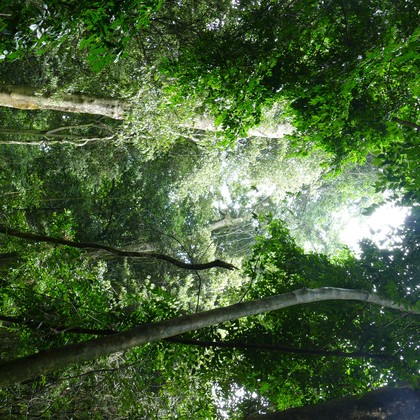
Edges of evergreen and gallery forest, secondary forest, wooded ravines and riverside thicket, and also plantations, farmland with trees and gardens. It takes nectar at flowering trees and shrubs, such as coral trees and exotic ornamentals, and catches many insects and spiders.
Where the bird is most at home, classified by the vegetation units of southern Africa.


Range and movements
Within the region in northern and western Angola, from Cabinda and Zaire south to Cuanza Sul and east to Malanje and the Lunda provinces, also in northern Zambia and northern Malawi. Beyond the region from Senegal east to Uganda, western Kenya and Tanzania, and south through Congo-Kinshasa.
- Resident
- dark = core range, pale = thinly spread
How and when to look
In Angola the species is common in gardens and forest edges around Luanda, Kalandula and in the forests of the Cuanza Sul escarpment. With any glossy-headed sunbird, check the throat and breast: in the female of this species the glossy head contrasts sharply with a grey throat, a pattern shown by no other sunbird in the region.
Conservation status
Not threatened. The species is widespread, adapts well to secondary growth and gardens and is often common within its range. At the southern edge of the range it is local and scarce.
Scientific name
Cyanomitra verticalis | (Latham, 1790)
Latham described the species in 1790 as Certhia verticalis; because it was later moved to another genus, the author and year stand in brackets. The genus Cyanomitra was introduced in 1853 by Reichenbach. Cyanomitra comes from the Greek kuanos, 'dark blue, greenish blue', and mitra, 'headband, diadem' — for the glossy blue or green head or throat of many species. verticalis is Late Latin for 'crowned, of the head', from vertex, 'crown of the head' — for the glossy green head. The specimen the first description was based on came from Senegal (originally just 'Africa').