All species › Passerines › Sunbirds › Blue-Throated Brown Sunbird
Blue-Throated Brown Sunbird | Cyanomitra cyanolaema
Bruinrughoningzuiger | Suimanga Gorjiazul
The Blue-Throated Brown Sunbird is a large, dark sunbird of the rainforest canopy, which within the region occurs only in north-western Angola and the far north-west of Zambia. The male shows steel-blue gloss only on the forehead and throat; the female stands out by her striped head.

Voice
A loud, sharp tcheep or tchoop that carries far through the forest. The song is a fast, descending series of clear, harsh notes, which may be delivered by a pair together, often from the tallest crowns.
Recording: Alain Malengreau — CC BY-NC-SA 4.0 · converted to mono · xeno-canto
Identification
13 to 15 cm, heavily built, with a long, stout, decurved bill. The male is dark chocolate-brown, slightly more olive above, with a glossy steel-blue forehead and a blue throat patch that looks black in poor light; pale yellow pectoral tufts are usually hidden. The female is olive-brown above and grey-brown below, with a white eyebrow and a white malar stripe that give the head a clear pattern. Juveniles resemble the female.
Confusion species
Carmelite Sunbird (Chalcomitra fuliginosa) of coastal Angola is also dark brown, but the male has violet rather than blue gloss on the forehead and throat and it lives in open coastal woodland and savanna, not rainforest. The female resembles that of Olive Sunbird (Cyanomitra olivacea), which is greener and has an almost plain head. Green-Headed Sunbird (Cyanomitra verticalis) is green and grey with a wholly glossy head.
Habitat
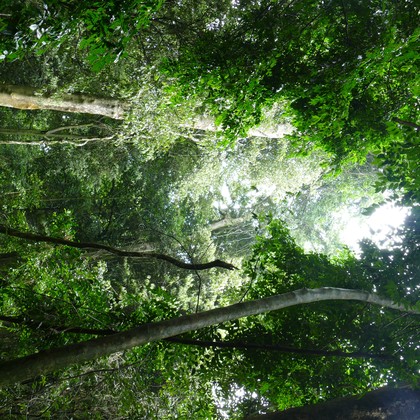
Canopy and edges of lowland and mid-altitude rainforest, old secondary forest and the forest edges of shade-coffee plantations. It takes nectar at flowering trees and lianas high in the forest and catches insects among the foliage.
Where the bird is most at home, classified by the vegetation units of southern Africa.
Range and movements
Within the region mainly in the escarpment rainforests of north-western Angola, in Cuanza Norte, Uíge, Malanje and Cuanza Sul, with a few records in the Lunda provinces; also rare in the far north-west of Zambia near Mwinilunga. Beyond the region from Sierra Leone through the rainforest of West and Central Africa to Uganda, Rwanda and Bioko.
- Resident
- dark = core range, pale = thinly spread
How and when to look
In Angola the forests of Kumbira in Cuanza Sul and the area around Ndalatando in Cuanza Norte are the best sites. Look for the species at flowering tree crowns and listen for the loud call; the female is identified by her white head stripes, while the male looks uniformly black against the light.
Conservation status
Not threatened. The species is widespread in the African rainforest. In Angola its habitat is small and fragmented, and clearance of the escarpment forests for farming and charcoal is the main threat there.
Scientific name
Cyanomitra cyanolaema | (Jardine & Fraser, 1852)
Jardine & Fraser described the species in 1852 as N[ectarinia] cyanolaemus; because it was later moved to another genus, the author and year stand in brackets. The genus Cyanomitra was introduced in 1853 by Reichenbach. Cyanomitra comes from the Greek kuanos, 'dark blue, greenish blue', and mitra, 'headband, diadem' — for the glossy blue or green head or throat of many species. cyanolaema comes from the Greek kuanos, 'dark blue', and laimos, 'throat' — for the male's glossy blue throat. The specimen the first description was based on came from Malabo (Clarence), Bioko, Equatorial Guinea.