All species › Passerines › Cisticolas › Bar-Throated Apalis
Bar-Throated Apalis | Apalis thoracica
Halsbandapalis | Apalis Acollarado
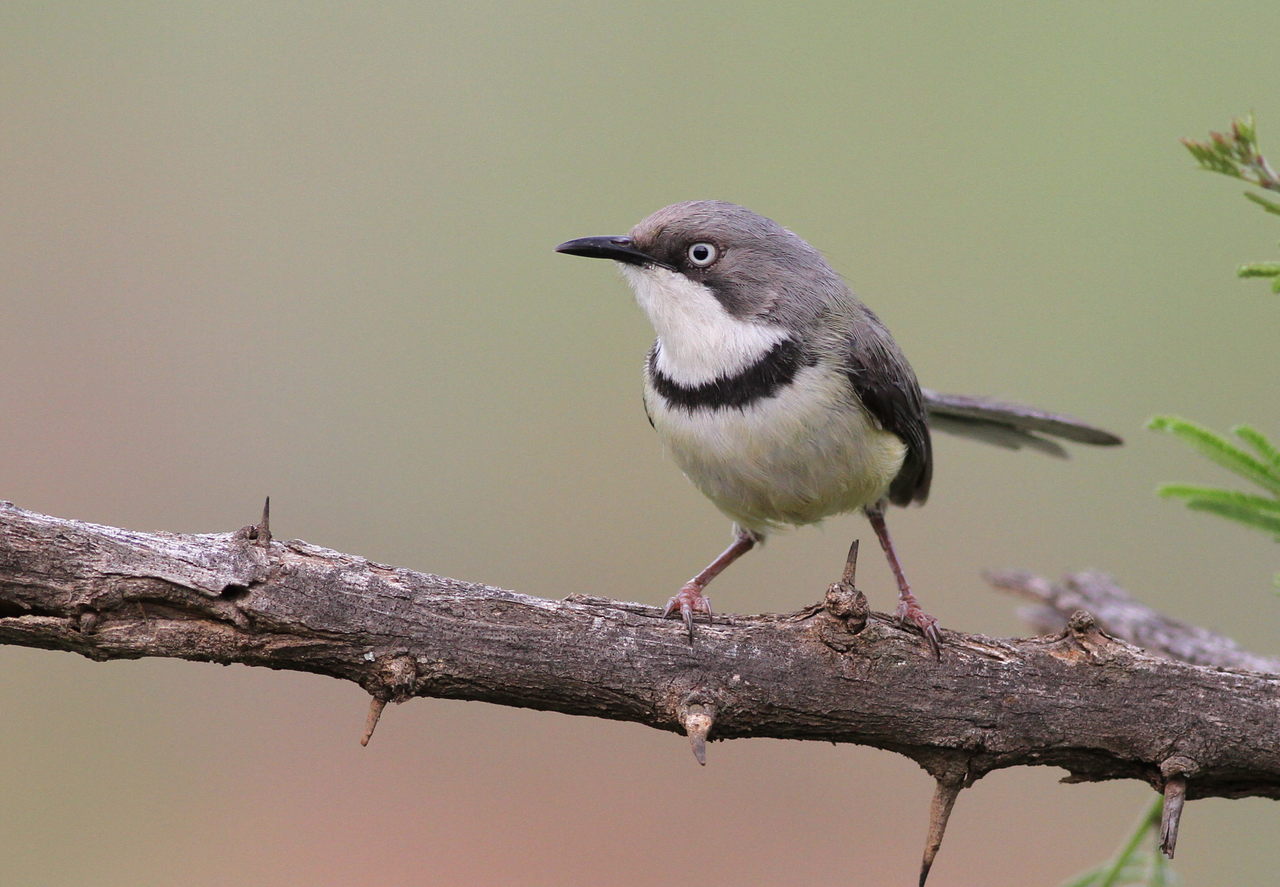
The Bar-Throated Apalis is a slender, long-tailed warbler with a white throat, a narrow black breast band and a strikingly pale iris. Pairs keep in contact with a fast, loud duet, one of the best-known sounds of the forests and kloofs of the south and east of the region. It is a variable species with many subspecies, ranging from almost grey to bright green above.
Voice
A loud, fast duet: the male sings a dry, repeated krrip-krrip-krrip or pilly-pilly-pilly, to which the female answers at once with a higher tee-tee-tee, so well timed that it sounds like a single bird. The contact call is a sharp chip.
Recording: Walter Wallner — CC BY-NC-SA 4.0 · converted to mono · xeno-canto
Identification
12–13 cm, almost half of which is tail. Crown and face are grey, the back varying by subspecies from grey to olive-green. Chin and throat are white, bordered by a narrow black breast band that runs from gape to gape; the rest of the underparts is white to pale yellow, depending on subspecies. The tail is dark with white outer feathers that show in flight and when the tail is fanned. The iris is pale yellow to almost white, the bill black, the legs pink. The female has a narrower breast band; juveniles have an incomplete, faint band and a darker eye.
Confusion species
Rudd's Apalis Apalis ruddi of coastal forest in southern Mozambique and north-eastern KwaZulu-Natal also has a narrow black breast band, but a dark eye, a white stripe in front of the eye and a greener back. Yellow-Breasted Apalis Apalis flavida has a yellow breast without a full band. Chirinda Apalis Apalis chirindensis of the eastern Zimbabwean forests is plain grey without a band. On the mountains of southern Malawi the species is replaced by Yellow-Throated Apalis Apalis flavigularis, with yellow throat and belly. The combination of pale iris, white throat and black band is diagnostic.
Habitat
Afromontane forest and forest edges, coastal forest, dense scrub in kloofs and on mountain slopes, fynbos kloofs, wooded dunes and gardens with dense planting in wooded districts. It forages in pairs in the canopy and mid-levels of bushes and trees, often in mixed parties with other small forest birds.
Where the bird is most at home, classified by the vegetation units of southern Africa.



Range and movements
Within the region in South Africa from the Cape Peninsula east along the south coast and through the Eastern Cape and KwaZulu-Natal into Eswatini, and north along the eastern Free State, the escarpment of Mpumalanga and Limpopo, the Waterberg, the Soutpansberg and the Magaliesberg; further in the Eastern Highlands of Zimbabwe, the mountains of western Mozambique, northern and central Malawi and the Nyika and Mafinga mountains in north-eastern Zambia. Beyond the region in the mountains of Tanzania and south-eastern Kenya.
- Resident
- Summer visitor (c. Oct–Mar)
- Winter visitor (c. Apr–Sep)
- Passage (Mar–Apr, Oct–Nov)
- dark = core range, pale = thinly spread
How and when to look
Year-round; the duet is the best clue. It is common in the Knysna forest, Kirstenbosch gardens, the forests of the Drakensberg foothills, Woodbush forest and the Eastern Highlands of Zimbabwe. When the duet starts, look for two birds following each other through a bush and check the pale iris, which stands out in the shade.
Conservation status
Not threatened. Common over a large range; it adapts well to gardens and exotic plantings, although some subspecies on isolated mountains have a small range.
Scientific name
Apalis thoracica | (Shaw, 1811)
Shaw described the species in 1811 as Motacilla thoracica; because it was later moved to another genus, the author and year stand in brackets. The genus Apalis was introduced in 1833 by Swainson. Apalis comes from the Greek hapalos, 'delicate, gentle' — for these slender, finely built little warblers. thoracica comes from the Greek thōrax, 'chest' — for the narrow black breast band. The specimen the first description was based on came from interior of Africa; later fixed as Makhanda (Grahamstown), Eastern Cape.