All species › Passerines › Cisticolas › Yellow-Throated Apalis
Yellow-Throated Apalis | Apalis flavigularis
Geelkeelapalis | Apalis Gorjigualdo
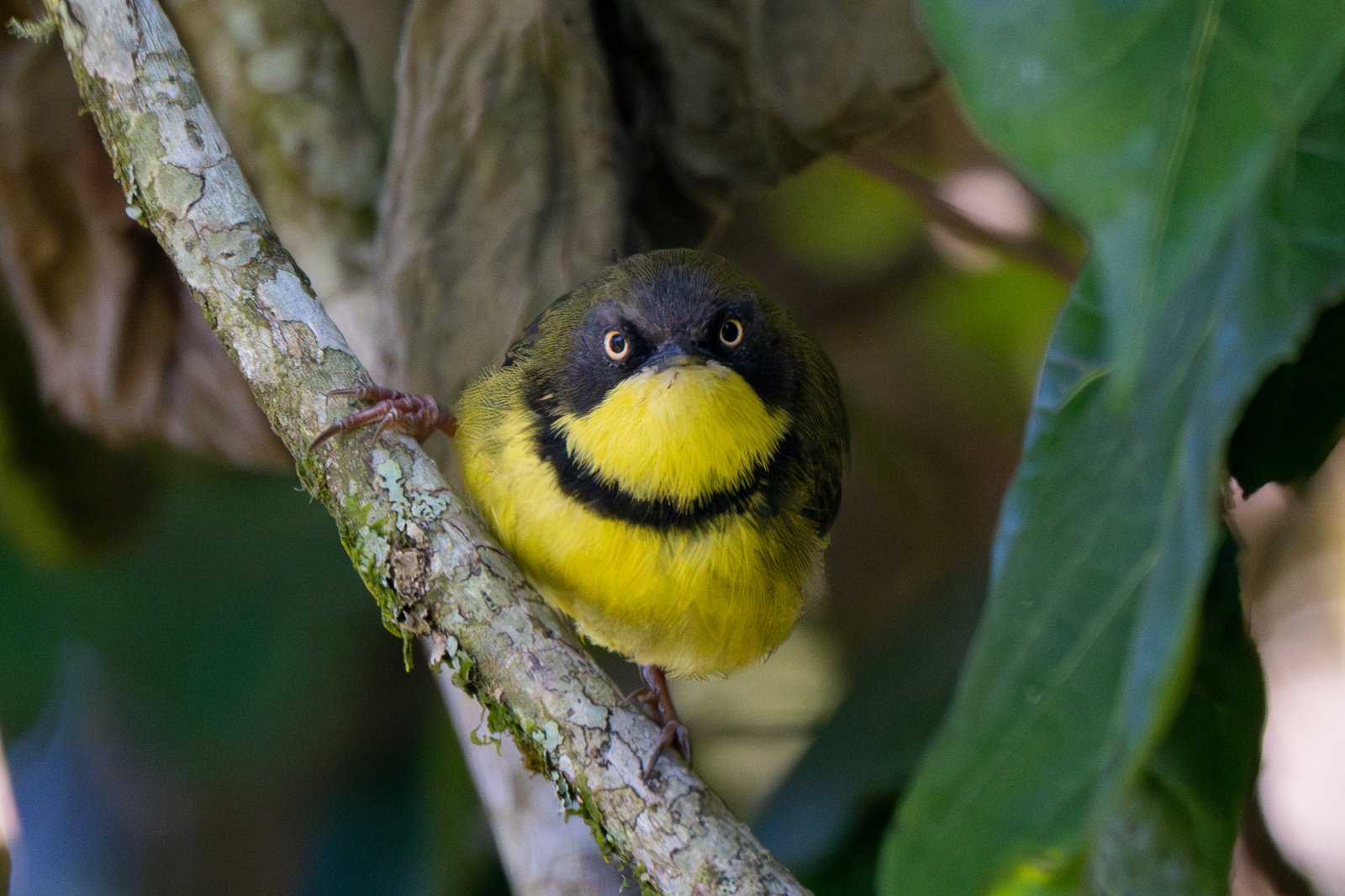
The Yellow-Throated Apalis is a small, long-tailed apalis with a bright yellow throat, a narrow black breast band and a yellow belly, which occurs only on three mountain massifs in southern Malawi. It was long treated as a subspecies of Bar-Throated Apalis and is the only bird species wholly endemic to Malawi.
Voice
A fast, loud duet as in Bar-Throated Apalis: a dry, repeated chirrup-chirrup-chirrup from the male, answered at once by a higher tee-tee-tee from the female. The contact call is a sharp chip.
Recording: Ruben Foquet — CC BY-NC-SA 4.0 · converted to mono · xeno-canto
Identification
12–13 cm, almost half of which is tail. Crown and face are grey, the back, wings and rump olive-green. Chin and throat are bright yellow, bordered by a narrow black breast band; breast and belly are also yellow, the flanks greenish. The tail is dark with white outer feathers. The iris is pale yellow to cream, the bill black, the legs pink. The female has a narrower breast band; juveniles are duller, with a faint or absent band and a darker eye.
Confusion species
Bar-Throated Apalis Apalis thoracica has a white throat above the black band and in Malawi occurs only in the north and centre, not on these mountains. Yellow-Breasted Apalis Apalis flavida, found lower on the slopes, has a white throat, a green crown with grey forehead and at most a small black spot on the yellow breast. Namuli Apalis Apalis lynesi lives only on Mount Namuli in Mozambique and lacks the yellow throat. On Zomba, Malosa and Mulanje an apalis with a yellow throat and a black band is therefore always this species.
Habitat
Edges and clearings of Afromontane forest, dense scrub and rank growth with bracken and brambles on mountain slopes, wooded ravines, and the edges of pine and eucalyptus plantations with a dense understorey, from about 1000 to over 2000 m. It forages in pairs in the middle levels, often in mixed parties.
Where the bird is most at home, classified by the vegetation units of southern Africa.

Range and movements
Endemic to southern Malawi: the Zomba Plateau, Mount Malosa and the Mulanje massif. It does not occur outside Malawi, and hence outside the region.
- Resident
- Summer visitor (c. Oct–Mar)
- Passage (Mar–Apr, Oct–Nov)
- dark = core range, pale = thinly spread
How and when to look
Year-round; it is most often recorded on the Zomba Plateau, where it is fairly common at forest edges and along the roads and tracks across the plateau. Listen for the duet and search the rank growth along the forest edge; on Mulanje in the patches of forest and scrub on the lower and middle slopes.
Conservation status
Near Threatened (IUCN). The entire world range covers only three mountains, where forest is being lost to logging, fire and farming. The species tolerates some disturbance and also lives at the edges of plantations, but its small range makes it vulnerable; climate models moreover predict a shift to higher parts of the mountains.
Scientific name
Apalis flavigularis | Shelley, 1893
Shelley described the species in 1893 and placed it straight away in the genus where it still stands. The genus Apalis was introduced in 1833 by Swainson. Apalis comes from the Greek hapalos, 'delicate, gentle' — for these slender, finely built little warblers. flavigularis is Latin for 'yellow-throated', from flavus, 'yellow', and gula, 'throat'. The specimen the first description was based on came from Mulanje Plateau, Malawi.