All species › Passerines › Weavers › Bertram's Weaver
Bertram's Weaver | Ploceus bertrandi
Bertrams wever | Tejedor de Malawi
Bertram's Weaver is a sturdy weaver of forest edges and scrub in the mountains of Malawi and adjacent areas. The male has a black mask below a yellow-orange crown, the female an all-black head; both have a pale eye.

Voice
A sizzling, buzzing song in typical weaver style, chip-chip-chizzzz, as well as short, sharp chik contact calls. Pairs often call to each other while foraging.
Recording: Jason Anderson — CC BY-NC-SA 4.0 · converted to mono · xeno-canto
Identification
About 15 cm, sturdy and compact, with a heavy black bill and a pale yellow eye. The male has a black mask over face, chin and throat, a yellow-orange forehead and crown and a small black spot on the hindcrown; the back is olive-green and the underparts bright yellow. The female has an all-black head and throat, an olive-green back and yellow underparts. The species wears much the same plumage all year; juveniles are duller, with an olive head and a darker eye.
Confusion species
Baglafecht Weaver (Ploceus baglafecht) of the Nyika Plateau has a yellow throat below the black mask, with no black chin and throat. Spectacled Weaver (Ploceus ocularis) is slimmer, with a finer bill, a narrow black eyestripe (in the male with a small black throat patch) and a pale eye; the female lacks the black head. Males of Village Weaver (Ploceus cucullatus) and Lesser Masked Weaver (Ploceus intermedius) have a black-blotched or greenish-yellow back and breed in colonies. The all-black head of the female is unique among the weavers of the Malawi highlands.
Habitat
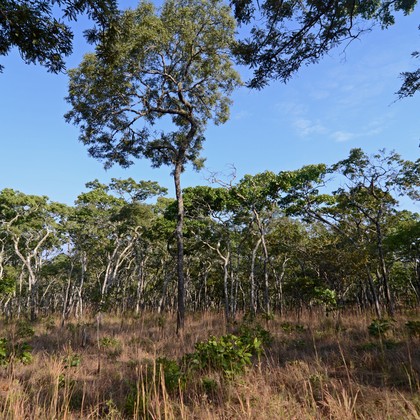
Afromontane forest edges, bracken and bramble scrub, wooded ravines, riverside growth and gardens in the highlands, from about 800 to 2,400 metres; also in higher miombo. It lives in pairs and nests solitarily, not in colonies; the nest often hangs from a branch over a stream or track. It forages in foliage for insects, and also takes seeds and fruit.
Where the bird is most at home, classified by the vegetation units of southern Africa.

Range and movements
Within the region in the highlands of Malawi (from the Nyika Plateau and Viphya to Dedza, Zomba, Thyolo and Mulanje), in adjacent eastern Zambia (Nyika, Makutu) and in the mountains of northern Mozambique (Niassa, Zambezia). Reports from Zimbabwe and South Africa are unconfirmed. Beyond the region only in south-western Tanzania.
- Resident
- dark = core range, pale = thinly spread
How and when to look
Most often recorded on the Zomba Plateau, around Mulanje and Thyolo and on the Nyika Plateau, along forest edges and overgrown gardens. Watch for pairs keeping low in scrub; the female with her fully black head is often identified sooner than the male.
Conservation status
Not threatened. Fairly common locally within its limited range. Loss of forest edge and montane vegetation to clearing may affect local populations, but the species tolerates gardens and secondary growth.
Scientific name
Ploceus bertrandi | (Shelley, 1893)
Shelley described the species in 1893 as Hyphantornis bertrandi; because it was later moved to another genus, the author and year stand in brackets. The genus Ploceus was introduced in 1816 by Cuvier, GLCFD. Ploceus comes from the Greek plokeus, 'plaiter, weaver', for the tightly woven, ball-shaped nest that gives weavers their name. bertrandi honours the British officer Bertram Lutley Sclater (1866–1897), son of the ornithologist Philip Lutley Sclater, who was serving in Nyasaland (Malawi) when Alexander Whyte discovered the species. The specimen the first description was based on came from Zomba, Malawi.