All species › Passerines › Weavers › Thick-Billed Weaver
Thick-Billed Weaver | Amblyospiza albifrons
Dikbekwever | Tejedor Picogordo
The Thick-Billed Weaver is a large, dark weaver with a huge, conical bill used to crack hard seeds and fruit stones. It breeds in small colonies in reedbeds and builds the most finely woven nest of any weaver in the region.
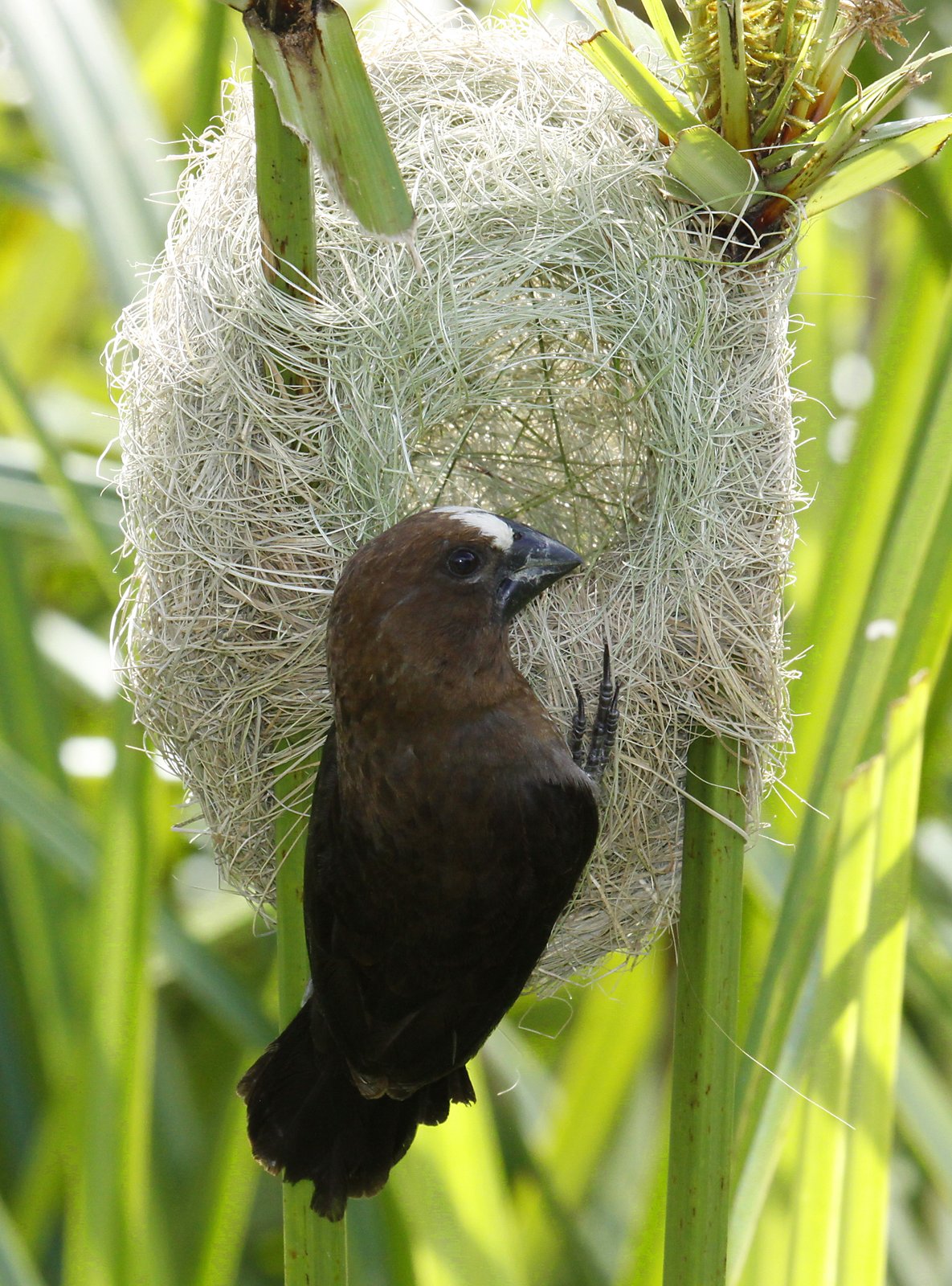
Click a thumbnail to switch the photo above.
Voice
A high, squeaky tsweek-tsweek flight call, often from small groups. The male's song is a soft, creaky, chirping chatter, usually at the nest.
Recording: Bram Piot — CC BY-NC-SA 4.0 · shortened to the first 60 s, mono · xeno-canto
Identification
17 to 19 cm, stocky, with a very heavy, deep conical bill. The male is dark chocolate-brown, almost blackish-brown on head and breast, with a white forehead patch and a white patch at the base of the primaries that shows as a bright window in flight; the bill is black. The female is warm brown above and white below with heavy dark brown streaks, lacks the white forehead and wing patches, and has a yellowish bill. Juveniles resemble the female, with a horn-coloured bill.
Confusion species
With its heavy bill and dark plumage the male is hardly confusable; no other weaver in the region is so dark with a white forehead and wing patch. The streaked female can suggest a thrush or a female of another weaver at distance, but the massive yellow bill and bulky build are decisive.
Habitat
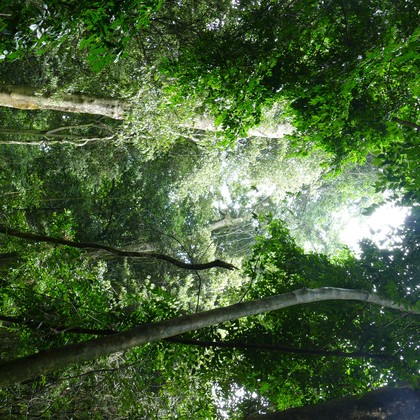
In the breeding season reedbeds, bulrushes and papyrus in marshes, vleis and along rivers; outside the breeding season forest edges, coastal forest, riverine forest and gardens with fruiting trees and shrubs. It eats hard seeds, fruit and stones, which are cracked with the bill.
Where the bird is most at home, classified by the vegetation units of southern Africa.


Range and movements
Within the region in eastern South Africa (from the Eastern Cape through KwaZulu-Natal to Mpumalanga and Limpopo), Eswatini, Mozambique, northern and eastern Zimbabwe, Malawi, Zambia, northern Botswana (Okavango and Chobe), Namibia's Zambezi Region and Angola. Beyond the region widespread in sub-Saharan Africa, from West Africa to Ethiopia and East Africa.
- Resident
- Summer visitor (c. Oct–Mar)
- Winter visitor (c. Apr–Sep)
- Passage (Mar–Apr, Oct–Nov)
- dark = core range, pale = thinly spread
How and when to look
The nest is the best clue: a ball very finely woven from thin strips of reed, between two or three upright reed stems, with a round entrance at the side near the top. In KwaZulu-Natal, around Durban and Lake St Lucia, colonies in reedbeds along roads and ponds are easy to watch. Outside the breeding season the cracking of seeds gives the birds away along forest edges.
Conservation status
Not threatened. Common and widespread; in South Africa the species is locally expanding along dams and in gardens. Loss of reedbeds through drainage can affect breeding colonies locally.
Scientific name
Amblyospiza albifrons | (Vigors, 1831)
Vigors described the species in 1831 as Pyrrhula albifrons; because it was later moved to another genus, the author and year stand in brackets. The genus Amblyospiza was introduced in 1850 by Sundevall. Amblyospiza comes from the Greek amblus, 'blunt', and spiza, 'finch' — for the heavy, blunt bill of Grosbeak Weaver. albifrons is Latin for 'white-fronted', from albus, 'white', and frons, 'forehead' — for the male's white patch above the bill. The specimen the first description was based on came from Algoa Bay, Eastern Cape (South Africa).