All species › Passerines › Weavers › Scaly-Feathered Weaver
Scaly-Feathered Weaver | Sporopipes squamifrons
Baardmanwever | Tejedorcito Escamoso
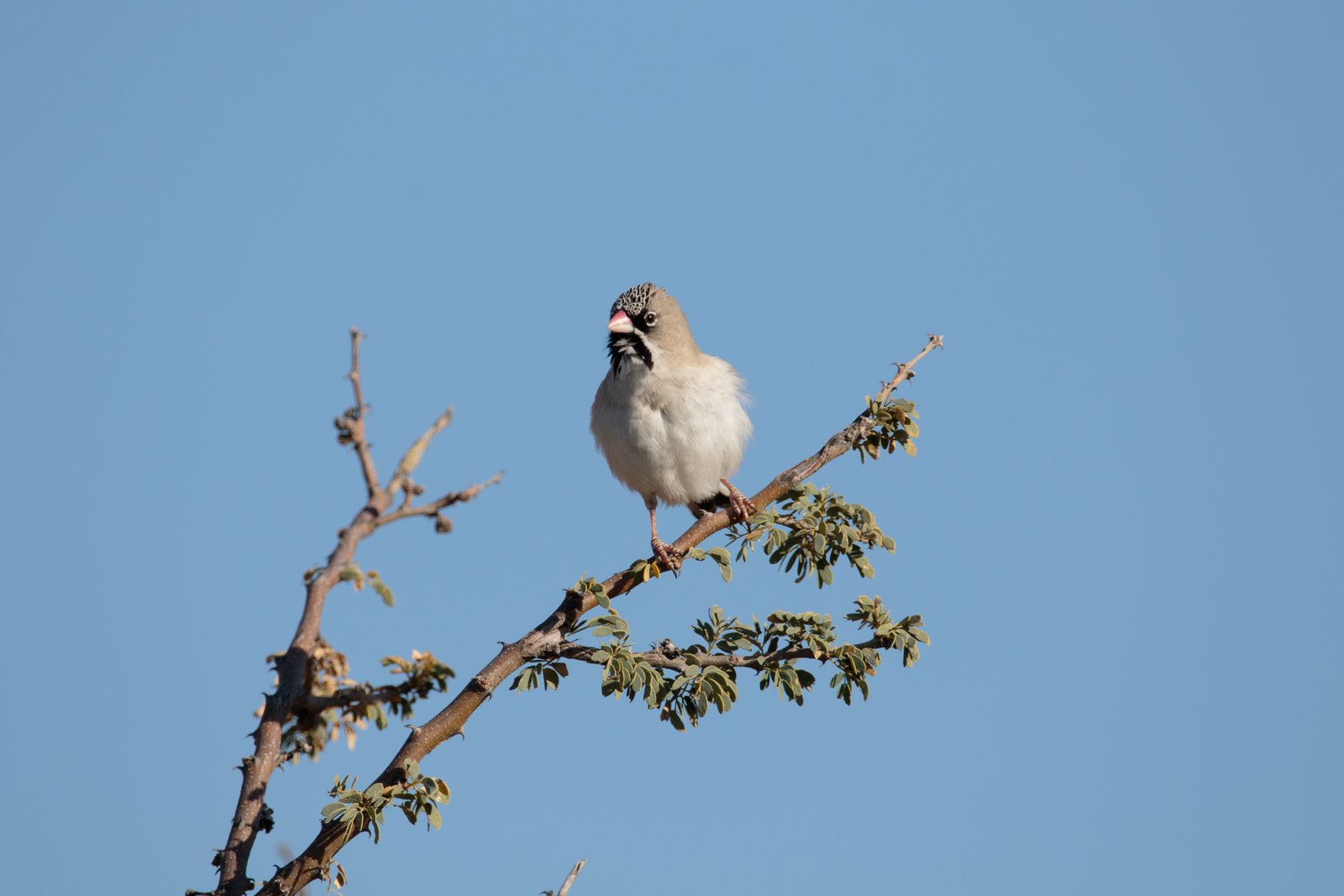
The Scaly-Feathered Weaver is a tiny, grey-brown weaver of dry thornveld, with a pink bill, a black moustachial stripe and a black forehead with white scaling. It lives year-round in small groups that roost together in untidy grass nests.
Voice
A soft, dry, buzzing tchizz and a constant twittering within the group, especially on take-off. The song is a simple, somewhat scratchy series of chirping notes.
Recording: Campbell Fleming — CC BY-NC-SA 4.0 · converted to mono · xeno-canto
Identification
10 to 11 cm, compact, with a short, conical pink to flesh-coloured bill. Forehead and forecrown are black with white scale-like feather edges, the rest of the head and the upperparts soft grey-brown. A striking black moustachial stripe runs from the base of the bill along the throat. Wings and tail are blackish with broad white edges to the feathers, giving the wing a scaled look. The underparts are white to pale grey. The sexes are alike; juveniles have a horn-coloured bill and a less clearly marked forehead.
Confusion species
Sociable Weaver (Philetairus socius) is larger, with a black chin and throat patch, a pale horn bill and black-and-white scaled flanks, and lives in large colonies in huge communal nests. Females of House Sparrow (Passer domesticus) and Cape Sparrow (Passer melanurus) are larger and lack the pink bill and moustachial stripe. On the ground, in small parties, the species can suggest a small waxbill, but the scaled wings and black moustache are diagnostic.
Habitat
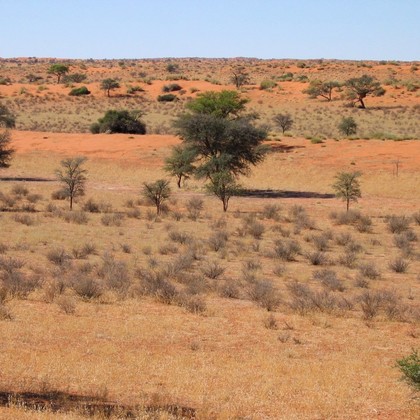
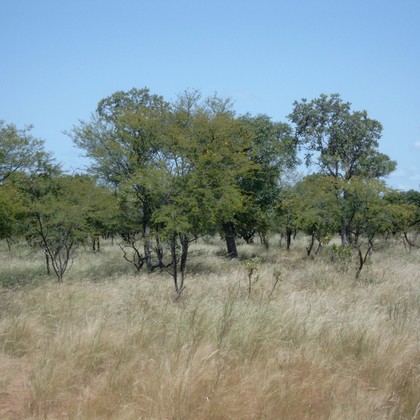
Dry acacia savanna, Kalahari thornveld, scrubby transitions to the karoo, dry riverbeds, farmyards and campsites. It forages on the ground for grass and weed seeds and can go a long time without drinking. It builds untidy, globular grass nests with a side entrance in thorny acacias, which also serve as roosting nests.
Where the bird is most at home, classified by the vegetation units of southern Africa.
Range and movements
Near-endemic to the region: almost all of Namibia except the bare Namib, all of Botswana, western and southern Zimbabwe, northern South Africa (Northern Cape, North West, Limpopo, western Free State and Gauteng), south-western Angola and south-western Zambia. Not found outside the region.
- Resident
- Summer visitor (c. Oct–Mar)
- Winter visitor (c. Apr–Sep)
- Passage (Mar–Apr, Oct–Nov)
- dark = core range, pale = thinly spread
How and when to look
Small parties often sit at waterholes and around camps in the Kalahari, Etosha and Kgalagadi, where they forage for seed close to vehicles. Note the pink bill and black moustachial stripe; in flight the white-edged flight feathers stand out.
Conservation status
Not threatened. Common within its arid range and without evident decline. It benefits locally from farmyards and stock watering points, where seed and water are available.
Scientific name
Sporopipes squamifrons | (Smith, 1836)
Smith described the species in 1836 as Estrelda squamifrons; because it was later moved to another genus, the author and year stand in brackets. The genus Sporopipes was introduced in 1847 by Cabanis. Sporopipes comes from the Greek sporos, 'seed', and opipeuō, 'to gaze or stare at' — Cabanis (1847) meant a bird that 'gazes greedily at seed'. squamifrons is Latin for 'scaly-fronted', from squama, 'scale', and frons, 'forehead' — for the white-edged black feathers on forehead and crown. The specimen the first description was based on came from South Africa (not specified).